
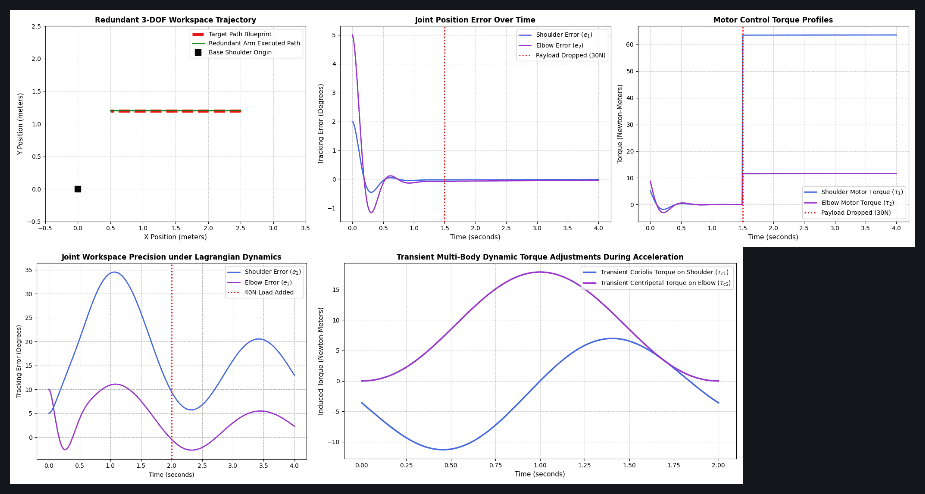
The analysis details the sophisticated mathematical architectures required for the operational predictability and control of robotic systems, emphasizing the transition from kinematic velocity mapping to full Lagrangian dynamic control. By utilizing the Generalized Moore-Penrose Pseudoinverse and Null-Space Projection Matrix, controllers can prioritize "External Tasks," such as precise path navigation, while simultaneously managing "Internal Tasks," like joint centering in redundant 3-DOF arms. To ensure hardware protection, a Saturating Velocity Scaler is employed to proportionally downscale joint speeds, maintaining geometric accuracy even when physical limits are reached. This framework extends into dynamic control, where the Jacobian Transpose acts as a feedforward mechanism to cancel external payloads, and the Euler-Lagrange equations account for complex, non-linear forces such as Coriolis and centripetal "cross-talk". Ultimately, these principles of mathematical decoupling through orthogonal basis dynamics are contrasted with the increased complexity of non-orthogonal systems, which require specialized tools like metric tensors and contravariant basis vectors to maintain computational consistency.
Comments ()