
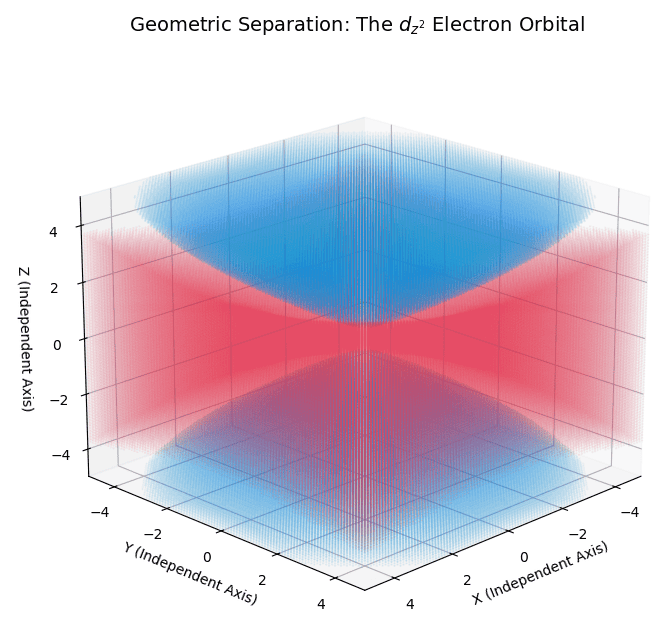
Imagine a massive industrial robot arm sweeping through a factory with surgical precision while, simultaneously, a ghostly electron dances in a perfect, nested shell around an atomic nucleus. Though separated by the vast scales of engineering and physics, these two systems are governed by the same invisible architecture: a hidden mathematical "gatekeeper" known as orthogonality. At its heart, this principle is about the power of perpendicularity, ensuring that different dimensions of movement or existence remain strictly independent and "un-mixed." By verifying that the primary directions in a coordinate system meet at perfect right angles, scientists and engineers can untangle the chaos of the physical world into clean, manageable streams of information.
In the world of robotics, this perpendicular foundation is the key to operational predictability. When a robot is commanded to extend its arm, it is critical that this motion does not trigger unintended "parasitic" movements, such as a sudden tilt or rotation. Because the underlying directions are orthogonal, the complex mathematical "engine" that controls the robot—the Jacobian matrix—becomes exceptionally simple and efficient. This reduction in mathematical overhead allows a computer to calculate thousands of adjustments per second, providing the real-time control necessary for a robot to trace complex paths or lift heavy payloads without vibrating or losing its way.
This same "un-mixing" of dimensions is what allows us to peer into the heart of the atom. In quantum mechanics, the probability clouds of electrons are naturally "entangled" in a mess of interacting variables. However, by applying an orthogonal framework, physicists can perform a "separation of variables," effectively splitting the atom's structure into independent layers. This reveals a beautiful, orderly universe of nested radial shells and geometric angular lobes, leading directly to the discovery of the specific quantum numbers that define the very nature of matter. Without this 90-degree relationship, the equations governing the hydrogen atom would be mathematically inseparable, leaving the fundamental building blocks of chemistry shrouded in mystery.
The reach of this principle extends far beyond the factory floor and the laboratory. It is the same logic that allows **5G phones** to stream massive amounts of data without signals bleeding into one another and enables **spatial audio** to reconstruct an immersive three-dimensional soundscape for virtual reality. Whether it is a meteorologist decomposing global climate patterns into independent planetary waves or a graphics engineer compressing complex lighting into a few simple numbers for a video game, they are all relying on the same foundational proof. By ensuring that the basic directions of their systems never overlap, they turn "mathematical entanglement" into scientific discovery and engineering efficiency.