
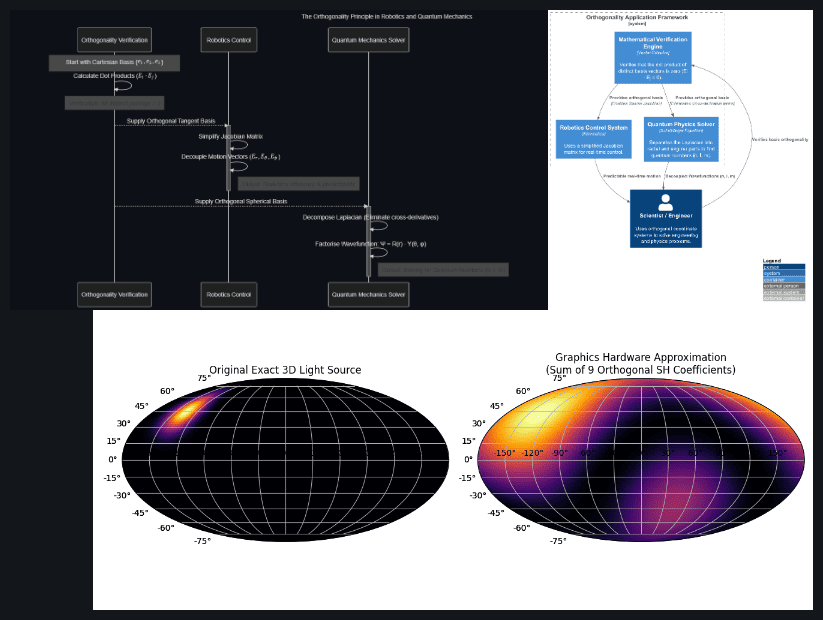
The orthogonality principle serves as a foundational mathematical framework that begins by confirming the dot product of any two distinct basis vectors is zero, effectively establishing the "un-mixing" of physical dimensions. In the field of robotics, this verification is used to simplify the Jacobian matrix into a sparse or diagonal structure, which drastically reduces mathematical overhead to enable real-time computer control while preventing unintended "parasitic" movements across different axes. For quantum mechanics, this same orthogonality ensures the Laplacian operator functions without cross-derivative terms, allowing for the separation of variables in the wavefunction to successfully derive quantum numbers. Beyond these core areas, the principle is applied to computer graphics through spherical harmonics, where the independence of orthogonal basis functions allows for massive data compression and zero cross-talk between lighting layers, permitting GPUs to render complex, realistic environments at high speeds.
Comments ()