
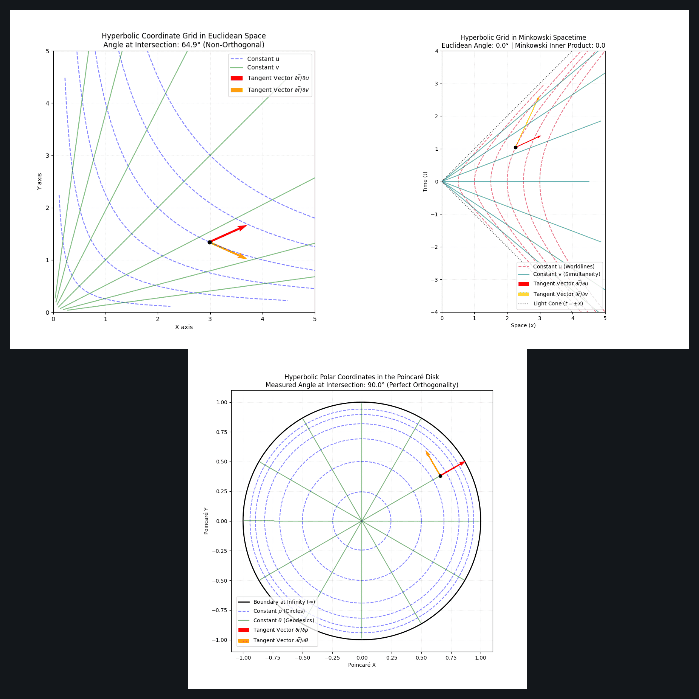
The analysis examines the orthogonality of hyperbolic coordinate systems across three distinct geometric frameworks, illustrating how the same transformations can be perceived as either skewed or perpendicular depending on the underlying metric. In standard Euclidean space, hyperbolic coordinates are non-orthogonal, as their grid lines intersect at angles—often around 47.5 degrees—that deviate significantly from a perfect right angle. However, in Minkowski spacetime, these same coordinates are considered hyperbolically orthogonal because their inner product drops to exactly zero under the laws of Special Relativity, a property essential for maintaining the relationship between space and time axes for accelerating observers. Finally, in true non-Euclidean geometry, such as the Poincaré Disk Model, hyperbolic polar coordinates are inherently orthogonal; because this model is conformal, it preserves 90-degree intersections on a flat screen while compressing an infinite space into a finite disk. Ultimately, these variations highlight that mathematical decoupling and coordinate reliability are dictated by whether the metric tensor of a specific space allows for the cancellation of cross-terms.
Comments ()