
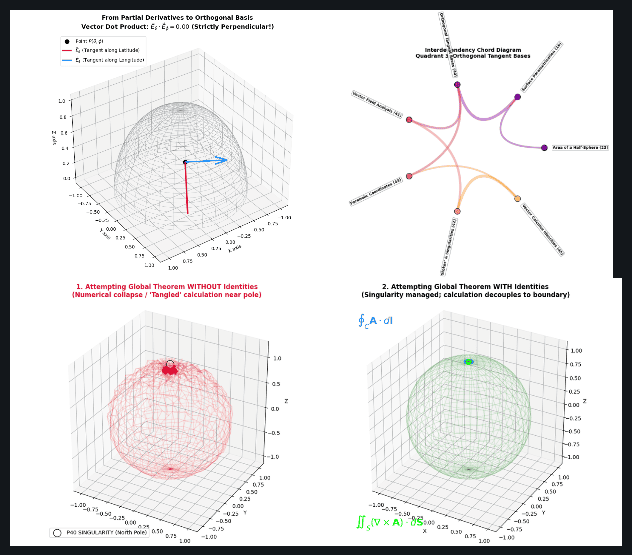
The analysis explains how Surface Parametrization serves as the foundation for generating Orthogonal Tangent Bases, which are critical for ensuring zero cross-talk and mathematical decoupling in three-dimensional systems. By mathematically verifying that the dot product of tangent vectors—such as those for longitude and latitude—is exactly zero, engineers can prove that movement along one parameter loop imparts no "entanglement" in the perpendicular direction. This structural stability is further reinforced by Vector Calculus Identities, which provide a "Unified" framework to prevent mathematical collapse near coordinate singularities, such as the North Pole. While brute-force numerical approaches often lead to "shattered" and unstable data at these singular points, established identities allow theorems like Stokes' to function by analytically "integrating out" the complex partial derivatives that would otherwise cause calculations to diverge. Ultimately, these relationships are visualized through a chord diagram, which maps the progression of geometric concepts and highlights Vector Calculus Identities as the central tool for resolving complex upstream systems.
Comments ()