
Imagine a shimmering, translucent dome bristling with thousands of microscopic blue compass needles, each one shivering and spinning in place as they react to an invisible, swirling force. Around the very bottom of this dome, a single, glowing red thread is pulled tight, forming a perfect anchor. No matter how much you stretch, dent, or ripple that dome—turning it from a smooth bowl into a jagged mountain range or a series of twisted petals—the total "twist" felt by all those blue needles combined will always exactly equal the total "push" felt along that single red thread at the base.
This visual captures the "gut sense" of the Generalized Curl Theorem: a perfect, invisible balance between the internal chaos of a surface and the calm constraint of its boundary.
The Surface is an Illusion
The most profound gut takeaway from the documents is that the surface geometry is effectively a ghost. In the world of this theorem, we have "Geometric Freedom". You can replace a nightmare calculation across a complex, rugged terrain with a simple stroll around its perimeter. Whether the field is smooth or rapidly pulsing with complex patterns, the internal "twists" always find a way to cancel each other out or sum up to match the boundary anchor. The documents describe this as Topological Independence—the idea that as long as you don't move the "red thread" at the base, the shape of the "dome" simply does not matter.
The Theoretical Bridge
Before the theorem is tested in the real world, it exists as a "Theoretical Engine"—a clever bit of mathematical architecture that builds a bridge between different ways of looking at space. This engine proves on paper that the "twistiness" spread out over a three-dimensional cap is physically identical to the "effort" exerted along its one-dimensional edge. It acts like a projection, where the high-level balance of a field is mapped down onto specific directions, showing how internal gradients drive circulation around the boundary.
The Gauntlet of Reality
The "gut sense" of the Numerical Feedback Loop is one of unrelenting stress-testing. To ensure this isn't just a "clean" theory for "nice" shapes, the sources describe dragging the theorem through a gauntlet of "difficult" conditions.
The Rippled Bowl: Even when the surface is forced to oscillate and ripple, the math holds. The Jagged Landscape: Even when the terrain is as rugged as a mountain range with unpredictable slopes, the internal tally remains consistent with the boundary.The Twisted Petal Bowl: Even when the surface bends upwards and downwards in complex waves, the positive and negative twists cancel each other out perfectly.
- The Rippled Bowl: Even when the surface is forced to oscillate and ripple, the math holds.
- The Jagged Landscape: Even when the terrain is as rugged as a mountain range with unpredictable slopes, the internal tally remains consistent with the boundary.
- The Twisted Petal Bowl: Even when the surface bends upwards and downwards in complex waves, the positive and negative twists cancel each other out perfectly.
The Limits: Spikes and Blurry Lenses
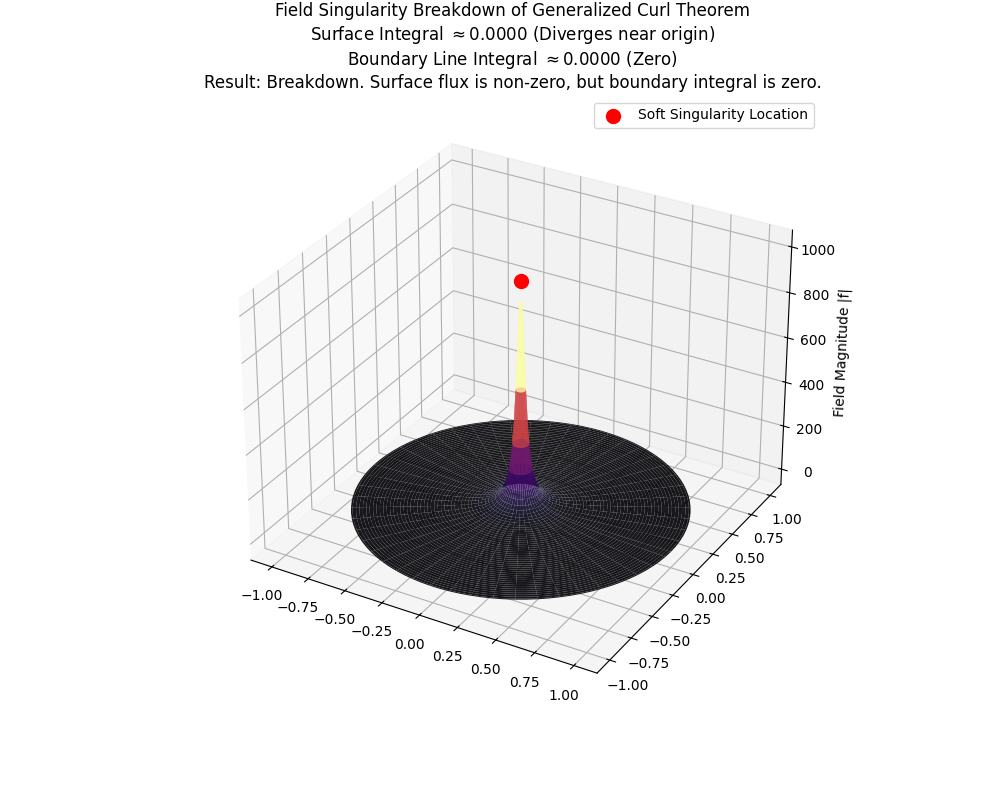
Finally, the sources provide a gut sense of the theorem's boundaries. The math only stumbles when it encounters a "singularity"—a violent, infinite spike in the field where the physical world effectively "breaks" or has a hole in it. In these rare moments, the internal twist can no longer map cleanly to the boundary.
Furthermore, the sources clarify that when computers seem to "fail" this theorem, it is often just a "measurement error" or a "blurry lens" caused by a rigid, uniform grid trying to capture a sharp peak. By simply sharpening the focus—using a more aligned or denser grid—the theorem’s perfect balance is always restored, proving that the identity is a robust, universal law rather than a fragile abstraction.