

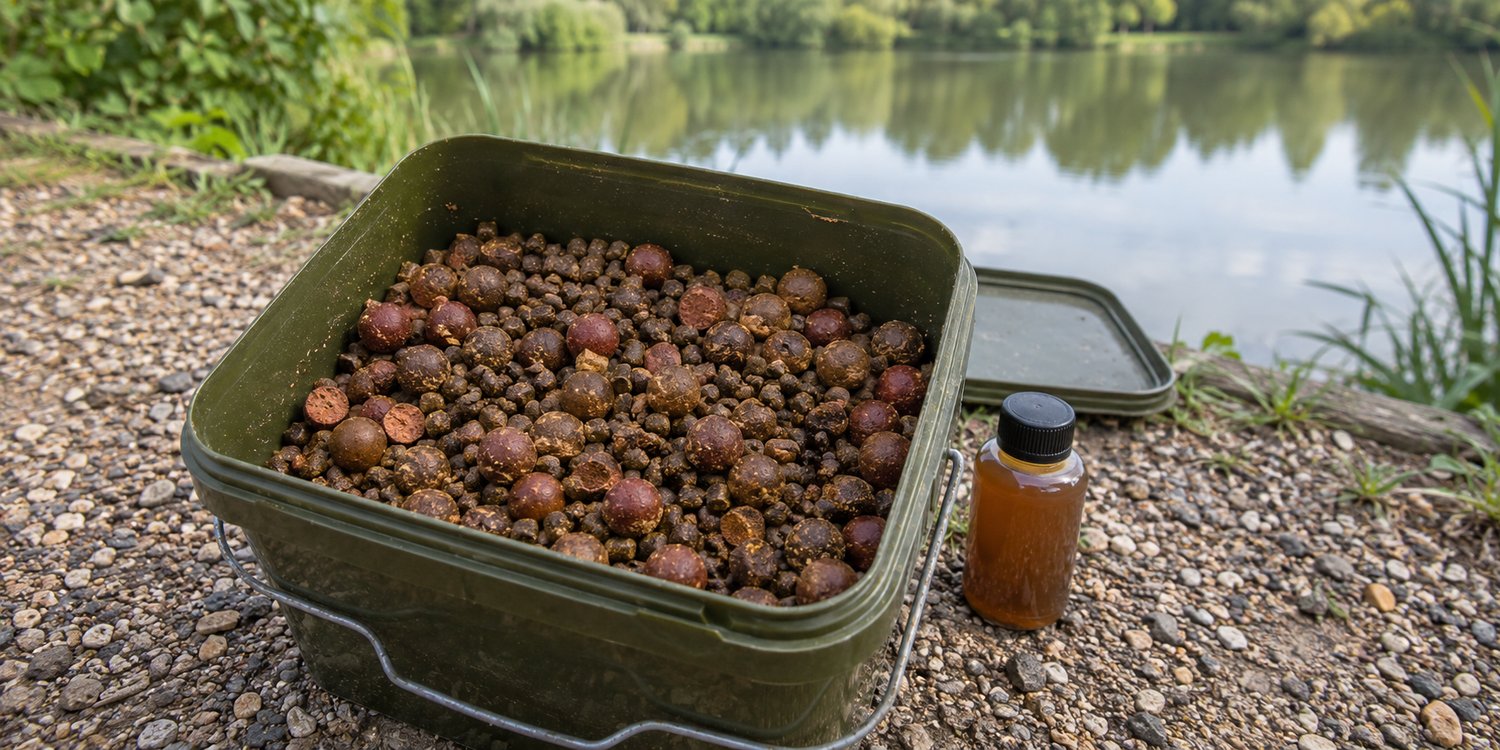
How much bait should you put in? It’s one of the first questions new carp anglers ask, and there isn’t an honest answer that fits every lake. The useful starting point is a modest, measured amount you can add to—not a bucket emptied because you brought it with you.
Separate hookbait from loose feed
Your hookbait is the bait attached to the rig. Loose feed is the extra bait introduced around it: boilies, pellets or prepared particles, for example. The job is to encourage carp to feed where your rig can work, not simply to cover the swim.
A small amount placed accurately can be more useful than plenty scattered beyond your casting range. Choose a spot you can reach consistently and keep the baiting method manageable. Before using any bait, check the fishery rules and its preparation or storage requirements.
Let the water and session guide you
Think about the number and size of carp, how actively they are feeding, the water temperature, other anglers’ baiting and how long you will be there. Ask the bailiff what has been working. A busy, well-stocked water in warm conditions can be very different from a quiet lake on a cold morning.
For a short first trip, a small measured pouch or tub is an easier starting approach than a large baiting campaign. Keep some bait back. There is no compulsory quantity to introduce just because a session lasts six hours rather than three.
Start lighter in cold water
Carp generally feed less in colder water, so a large bed of bait can be unnecessary. A single hookbait or a small amount of loose feed may be a sensible approach where the venue and presentation suit it. Location still matters: feeding an empty part of the lake won’t create carp.
A bright hookbait can help your bait stand out, but colour isn’t a guarantee. Match any pop-up or wafter to a suitable rig and test the actual baited presentation. In warmer months, increase bait in response to feeding activity rather than assuming warm weather always means hungry fish.
Add bait for a reason
A caught carp, repeated clear feeding activity or reliable local advice may justify a small top-up. A quiet alarm on its own doesn’t. More bait won’t solve a tangled rig, a blunt hook or a bait sitting out of reach of the fish.
Before topping up, ask what has changed. Have you seen fish on the spot? Is your presentation sound? Are small fish eating the feed? If the answer is simply “I’m bored”, leave the bucket alone for a while and watch the water.
Record enough to learn next time
Write down what you introduced, roughly how much, where you fished and what happened. Use a consistent measure—a particular scoop or small tub—so your notes mean something on the next visit. Record blanks as well as catches.
There will still be trial and error, but you’ll have something better than a vague memory of “quite a lot”. The CarpAnswers beginner’s guide covers bait, finding fish and putting a straightforward session together, with a fillable log for your own notes. The complete illustrated PDF is £9.99; the sample is free.