


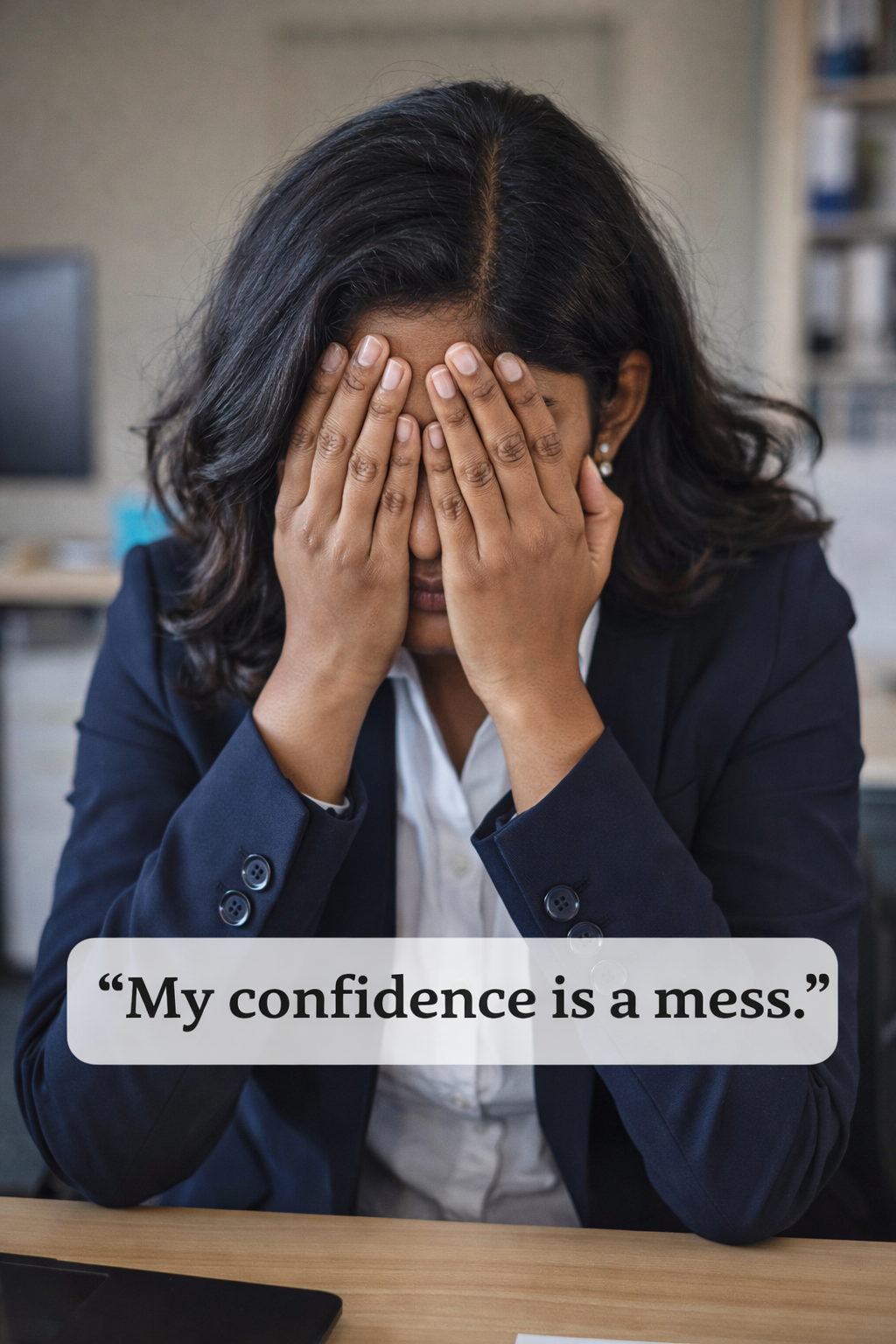
Confidence is usually a glow-up. But there’s a sneaky cousin of confidence that shows up wearing designer sunglasses indoors…In 2024, I discovered something about myself that made me pause. I often question my decisions and actions, while genuinely being excited about life. I’ve learned that some moments require a step back. This is when I came to this conclusion that, "alarming confidence compels the mind to make impulsive decisions." Honestly, things had to go wrong before I could see it clearly: sometimes my confidence isn’t just confidence-it can be alarming. That realization changed how I move, speak, and show up for myself. It is a learning process till to this day. SO, be gentle with yourself!
What Is Confidence?
Confidence is a steady belief that you can handle what’s in front of you-not because you’re perfect, but because you trust your ability to learn, adapt, and keep going. Real confidence isn’t loud 24/7; it can be calm, quiet, and grounded. At its best, confidence is courage with stability: it helps you speak up, try new things, set healthy boundaries, and recover from mistakes without falling apart. It’s also protective-when you believe you matter, you’re more likely to make choices that align with your values and treat others with respect. However, alarming confidence is when someone feels extremely sure of themselves even though their certainty is bigger than the facts, skills, or situation and it starts causing harm to their choices or relationships.
In simple terms: confidence helps you show up fully-in your work, relationships, and goals.
Why it is a gift?
But confidence doesn’t grow in a vacuum. The world constantly sends messages that shape how you see yourself-through social media, family expectations, culture, beauty standards, money, popularity, and comparison. Some of those messages push confidence upward. “Be bold! Be independent!”, while others quietly chip it away “You’re not enough unless you look/earn/act like this”. Even praise can influence confidence in tricky ways: if you only feel confident when people clap for you, your confidence becomes fragile. That’s why the healthiest confidence is built on truth + practice + self-awareness, not on likes, attention, or someone else’s opinion.
Alarming confidence on the flip side:
- ignores reality checks,
- bulldozes feedback,
- and makes you certain you’re right… even when you’re missing key facts.
The good news is you can keep your confidence and keep your wisdom.
What “alarming confidence” actually means?
Alarming confidence = high certainty + low calibration.
In simple terms it means you feel very sure, but your certainty isn’t matching your evidence, preparation, or results.
It can look like:
- “I don’t need to prepare. I’m naturally good at this.”
- “They’re just hating. I’m fine.”
- “Rules don’t apply to me.”
- “I’m 100% right—and I’m not checking.”
This isn’t about being a man or a woman. Anyone can slip into it. The difference is often how it shows up and what society rewards.
Why it’s important to acknowledge?
Because ignoring it can quietly cost you, better decisions. Overconfidence can make you skip the “boring” step that saves you-double-checking. It impacts our relationship dynamics as well. When confidence turns into certainty, it can sound like:
- not listening,
- interrupting,
- dismissing feelings,
- refusing accountability.
It is essential to understand accountability leads to better growth. The fastest growers are confident and coachable. Not “small,” not “shrinking”-just teachable.
Two stats that show how common it is:
The “everybody thinks they’re above average” problem
In a classic driving-skill study, 93% of a U.S. sample believed they were more skillful than the median driver-which can’t be true for everyone at the same time. Overconfidence can get expensive! In a large investing study, men traded 45% more than women, and that extra trading reduced men’s net returns by 2.65 percentage points per year vs. 1.72 for women. That doesn’t mean “men bad, women good.” It means: overconfidence can show up differently-and it has real consequences.
What it can mean for both genders? (without stereotypes)
For men: A lot of cultures reward “certainty” in men-being bold, leading, deciding quickly.
That can be a strength…until it becomes:
- refusing help,
- never revising opinions,
- turning confidence into dominance.
For women: Women often get social messages to be “nice,” “not too much,” or to double-check themselves.
That can create strengths like preparation and reflection… but can also swing into:
- second-guessing,
- shrinking,
- or overcompensating later with “I’ll prove it” energy.
The healthiest lane for both genders is confident paired with curiosity.
Why it can be bad?
Alarming confidence often comes from one of these:
- Low feedback (no one’s telling you the truth)
- High emotion (anger, pride, insecurity, adrenaline)
- A little success (enough wins to stop checking yourself)
- Skill gaps you can’t see yet
Researchers Justin Kruger and David Dunning showed that people who perform poorly in an area can overestimate themselves—partly because the skills needed to do well are often the same skills needed to evaluate performance.
Here are 5 quick self-check questions (for men and women)
1.What evidence do I have-besides my feelings?
(Receipts: results, practice, feedback, data.)
2.What would change my mind?
(If the answer is “nothing,” that’s a red flag).
3.Have I asked at least one person I trust for a reality check?
(Not a hype friend-a truth friend.)
4.Am I ignoring a downside because it’s inconvenient?
(Time, safety, money, relationships, reputation.)
5.If someone I love were doing this, what would I advise them?
(This question is shockingly clarifying.)
When you feel extra confident (like “I can’t miss ”), ask yourself those 5 questions.
Bonus fun rule: If you say “I don’t need to check,” you should check.
How to keep confidence positive?
Try this confidence formula:
Confidence = Courage + Preparation + Humility
- Courage to try
- Preparation to perform
- Humility to adjust
That’s not “less confidence.” That’s premium confidence.
Your confidence is a gift-don’t throw it away.
Just make sure it’s aligned with wisdom, so it builds your life instead of surprising you later.
You’re allowed to be bold and self-aware. That’s the real glow.
Summary:
Alarming confidence is when your certainty outpaces your preparation, evidence, or results, and it starts affecting your choices and relationships. While healthy confidence helps you show up with courage and resilience, unchecked confidence can make you ignore feedback, take unnecessary risks, and miss growth opportunities. It can show up in both men and women in different ways, shaped by culture, expectations, and social rewards, but the solution is the same: stay confident and coachable. By pausing to ask a few honest self-check questions, you can keep your confidence positive, grounded, and genuinely powerful.
Sources: (legit references)
Svenson, O. (1981). “Are we all less risky and more skillful than our fellow drivers?”
Barber, B. M., & Terrance Odean (2001). “Gender, Overconfidence, and Common Stock Investment.”
Ehrlinger, J., et al. (2008). Review on miscalibration / overestimation patterns building on Kruger & Dunning (1999).
Kruger, J., & Dunning, D. (1999). “Unskilled and unaware of it…” (original paper PDF).
One tip from my personal life is, I practice self talk in the mirror. It helps me stay connected to my self in a real away. I acknowledge where I am at and stay positive in the present.

Stay Connected
Don’t forget to subscribe for more insights and practical advice on mindfulness. Share your thoughts in the comments below. How do you express confidence?
Comments ()