


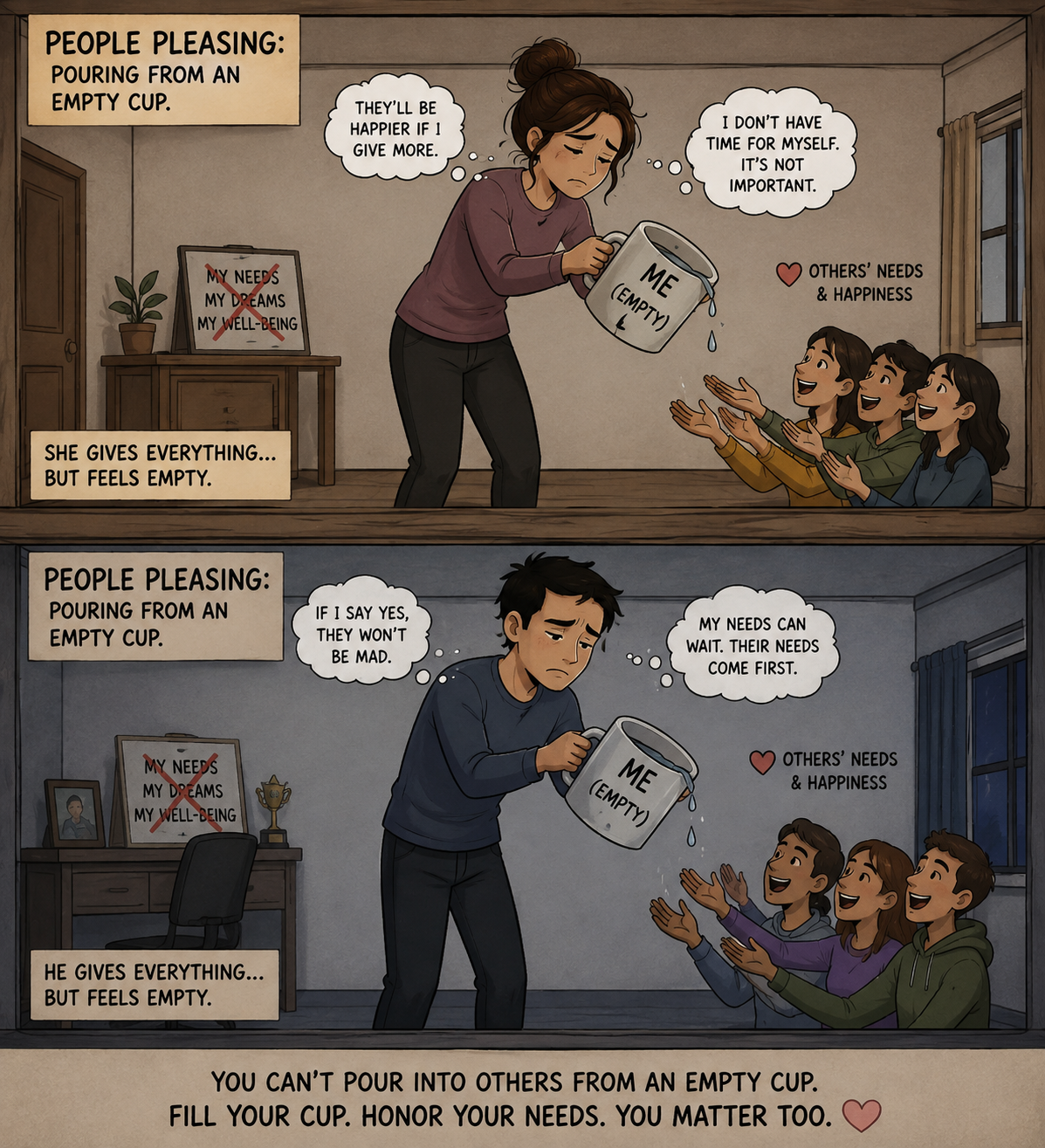
People-pleasing only made your heart less fertile. It didn't earn you the respect you were chasing — it just wore you down. Human beings are takers by nature — which is exactly why the law of receptivity gets misunderstood: it says if you open yourself to give, you'll receive in return, but it doesn't say people will give back fairly. It comes down to what standards you're willing to lower just to be seen as agreeable. Taking on everyone else's responsibilities doesn't make you a functional adult — it makes you an overextended one. Think of it this way: watering an empty pot does nothing, and feeding a dead plant does nothing either — you have to know where to actually put your energy. How can you grow and produce in life if you never shed your old way of thinking?
What Is People-Pleasing?
People-pleasing describes overextending yourself to people and situations out of self-pity rather than genuine desire. Research shows this is a real behavioral pattern — sometimes an adaptive mechanism, sometimes a psychological coping technique rooted in childhood trauma. According to YouGov, "17% of self-described people-pleasers say it has made their life easier; 48% say it's made their life harder. 22% say it has had no effect." That tells us people-pleasing isn't the harmless habit it's made out to be — for nearly half of people, it's actively making life harder. Sometimes when you put yourself in the position to receive from others, you don't always get back the same grace or gratitude. People become selfish, and stuck up too. How does it make you feel? In some cases, you may revert to what you were taught — overextending yourself — hoping you'll get more back in return. But that doesn't work the way it used to.
What Causes It?
People-pleasing often stems from childhood trauma, or from growing up in environments that taught you respect has to be earned by doing more. It can look like abandoning your own hygiene, health, and goals to keep everyone else comfortable. Cultural upbringing plays a huge role in normalizing this pattern too.
Is this behavior something we inherited from our ancestors?
Consider the 1600s through the 1800s: enslaved people were expected to be in constant motion, no matter the hour, expected to complete every task — in the fields or in the house — with almost no time to rest. As the Smithsonian's Searchable Museum states, "Enslavers were driven by the desire to maximize agricultural output (such as cotton or sugar). Enslaved workers were assigned rigorous daily quotas. The whip was used as a tool of torture to enforce these unrelenting work paces and increase daily productivity, often from dawn until dark."
This pattern highlights rest wasn't safe. Slowing down wasn't safe. Saying no wasn't safe. For enslaved people, working nonstop and never resisting was about survival, not choice. That fear got passed down. Long after slavery ended, the pattern stayed — the belief that you have to keep producing, stay agreeable, and never rest to be safe or valued. That's the root of the people-pleasing pattern many trace in Black Americans and other historically marginalized groups today.
Cultural conditioning shows up differently but just as powerfully elsewhere. In many Asian cultures, authoritarian parenting rooted in filial piety has been embedded since childhood. As Angela Wu puts it, "The expectation of unquestioned obedience in authoritarian parenting is a tenet held in Asian culture, known as filial piety (parent worship). Children are expected to treat parents and elders with utmost respect and reverence. Any form of questioning, disagreement, or even speaking of our own opinions could be seen as disrespect and disobedience."
In Indian culture, this pattern is often romanticized as an act of respect. As Anusha Atmakuri states, "In Indian culture, people-pleasing often stems from deep-rooted collectivism, where maintaining family honor, respecting elders, and prioritizing community harmony take precedence over individual desires. This upbringing can foster lifelong habits of suppressing personal needs and avoiding conflict to seek external validation." Indian culture, normalizes people-pleasing behavior. It isn't usually seen as a personal quirk — it's baked into how the culture defines a "good" person. What looks like "being a good daughter/son/family member" on the surface can actually be a survival strategy — one where self-abandonment gets rewarded and mistaken for virtue.
Signs of People-Pleasing
- Overextending yourself to others out of self-pity, not genuine desire
- Abandoning your own needs to meet everyone else's
- Always being the "yes" person, even when you don't agree
- Constantly apologizing, even when you've done nothing wrong
- Struggling to set boundaries with loved ones or coworkers
Effects of People-Pleasing
- Constant tiredness and burnout
- Resentment toward the people you keep saying yes to
- Loss of your own identity, opinions, and preferences over time
- Anxiety around conflict or disappointing others
- Neglecting physical and mental health
- Difficulty trusting your own decisions
How to Set Healthy Boundaries
- Prioritize your needs and act on them. Naming a need isn't enough — follow through on it.
- Nurture your mind and body first. You can't pour into anyone else from an empty plate.
- Check your "why." Before saying yes, ask why you're doing it and whether it actually matters to you — or if you're just avoiding discomfort.
- Practice the pause. Give yourself permission to say "let me think about it" instead of an automatic yes.
- Let disappointment be okay. Someone else's disappointment isn't proof you did something wrong.
Resources to Support Healing
- Set Boundaries, Find Peace by Nedra Glover Tawwab
- The Disease to Please by Dr. Harriet Braiker
- Psychology Today's therapist finder (psychologytoday.com) to locate a licensed therapist near you
- NAMI (National Alliance on Mental Illness) for general mental health support and helplines
- Working with a Board Certified Peer Support Specialist or Life Coach who understands lived experience, not just theory
Citations
YouGov → yougov.com/en-us/articles/50734
Smithsonian's Searchable Museum → searchablemuseum.com/a-punishing-system
Angela Wu → thesassyasiantherapist.com
Anusha Atmakuri→ antaracounselingandwellness.com
Summary
People-pleasing isn't kindness — it's often survival dressed up as virtue. Whether it's inherited from generations who had no choice but to comply, or learned in a home where love felt conditional on obedience, the pattern is the same: your needs get pushed to the back of the line. Healing starts with the same principle it always does — you can't pour from an empty vessel. Setting boundaries isn't selfish; it's the foundation that lets you actually show up for the people and purpose in your life, instead of just performing for them.
You just read about the pattern — now find out which version of it is yours. Takes 90 seconds. No judgment, just clarity. 💚
https://archetype-destinforgreatness.netlify.app/
In my own personal life, one way I set boundaries with others is by putting my phone on "Do Not Disturb" especially when I'm occupied with important tasks. One tip is: Connect the action with the emotion you're feeling. This helps you distinguish the why. This is a principle I teach to all my clients no matter their age range.

Stay Connected
Don’t forget to subscribe for more insights and practical advice on mindfulness. Share your thoughts in the comments below. How do you set healthy boundaries with your self and others?
Comments ()