
Published on Digital Wealth Series
Most people believe wealth is a simple function of intelligence multiplied by effort. Work 60 hours a week, outsmart the room, and the bank account will follow.
It’s a comforting myth—and it’s financially dangerous.
Warren Buffett once told a story about a close friend from business school. By Buffett’s own admission, his friend was both smarter and harder working than he was. After graduation, the friend went into the steel industry, while Buffett went into investing. Decades later, despite the friend’s superior work ethic and intellect, the gap between their fortunes was staggering. The difference wasn’t the rower; it was the boat.
In a recent breakdown based on evaluating over 10,000 companies: the business vehicle you choose matters far more than how hard you push it.
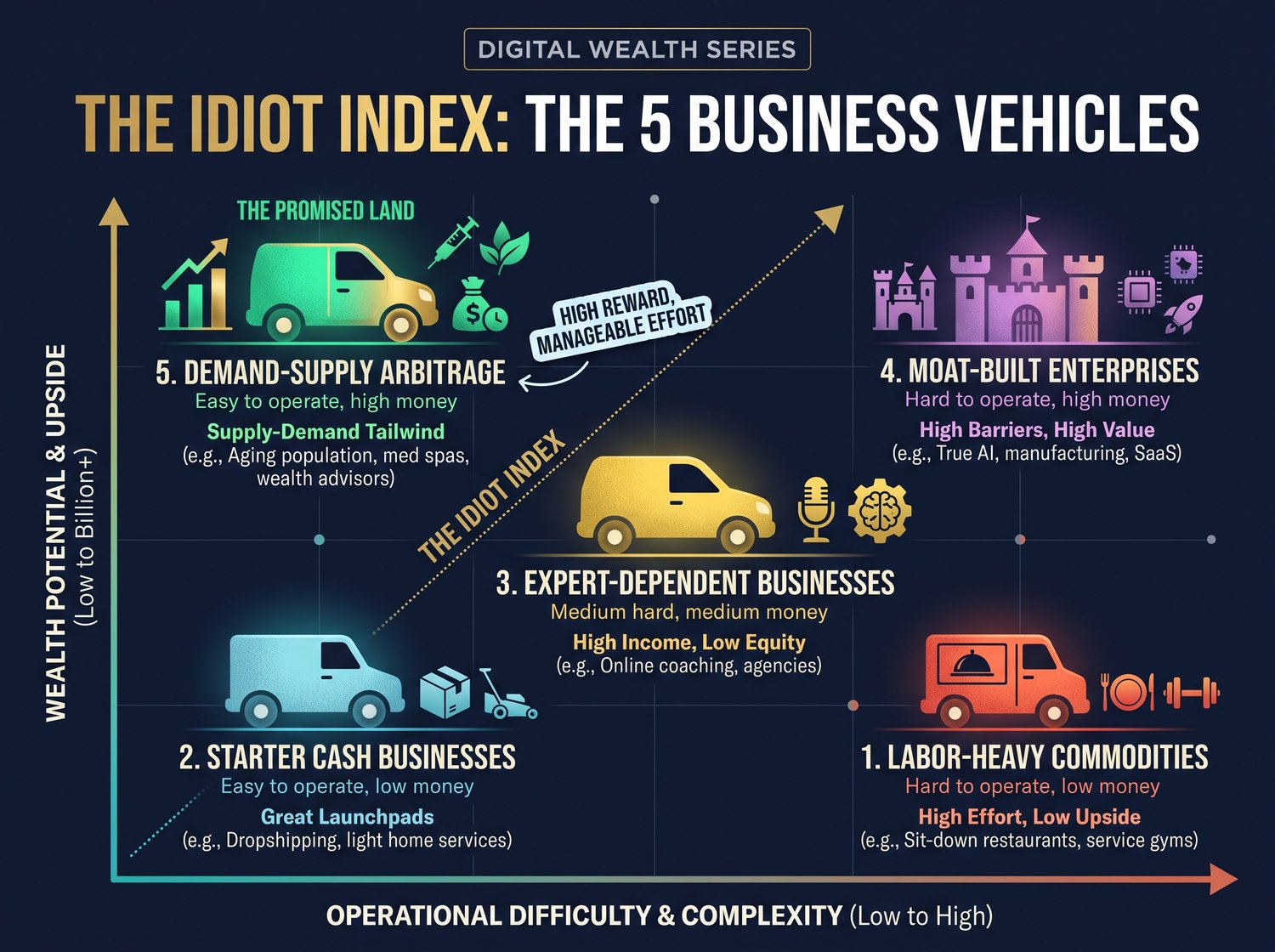
To make this actionable for 2027 and beyond, we’ve mapped out the five core business vehicles—ranked by operational difficulty versus realistic financial upside—and added the critical financial, AI-era, and wealth-sequencing lenses you need before committing your time or capital.
1. Labour-Heavy Commodities (High Effort, Low Upside)
Examples: Traditional sit-down restaurants, service-based gyms, small-business marketing agencies, brick-and-mortar retail, event planning.
These are the traps most first-time entrepreneurs walk straight into. Because the barrier to entry is low, almost anyone can launch one. The result is ruthless price competition, razor-thin margins, and heavy operational drag—meaning every incremental increase in revenue requires more staff, more management headaches, and more of your personal hours.
Look at the ceiling of any industry before you enter it. You won’t find billionaires who built their wealth purely by operating independent service gyms or neighbourhood restaurants. (Franchisors are a completely different business model.) Even if you are extraordinarily talented, applying elite execution to a low-leverage vehicle caps your upside. Unless a labour-heavy business is your genuine life’s calling, your skills will compound far faster elsewhere.
2. Starter Cash Businesses (Low Effort, Moderate Upside)
Examples: Dropshipping, light home services (power washing, lawn care, deck staining), vending machines and ATMs, real estate wholesaling, short-term rental arbitrage, affiliate content.
An "easy" business is not a bad business—it simply serves a different purpose. Starter cash vehicles are capital-light, relatively simple to operate, and capable of taking a single disciplined operator into a top-1% personal income.
The mistake people make is confusing a launchpad with a destination. Very few people build generational, sellable empires from power washing or affiliate links. Instead, treat these vehicles as skill and capital accelerators. Use them to master customer acquisition, build your first reserve of investment capital, and buy back your time—then graduate.
3. Expert-Dependent Businesses (Medium Effort, High Income, Low Equity)
Examples: Online coaching, AI implementation consulting, specialized construction, medical/surgical practices, enterprise agencies, personality-driven media and podcasts.
This is where many high earners live—and get quietly stuck. By pairing deep expertise with a lean team or media leverage, you can generate extraordinary profit margins and an enviable lifestyle.
The non-obvious catch is transferability. A business that revolves around your personal reputation, clinical skill, or sales charisma is an enhanced job, not a sellable asset. When buyers look at an expert-dependent company, they see key-person risk: if the founder leaves, the clients leave.
The 2027 Upgrade: If you operate in this tier, your financial priority isn’t just making more money—it’s converting high active income into passive assets (index funds, commercial real estate, or equity stakes) or systematically productizing your knowledge so the business can run without your name on the door.
4. Moat-Built Enterprises (Extreme Effort, Massive Upside)
Examples: Foundational AI infrastructure (not thin software wrappers), pharmaceuticals, specialty manufacturing (chips, aerospace), franchising, industry roll-ups, two-sided marketplaces, consumer packaged goods (CPG), regulated banking, energy and data centre's.
Early in your journey, high barriers to entry look like obstacles. Later, you realize difficulty is your greatest competitive advantage.
If a business requires regulatory approval, deep technical IP, massive upfront capital, or years of compounding network effects, 99.9% of potential competitors are eliminated before day one. You are no longer competing against five million hustlers on the internet; you are competing against 20 serious operators.
The 2027 Reality Check on SaaS: For the last decade, Software-as-a-Service (SaaS) sat comfortably in this tier. In 2027, AI-assisted coding has drastically lowered the cost of building software. Thin SaaS tools and basic "AI wrappers" are rapidly sliding back toward Starter Cash or Commodity territory. True software moats today require proprietary data, deep workflow lock-in, regulatory compliance, or network effects—not just clean code.
5. Demand-Supply Arbitrage: The "Promised Land" (Manageable Effort, High Upside)
Examples: Med spas, wealth advisory, elder care and assisted living, GLP-1 wellness clinics, debt collection, waste management, commercial cleaning, elevator maintenance, real estate syndication.
Every investor and operator eventually notices a strange phenomenon: brilliant, exhausted founders scraping by in brutal industries, while average operators quietly print money in overlooked niches. The secret is asymmetric supply and demand.
These "high-leverage, lower-friction" vehicles usually emerge from three forces:
- Demographic Tailwinds: Wealth is heavily concentrated in aging populations. Businesses serving longevity, aesthetics (med spas), elder care, and wealth management benefit from a wave of clients who have both capital and urgency. In wealth advisory, for example, client retention is famously sticky and fees compound automatically as portfolios grow—meaning the business expands even with minimal new client acquisition.
- Regulatory & Innovation Windows: When laws shift or breakthrough treatments hit the market—just as Botox did decades ago, cannabis did during its early boom, and GLP-1 therapies are doing now—demand temporarily outstrips supply, creating windows of outsized margins.
- The "Cocktail Party Discount": Nobody brags at a dinner party about owning a waste management route, a debt collection agency, an elevator maintenance company, or a commercial cleaning firm. Because these businesses aren't glamorous, ambitious talent avoids them. Fewer smart competitors means wider margins, stickier recurring B2B contracts, and prime positioning for private equity roll-ups.
- Structural Capital Leverage: Models like real estate syndication allow operators to put in a small percentage of equity (often around 5%), raise the remaining capital from investors, apply institutional debt leverage, and capture meaningful upside—turning deal-sourcing and capital-raising skills into massive asset control.
Three Essential Additions for Building Wealth in 2027
Knowing the five vehicles is only half the battle. To actually turn this framework into net worth, apply these three filters that most business advice leaves out.
1. Sequence Your Vehicles (The Wealth Ladder)
You do not need to jump straight into a Moat-Built Enterprise if you are starting with limited capital or working a full-time career. Treat your business journey like a relay race:
- Phase 1 (Capital & Skills): Use a Starter Cash or Expert-Dependent model (or a high-earning career) to build free cash flow and master marketing, sales, and unit economics.
- Phase 2 (Cash-Flow Engine): Deploy that capital and skill into a Demand-Supply Arbitrage business with recurring revenue and low founder dependency.
- Phase 3 (Compounding Equity): Funnel profits into durable, appreciating assets or scale into a Moat-Built Enterprise with institutional exit value.
2. Apply the "AI-Proofing" Test
Before committing to any vehicle in 2027, ask: Does AI compress my margins or expand them?
- High Risk: Businesses selling generic digital labour, basic content, or simple software features. Prices here are racing toward zero.
- High Advantage: Businesses anchored in the physical world (commercial cleaning, elevator maintenance, elder care), regulated trust (wealth advisory, healthcare), or complex distribution—where you can use AI internally to slash your own operating costs while your competitors remain stuck in manual workflows.
3. Audit the Unit Economics Before You Row
Even within a great vehicle, bad math will sink the boat. Before launching or acquiring a business, run a quick four-point audit:
- LTV-to-CAC Ratio: Does the lifetime value of a customer comfortably exceed the cost to acquire them (ideally 3:1 or higher)?
- Payback Period: How many months does it take to recover your upfront marketing and setup costs?
- Revenue Quality: Is the income one-off (transactional) or recurring (contractual/retainer)? Recurring revenue dramatically increases both peace of mind and exit multiples.
- Founder Dependency: If you stepped away for 30 days, would revenue drop by more than 20%
Choose the Boat, Then Row
Working 60 hours a week takes the exact same toll on your health, time, and family whether you are running a struggling neighbourhood restaurant or building a recurring B2B service in a supply-constrained market. Yet the financial outcomes are worlds apart.
Define your actual goal first—whether that’s fast cash flow, high personal income, or a sellable multi-million-dollar asset. Pick the vehicle engineered to deliver that exact outcome, verify the unit economics, and only then pour in the relentless effort required to win.
Disclaimer: This article is published by Digital Wealth Series for educational and informational purposes only and does not constitute registered financial or tax advice. Consult a FSCA-registered financial planner or tax practitioner before making major portfolio changes.