
Why These Skills Matter (Backed by Research)
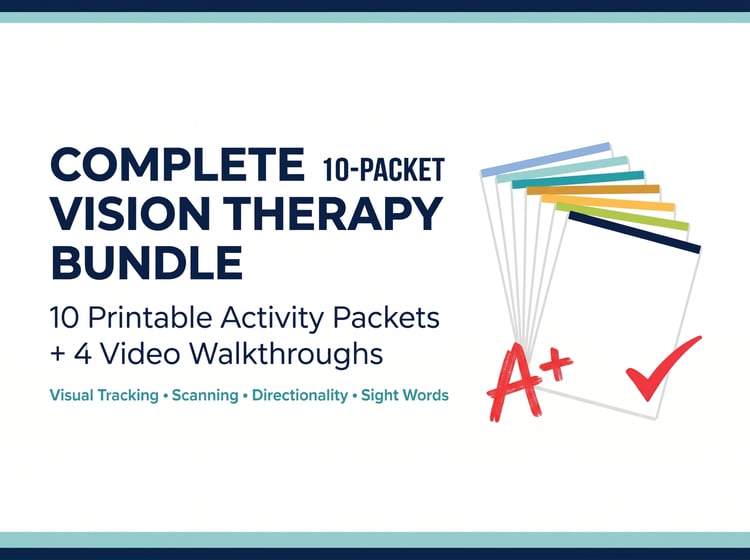
Why These Skills Matter (Backed by Research) Fluent reading relies on more than phonics alone—it also depends on how smoothly and accurately the eyes and visual system process print. Peer-reviewed research highlights four key visual foundations practiced in these packets:
- Eye Tracking (Saccades): Randomized controlled trials in elementary students (Clinical Pediatrics, 2014; Journal of Child Neurology, 2017) found that structured saccadic eye-movement practice led to measurable gains in both reading fluency and comprehension.
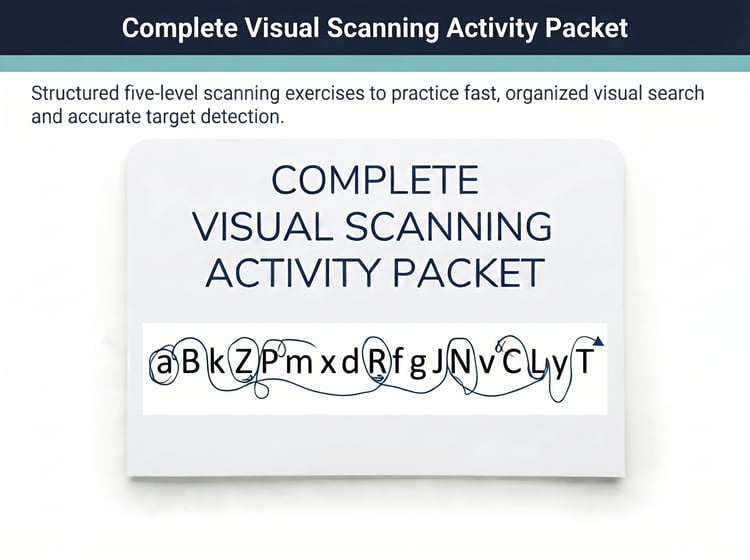
- Visual Scanning & Attention: Eye-tracking research (Caldani et al., 2020) shows that timed visual search tasks—finding target symbols among distractors—strengthen selective visual attention and help readers handle dense text.
- Directionality & Orientation: Eye-tracking and literacy studies (Duñabeitia et al., 2013; Frontiers in Psychology, 2014) show that beginning readers naturally experience "mirror invariance," which can cause processing delays with directional symbols like b/d and p/q. Targeted orientation practice helps build automatic left-to-right visual discrimination.
- Sight Word Automaticity: Reading science research (Ehri, Scientific Studies of Reading, 2005 & 2014) demonstrates that repeated, active practice with high-frequency words (like the Fry 1000 list) builds orthographic memory for instant word recognition, freeing up mental energy for comprehension.
These printable activities are designed to build visual and attentional skills alongside phonics-based reading instruction.

About Me
Created by optometrist Dr. Philip Nicholson, O.D.—founder of the Visual Learning Center for over 20 years—these exclusive, clinic-tested printable vision therapy and literacy activities bring favorite practice exercises with video walkthroughs or simple and concise printed instructions straight to your home or classroom.