

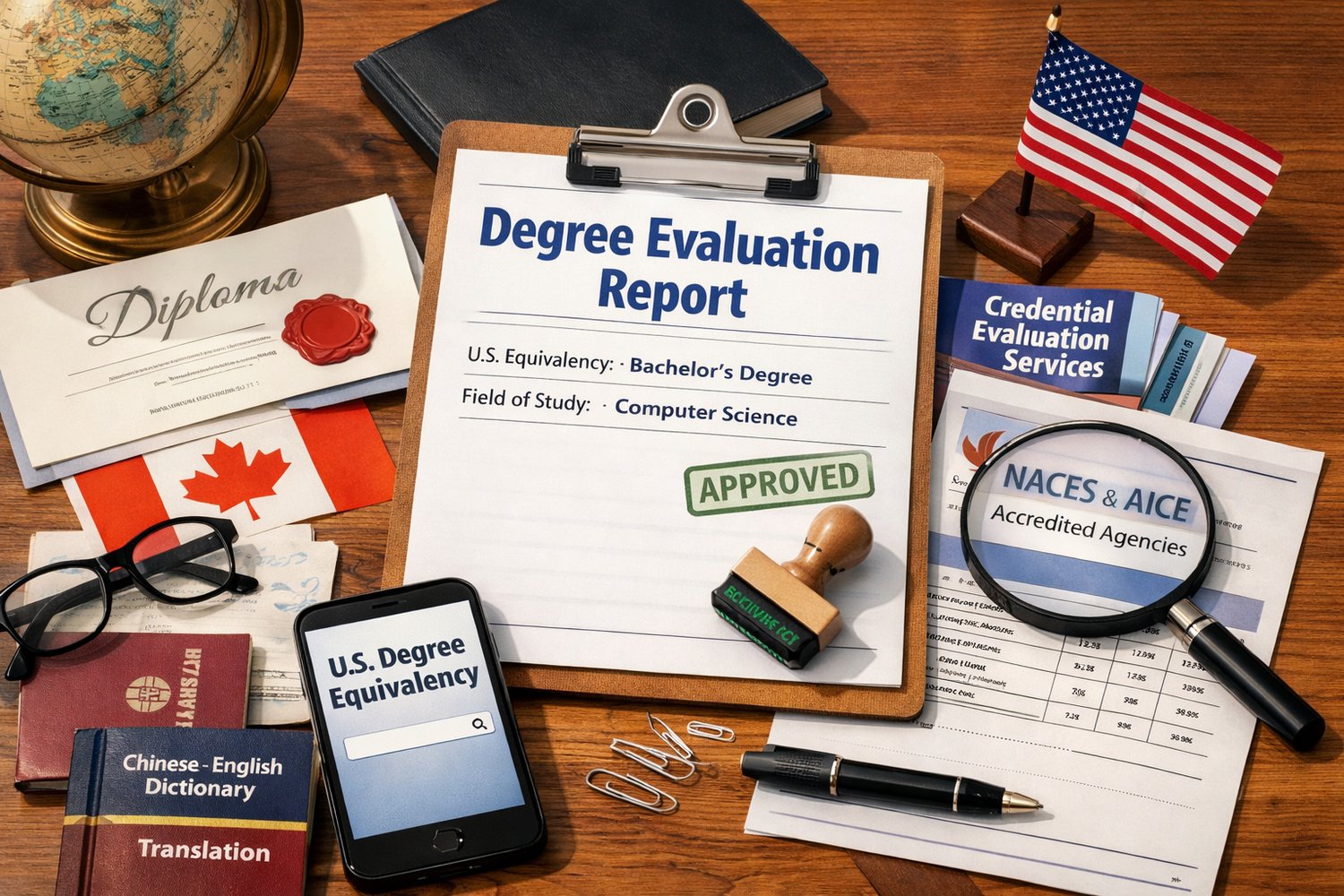
Credential Evaluation (Degree Equivalency)
Recently, some people asked about credential evaluation for NIW, so I’ll walk through my experience getting my degrees evaluated for U.S. equivalency.
My degrees are from the UK and Canada. While people often assume that English-speaking countries have very similar systems—and Canada’s system is indeed one of the closest to the U.S.—non-U.S. degrees still need to be evaluated. You also shouldn’t assume that the reviewing officer shares your understanding. They may not be familiar with other education systems, even similar ones. So having a formal evaluation is necessary.
First, if you want your credentials recognized as equivalent to a U.S. degree, it has to be determined by a U.S.-based evaluation agency. A simple translation alone isn’t sufficient. For example, if your original degree is in Chinese, translating it into English does not make it an official equivalency evaluation.
Step 1
I started by searching for “U.S. degree equivalency evaluation.” A number of agencies came up. However, the most valuable resource at this stage was the guidance from the U.S. Department of State. Since U.S. Citizenship and Immigration Services (USCIS) processes immigration petitions and the State Department ultimately verifies documents for visa issuance, it’s fair to say they have the final say. So their guidance is especially important.
Step 2
The State Department explains that degrees and transcripts from other countries and/or in other languages cannot be used directly. They list two recognized associations: National Association of Credential Evaluation Services and Association of International Credential Evaluators.
Together, these include around 30 member agencies—one of the most well-known being World Education Services (WES). Although the State Department doesn’t officially endorse any specific agency, at least you can be confident that members of these associations are legitimate.
Step 3
I browsed through many of these agencies’ websites. Some felt overly complicated, others looked outdated or required filling out PDFs and emailing documents—which didn’t feel very reliable to me.
In the end, I chose Scholaro. From what I remember, I created an account, uploaded the required PDF documents, and that was it. You can also evaluate multiple degrees in one order. I only did a basic degree evaluation (not a course-by-course report with transcripts).
If your documents are entirely in any other language, you’ll need certified translations before submitting them for evaluation.
About a week later, I received an email saying my evaluation report was ready, and I was able to download it directly from my account.