
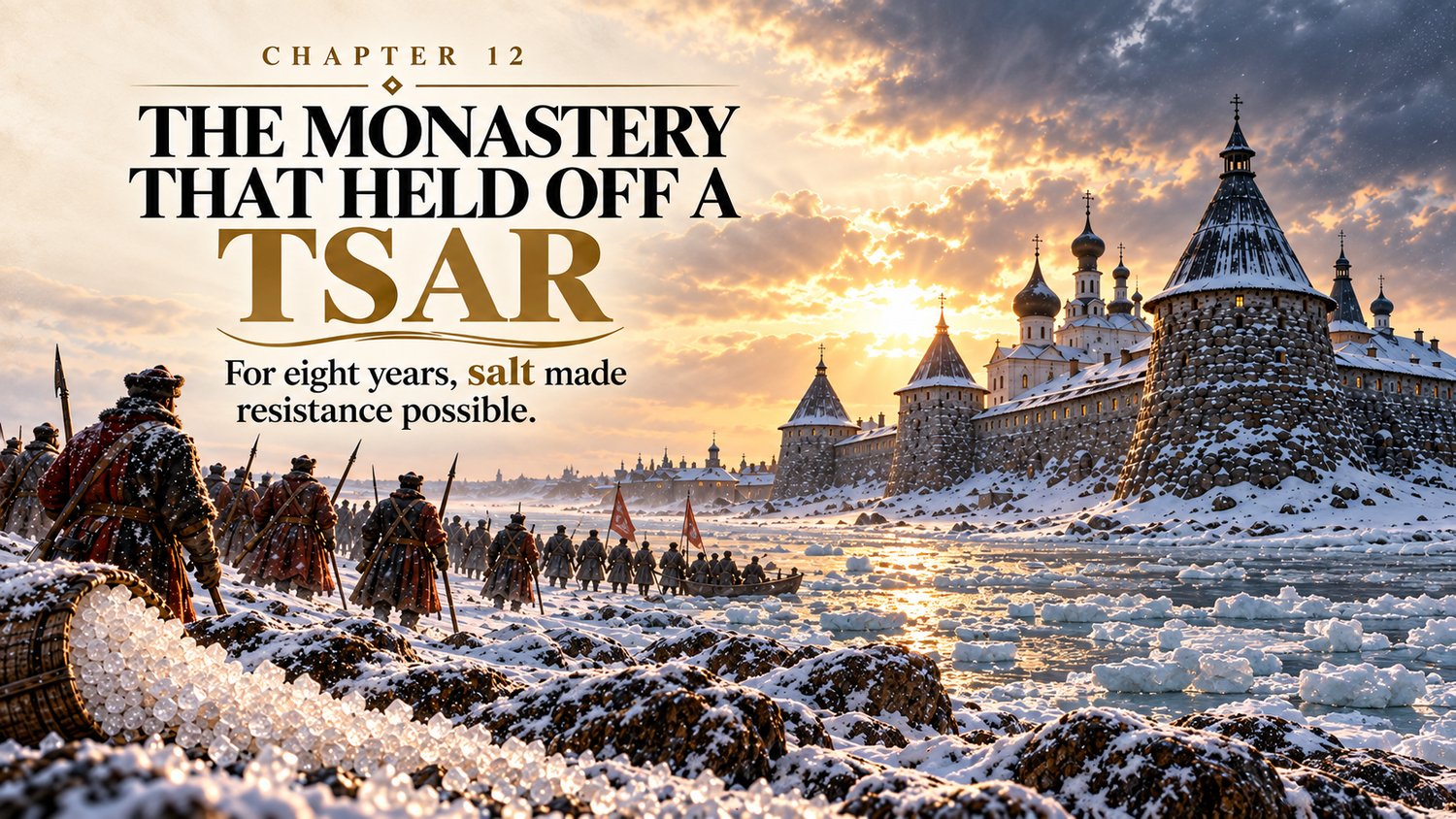
A monastery held off the Russian state for eight years.
Not because it possessed a great army.
Because it had salt.
In 1668, Tsar Aleksey Mikhaylovich sent troops to the Solovetsky Monastery, a fortified religious community on islands in the White Sea. Officially, the conflict was about religion. The monks rejected the reforms introduced by Patriarch Nikon, refusing to alter long-established practices, from the way they crossed themselves to the spelling of the name of Jesus in religious texts.
But theology alone does not explain why a government would spend eight years besieging a monastery in the Arctic.
The real story begins with economics.
By the seventeenth century, the monastery was far more than a spiritual center. It had become one of the most powerful economic institutions in northern Russia. It controlled extensive salt production, fisheries, ironworks, trade networks, food stores, and even its own freshwater infrastructure. Hundreds of workers labored for an organization whose wealth extended far beyond the monastery walls.
Its defenses reflected that wealth.
The massive granite walls, built between 1584 and 1594, rose eight to eleven meters high and were up to six meters thick. Contemporary Russian artillery could not breach them. Inside the fortress were stores of preserved food, fresh water supplied through an ingenious canal system, and enough resources to withstand years of isolation.
That is what made Solovetsky dangerous.
A community that can produce its own salt, preserve its own food, control its own trade, and survive without outside support is more than prosperous.
It is autonomous.
And autonomous institutions rarely coexist comfortably with centralized power.
When the siege began, Moscow expected a quick victory. Instead, the monastery proved almost impossible to subdue. The walls held. The defenders included not only monks but also experienced soldiers, Cossacks, and fugitives who knew how to fight. Most importantly, the monastery remained supplied while the besieging troops struggled with harsh Arctic conditions and fragile supply lines.
For eight years, the fortress resisted.
Then, on a winter night in January 1676, a monk named Feoktist revealed a hidden, unguarded entrance. Troops slipped through the passage during a blizzard and entered the monastery under cover of darkness. By morning, the resistance had been crushed. Of roughly five hundred defenders, only about sixty survived.
The fortress that artillery could not break fell through betrayal in a single night.
What followed was just as important as the siege itself.
The monastery's salt operations were brought under Moscow's control. Its special trading privileges were revoked. The autonomous institution that had accumulated wealth, influence, and independence over centuries was absorbed into the authority of the state.
The dispute may have begun with religion, but beneath the arguments over ritual lay a much older and more universal question:
"Who controls the resources people cannot live without"?
The history of salt repeatedly returns to this theme. Governments tax it, monopolize it, and regulate it because salt is never merely a seasoning. For most of human history, it was essential for preserving food, sustaining trade, and maintaining economic power.
At Solovetsky, salt created wealth.
That wealth created independence.
And that independence became strong enough to challenge the authority of a state.
Chapter 12 of Worth Your Salt tells the story of the monastery that would not fall, revealing how a remote Arctic fortress became the stage for a struggle over faith, power, and economic autonomy.
Because sometimes the most important battles in history are not fought over land or ideology.
They are fought over control of the things people need to survive.
Comments ()