
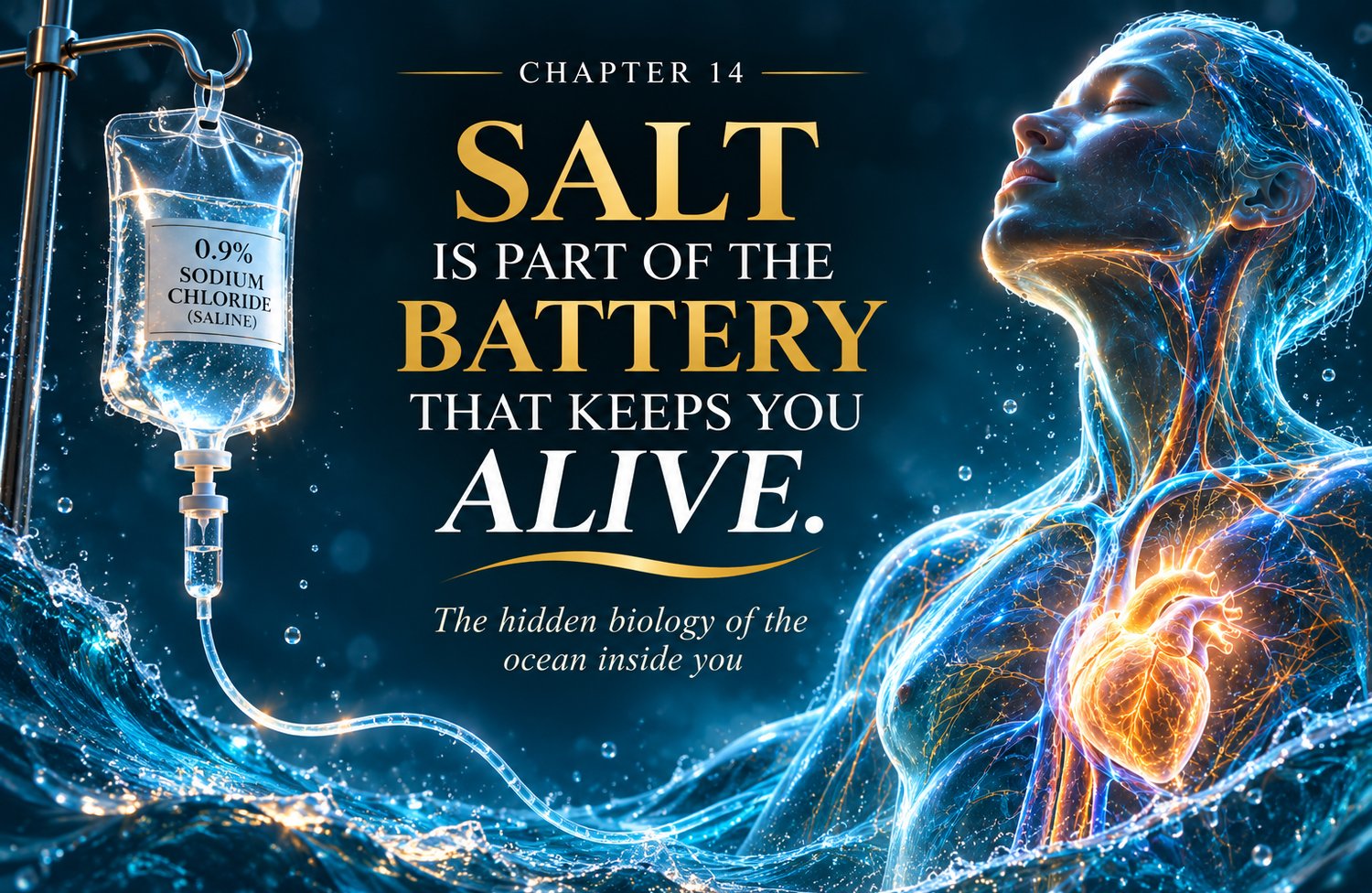
What if salt is not something you simply add to food, but something your body is built around?
Walk into almost any emergency room, and one of the first things you'll see is a clear bag hanging beside a patient's bed.
Water.
And salt.
Specifically, a solution containing 0.9% sodium chloride, known as normal saline.
Most people never stop to ask why that concentration is used. Why 0.9%? Why not more, or less?
The answer is surprisingly profound.
Because your blood is itself a carefully regulated saline environment. Every moment of your life depends on maintaining that internal chemistry within a very narrow range. When doctors administer saline, they are not introducing something foreign to the body. They are restoring a balance the body already recognizes.
In a sense, each of us carries a small internal ocean.
The idea may sound poetic, but it reflects a biological reality. Blood plasma, lymph, tears, sweat, and many other bodily fluids are saline solutions. From the earliest stages of development, life unfolds within a carefully controlled saltwater environment. Long after our distant ancestors left the sea, the chemistry of that ancient world remained with us.
But the story becomes even more remarkable when we look inside our cells.
Every nerve impulse.
Every heartbeat.
Every muscle contraction.
Every thought.
All of them depend on tiny electrical signals generated by differences in sodium and potassium concentrations on opposite sides of cell membranes.
That imbalance is electricity.
Your cells constantly spend energy maintaining it, moving sodium out and potassium in through microscopic molecular pumps. This process occurs continuously, day and night, throughout your entire life. Without it, nerves could not transmit signals, muscles could not contract, and the brain could not function.
In other words:
Salt is part of the battery that keeps you alive.
This is why the body works so hard to regulate sodium levels. It is not managing a dietary ingredient. It is protecting one of the fundamental conditions that make life possible.
The importance of that balance becomes especially clear when it is disrupted.
Most people know that dehydration can be dangerous. Far fewer realize that drinking too much plain water can also become a serious problem.
In endurance sports, athletes have occasionally become critically ill after consuming so much water that the sodium concentration in their blood fell to dangerously low levels. The condition, known as hyponatremia, can cause confusion, seizures, loss of consciousness, and in severe cases can become life-threatening.
The problem is not a lack of water.
The problem is too much water relative to salt.
As one sports physiologist in Worth Your Salt explains:
"The body is not a bucket. It is an ocean, carefully balanced."
That balance is what matters.
Too little water is dangerous.
Too little sodium is dangerous.
Too much plain water can be dangerous.
The body continuously adjusts both, working to preserve the internal environment on which every cell depends.
This perspective changes how we think about salt. Rather than viewing it simply as a seasoning or a controversial dietary topic, we can see it for what it is biologically: an essential component of the system that keeps us alive.
We evolved out of the sea. But in an important sense, we never truly left it.
We carry it within us, in blood, tears, sweat, lymph, and the fluid that surrounds us before birth. Every heartbeat, every movement, and every thought depends on maintaining that ancient chemistry.
Chapter 14 of Worth Your Salt explores the hidden biology of this remarkable mineral and the surprising ways it shapes human life, from emergency medicine and athletic performance to the electrical activity that powers every cell in the body.
Comments ()