
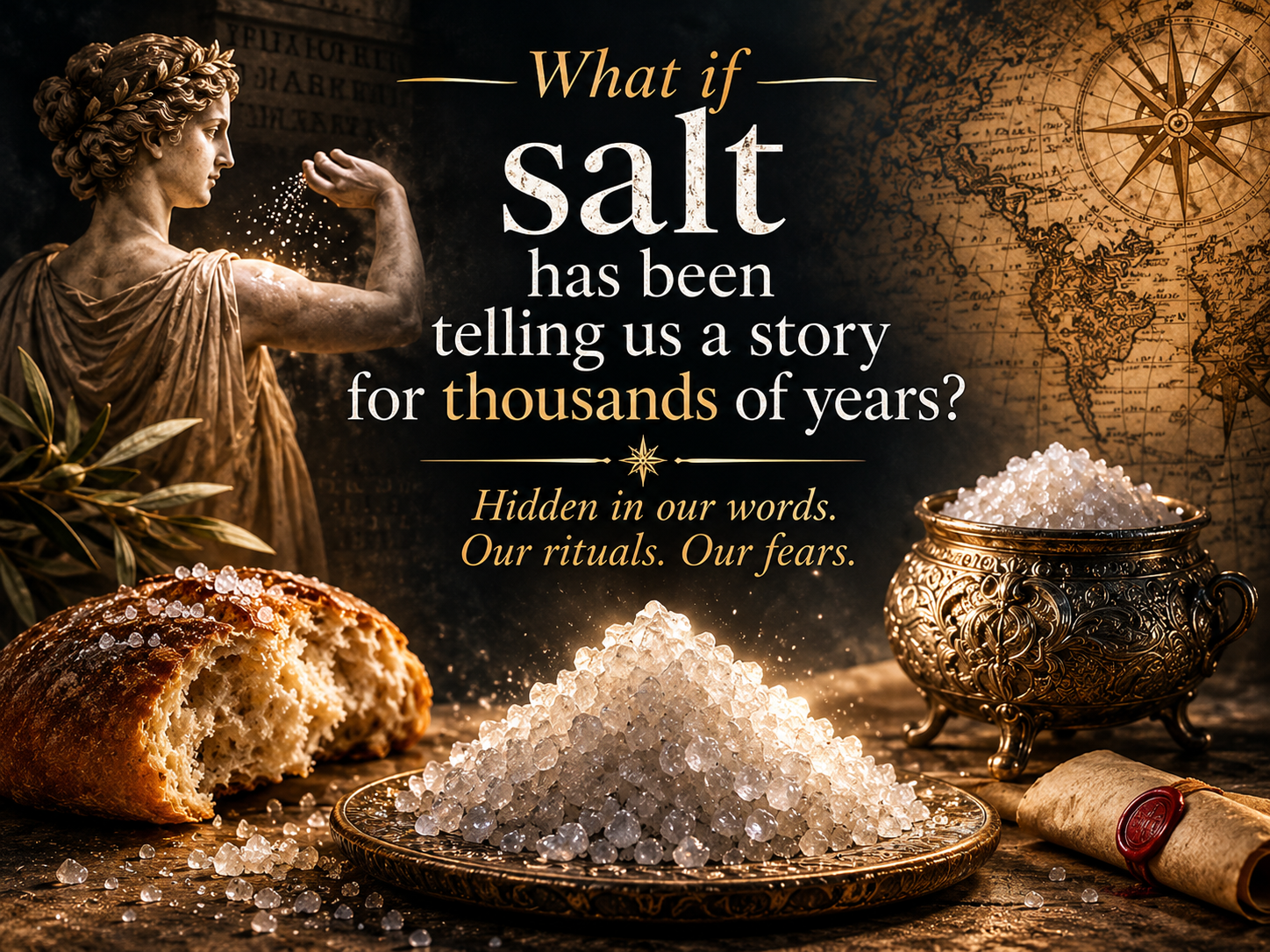
What if salt has been speaking to us for millennia, and we simply stopped listening?
Its story is hidden in places we encounter every day, often without noticing.
It survives in language: in salary, in salute, and in the expression “worth your salt.” It appears in proverbs, such as the Russian saying that you must eat a whole pood of salt with someone before truly knowing them. It lingers in the ancient tradition of welcoming guests with bread and salt, a gesture that once symbolized hospitality, trust, and protection.
Salt also lives in customs that many people still follow without knowing their origins.
The fear of spilling salt. The habit of throwing a pinch over the shoulder. Rituals of blessing, purification, and protection passed from one generation to the next. Across cultures and centuries, salt has appeared in sacred covenants, baptismal practices, Shinto purification rites, folk magic, and countless local traditions whose original meanings have gradually faded.
Why did one ordinary mineral become so deeply woven into human culture?
Because salt was never just a seasoning.
For much of history, it carried meanings that went far beyond food. It measured value. It symbolized loyalty and friendship. It marked the boundary between the sacred and the ordinary. It was believed to protect homes, seal agreements, and ward off unseen dangers.
At the same time, salt was essential to daily survival. It preserved food through winter, enabled long-distance trade, and supported entire civilizations. Over time, its practical importance merged with symbolic meaning. A substance that helped sustain life naturally acquired spiritual, social, and cultural significance.
The result is remarkable: few materials have left such a deep imprint on both our physical world and our imagination.
Even today, traces of that history remain embedded in our languages, customs, and beliefs. We inherit them automatically, often without realizing that many began with humanity’s long relationship with a simple white crystal.
Chapter 4 of Worth Your Salt explores how salt became woven into our words, rituals, superstitions, friendships, and ideas of value. It follows the surprising ways in which a mineral essential to survival evolved into a powerful cultural symbol across continents and centuries.
Because sometimes the smallest grain casts the longest shadow.
And sometimes the oldest stories survive not in books, but in the habits, expressions, and traditions we continue to carry with us every day.
Comments ()