
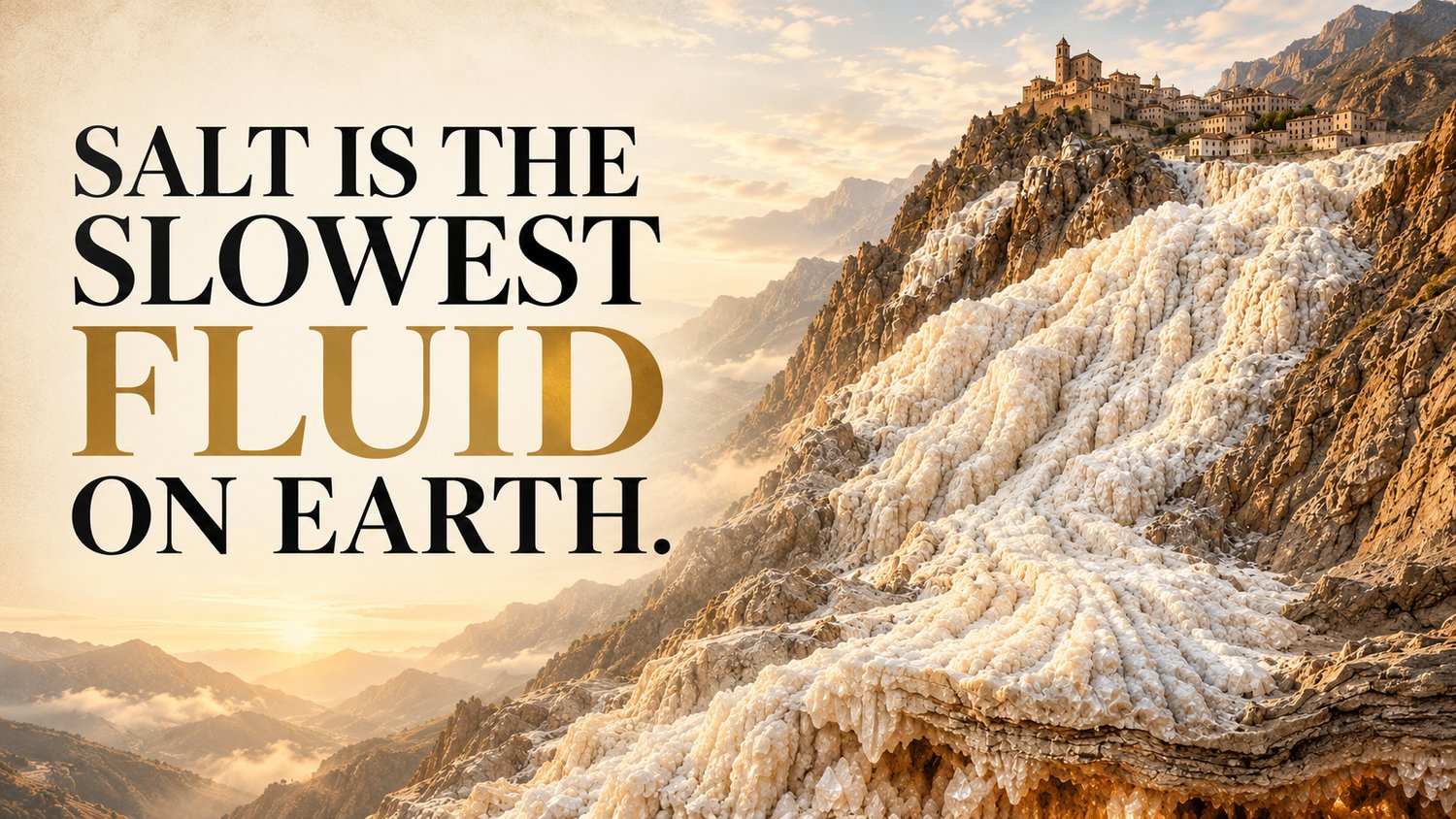
Salt looks like stone.
But given enough time, it behaves more like a glacier.
And in some places on Earth, it can even build mountains.
At first glance, that sounds impossible. We think of rock as solid, fixed, and permanent. Yet one of the most surprising facts in geology is that salt does not always behave like ordinary rock. Deep underground, under enough pressure, it slowly deforms and flows. Not metaphorically. Physically.
The story begins in Cardona, Catalonia, home to one of the world's most extraordinary geological formations: a mountain made almost entirely of salt. For more than two thousand years, people have marveled at it. The Roman writer Pliny the Elder described the mountain as seemingly inexhaustible. No matter how much salt miners removed, fresh salt continued to appear.
The Romans correctly observed that the mountain appeared to renew itself. They were simply wrong about the reason.
The salt was not being replenished from above by rain, as they believed. It was rising from below. Beneath Cardona lies a massive ancient salt deposit that has been slowly pushing upward through surrounding rock for millions of years. The mountain exists because the salt is still moving. Today, geologists can measure that movement in millimeters per year. It is slow enough to be invisible in a human lifetime, yet fast enough to reshape an entire landscape over geological time.
Cardona is not unique.
Across the world, ancient salt deposits are quietly migrating through the Earth's crust. In the Zagros Mountains of Iran, some of these structures have reached the surface and created one of the strangest landscapes on the planet. There, enormous masses of salt emerge from underground and begin flowing downhill.
Not as liquid.
As solid rock.
These formations, known as salt glaciers, can creep downslope at rates of several meters per year. They develop ridges, folds, crevasses, and lobes remarkably similar to those found in ordinary ice glaciers. The difference is that the material moving across the landscape is not ice but rock salt.
The implications of this strange behavior extend far beyond geology.
What makes salt mobile also makes it extraordinarily useful. Because salt slowly deforms and seals fractures, engineers have discovered that it can act as one of nature's most effective underground containers. Salt caverns are now used to store natural gas, hydrogen, compressed air, and strategic petroleum reserves. Around the world, enormous quantities of critical energy resources sit underground, protected by the unique properties of salt.
But the same property that makes salt useful can also create problems.
One of the most important examples comes from Germany's Asse II salt mine. For decades, scientists believed salt would be an ideal material for permanently isolating radioactive waste. The logic seemed compelling: salt is impermeable, self-sealing, and geologically stable. Between 1967 and 1978, approximately 126,000 barrels of radioactive waste were stored deep within the mine.
Then reality intervened.
Groundwater entered the mine. The surrounding salt continued to deform. Storage chambers gradually closed, damaging waste containers and creating one of the most complex environmental remediation projects in modern Germany. Eventually, authorities concluded that the waste would have to be retrieved rather than left in place.
The lesson is both fascinating and humbling.
Salt did not fail.
Salt behaved exactly as it always has.
For millions of years, it has been rising, flowing, deforming, and reshaping the world according to the laws of physics. The mistake was assuming that a material capable of moving mountains would remain perfectly still simply because we needed it to.
Chapter 9 of Worth Your Salt explores this hidden geological story, from the rising salt mountain of Cardona to the flowing salt glaciers of Iran and the engineering challenges beneath northern Europe.
Because salt is not merely a mineral we extract from the ground.
It is an active force within the planet itself.
And long after our cities, industries, and political borders have disappeared, the salt beneath them will still be moving.
Comments ()