
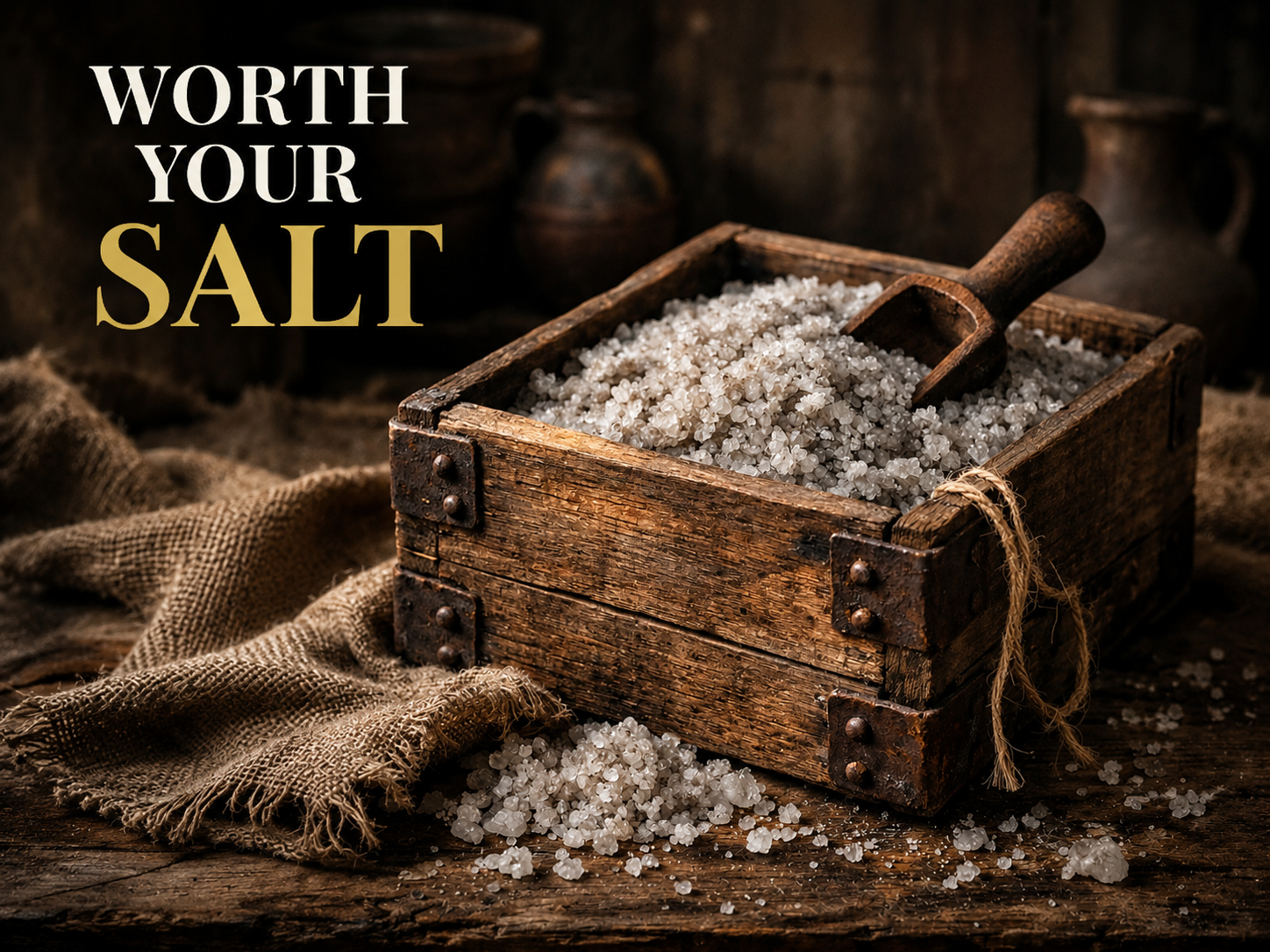
Before refrigerators, there was a wooden table, a cold December morning, and a single box that could determine whether a family survived the winter.
In medieval Europe, salt wasn’t seasoning. It wasn’t something sprinkled over food at the end of a meal. Salt was the difference between nourishment and rot, between security and hunger.
Chapter 1 of WORTH YOUR SALT opens with a scene that repeated itself for centuries across Europe. A family gathers around a freshly slaughtered pig. The animal is still warm when the work begins.
As I write in the book:
“The pig is still warm when they begin.”
“Because without this salt, the pig is worthless… in three days.”
In a world without refrigeration, fresh meat was a race against chemistry. Once an animal was slaughtered, spoilage had already begun. The family’s survival depended on preserving that meat before bacteria claimed it.
Salt was the solution.
But salting food was not a simple matter of adding a little extra seasoning. It was a form of practical engineering passed down through generations. Every handful mattered. Too little salt, and the meat spoiled. Too much, and it became difficult to eat. Families learned these lessons through experience long before anyone understood microbes, osmosis, or food science.
Women who never attended a university carried in their hands a sophisticated body of knowledge that kept entire households alive. Their expertise was rarely recorded, yet it was as essential as any technology of the age.
And this story extends far beyond medieval Europe.
Salt helped preserve the foods that sustained Roman armies and navies. It made long-distance sea voyages possible. It supported the growth of medieval cities by allowing food to travel farther and last longer. It shaped culinary traditions from Tunisia to Newfoundland and influenced what entire civilizations could eat, trade, and store.
For thousands of years, salt performed the role that refrigeration performs today. It was the invisible infrastructure behind food security. Without it, cities struggled to grow, ships struggled to sail, and winters became far more dangerous.
That importance is easy to overlook because modern refrigeration has hidden the problem salt once solved. Food appears in supermarkets year-round. Meat travels across continents. Dairy products remain fresh for weeks. We rarely think about preservation because machines quietly handle it for us.
The refrigerator did not eliminate humanity’s need to preserve food. It simply replaced the technology that had served that purpose for millennia.
Chapter 1 explores that forgotten world: a world in which salt was not primarily a flavoring, but one of the most important survival technologies ever developed.
Because before salt enhanced food, it made food possible.
Chapter 1, “Before Refrigerators, There Was Salt,” is the opening chapter of WORTH YOUR SALT, a history of the mineral that preserved food, powered trade, and helped shape civilizations for thousands of years.
Comments ()