
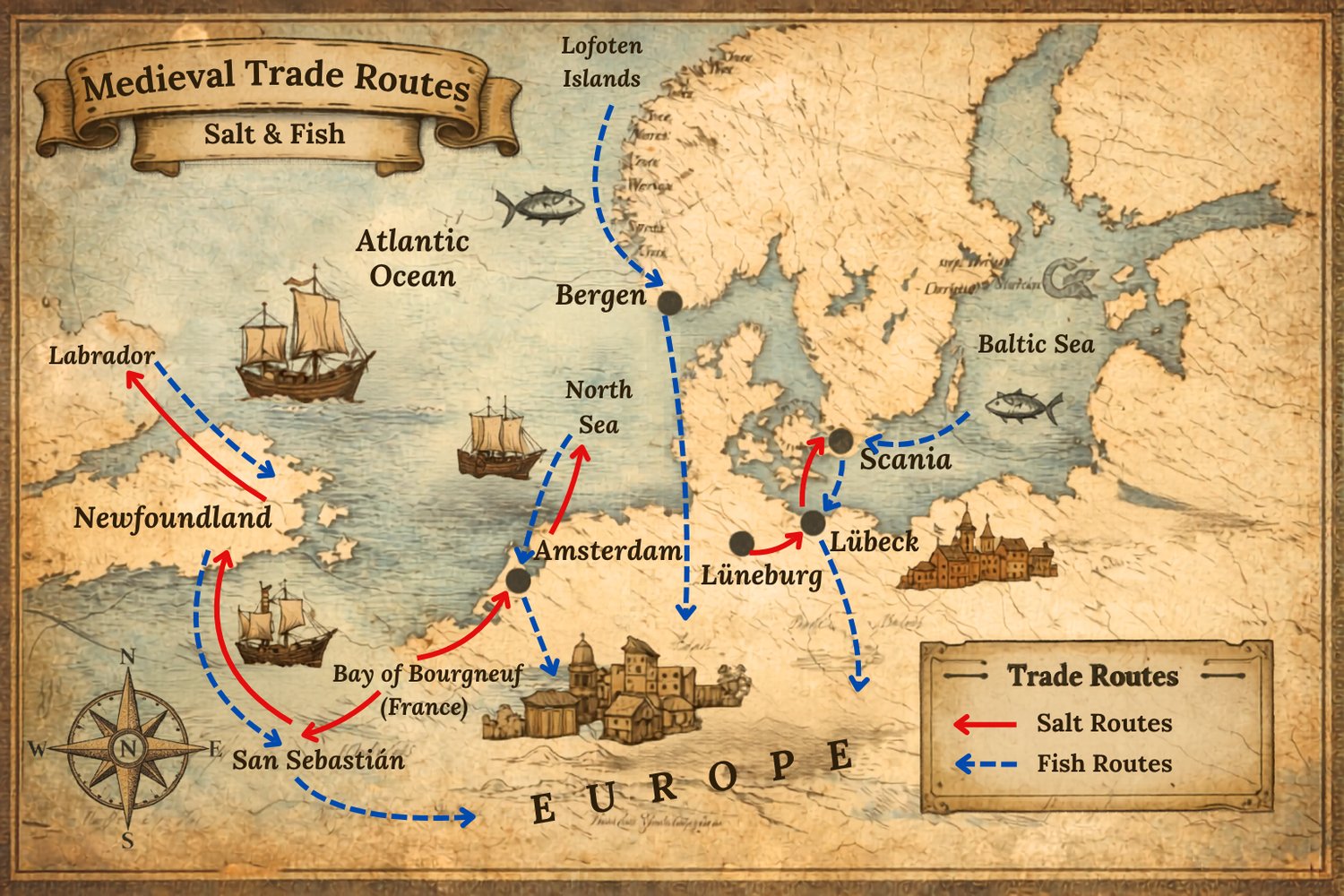
The second chapter of Worth Your Salt opens in Bergen, Norway, around the year 1400. A sailor approaching the harbor smells the city before he sees it.
The odor comes from wooden warehouses packed with dried cod. Fish from the Lofoten Islands. Salt from Lüneburg. Grain from the Baltic. Together they form a network of trade that stretches across northern Europe.
As I write in the book:
“Fish flows south. Salt flows north. The men who control the space between them grow rich.”
What began as a religious rule gradually became one of the most powerful economic engines of the medieval world.
For centuries, Christians were prohibited from eating meat on numerous days throughout the year: Fridays, much of Lent, parts of Advent, and many other fast days. Depending on the period and location, these restrictions could affect between 150 and 250 days annually.
Fish, however, was permitted.
That seemingly simple exception created an enormous and predictable demand. Millions of people needed fish. But there was a problem: fish spoils quickly, and without preservation it could never travel far from the coast.
The answer was salt.
Salt did not merely preserve herring and cod. It made the medieval fish economy possible.
By allowing fish to be stored for months and transported over great distances, salt transformed a local food source into an international commodity. Entire industries emerged around this chemistry. Coastal fishing communities, inland salt producers, merchants, shipowners, and market towns became linked in a vast commercial system.
The result was one of the first truly international food networks in history.
Salted fish fueled the famous herring fairs of Scania, where enormous seasonal catches were processed and traded. It helped power the rise of the Hanseatic League, whose merchants built fortunes moving fish, salt, grain, and other essential goods across northern Europe. It enabled Basque sailors to cross the Atlantic and exploit the rich cod fisheries of Newfoundland, turning salt cod into a global commodity traded across continents.
In each case, the pattern was the same.
A religious requirement created demand. Salt made preservation possible. Trade expanded to meet that demand. Wealth flowed toward those who controlled the routes, warehouses, ports, and markets.
What began as theology became logistics.
What began as abstinence became industry.
And what began as a dietary rule helped transform the North Sea and the Atlantic into engines of commerce, connecting distant regions through the movement of fish and salt.
Chapter 2 explores that unintended empire: the one built not by armies or kings, but in the space between a papal decree and a barrel of salt.
Because sometimes the forces that reshape history are not battles or revolutions, but supply chains so successful that people forget they ever existed.
Comments ()