
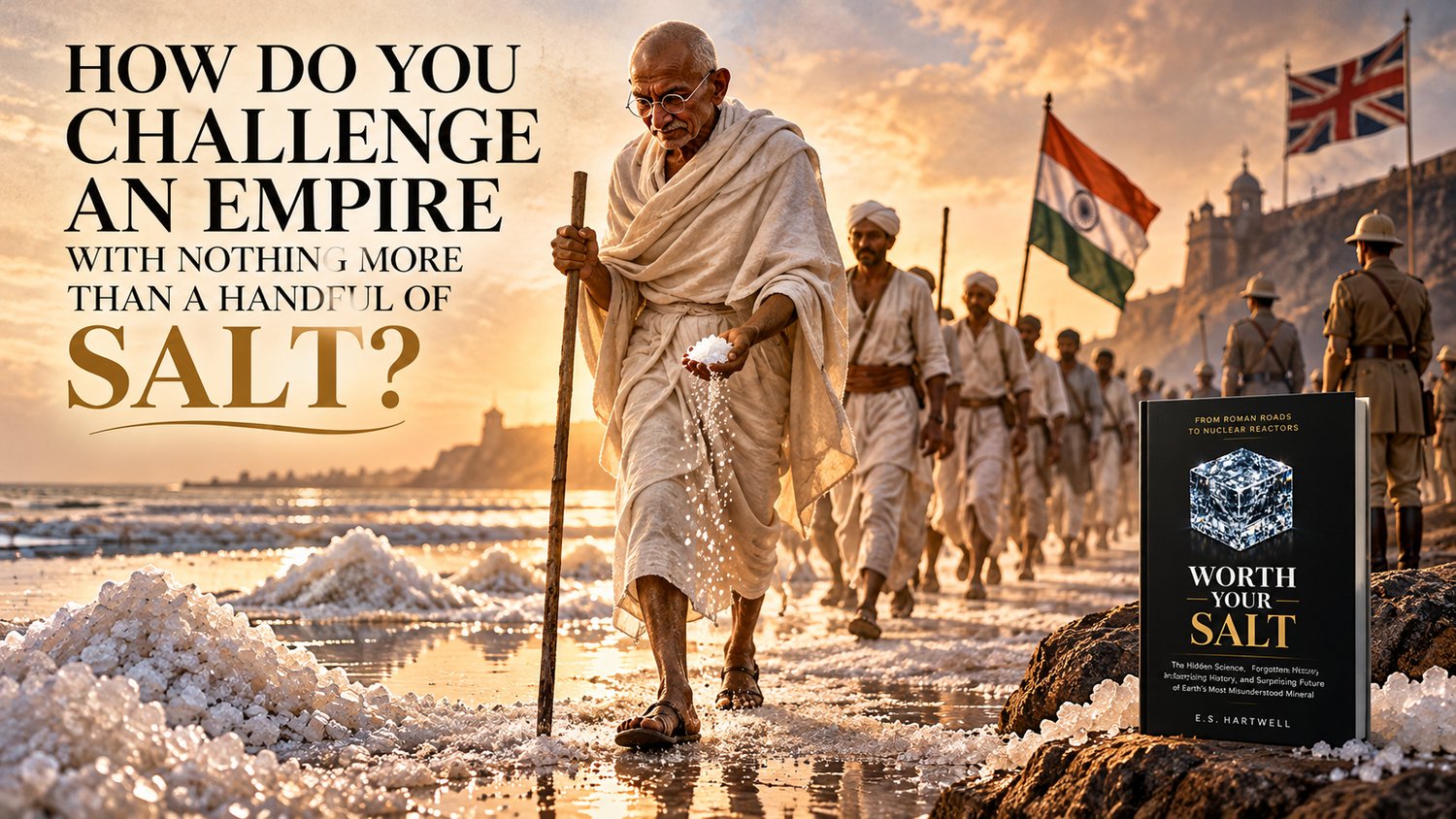
How do you challenge an empire with nothing more than a handful of salt?
In 1930, Mohandas Gandhi found an answer that the British authorities had profoundly underestimated. What followed became one of the most remarkable acts of nonviolent resistance in modern history.
At first glance, salt seemed an unlikely weapon.
It was ordinary, inexpensive, and found in every kitchen. Yet Gandhi understood something the British administration did not: salt was far more than a commodity. It was a symbol of colonial power reaching into the daily lives of millions of ordinary people.
The British salt monopoly prohibited Indians from freely producing or collecting their own salt, even along a coastline stretching thousands of kilometers. The tax fell on everyone, but its burden was felt most heavily by the poor. Wealthy and impoverished families alike needed salt to survive. That universality made it uniquely powerful as a political symbol.
Many of Gandhi's contemporaries were skeptical. Some believed there were more important grievances to confront. Others worried that a campaign centered on salt would look trivial.
Gandhi saw the situation differently.
He recognized that the most powerful acts of resistance are not always the largest or the most dramatic. Sometimes they are the simplest, especially when everyone can immediately understand why they matter.
On March 12, 1930, Gandhi left Sabarmati Ashram with seventy-eight followers and began a 387-kilometer march to the coastal village of Dandi. As the march progressed through towns and villages, crowds gathered, support grew, and what began as a symbolic protest evolved into a national movement.
Twenty-four days later, Gandhi reached the Arabian Sea.
He bent down and picked up a lump of natural salt from the shore.
The gesture lasted only seconds.
Its consequences lasted decades.
Across India, millions followed his example. People made salt, bought illegal salt, boycotted British goods, and joined acts of civil disobedience. Tens of thousands were arrested. Yet the movement continued to grow because its message was impossible to miss: no government should have the authority to control something so fundamental to human life.
The Salt March revealed a weakness shared by many empires throughout history. Force can compel obedience. It cannot guarantee moral authority.
When British authorities responded with arrests and repression, the world was watching. International newspapers carried reports and photographs that transformed what might have been a local protest into a global story. The image of unarmed people suffering punishment for collecting salt challenged the legitimacy of imperial rule more effectively than many political speeches ever could.
In the end, the march was never really about salt.
It was about dignity.
It was about the right of ordinary people to govern their own lives.
And it was about demonstrating that even the most powerful empire can be challenged when a simple act exposes an obvious injustice.
The history of salt is filled with stories of wealth, monopolies, trade routes, and political power. But few episodes illustrate its symbolic force more clearly than the Salt March. A substance that had long been taxed, controlled, and monopolized became an instrument of resistance and a catalyst for change.
Chapter 13 of Worth Your Salt explores this extraordinary story in full, showing how one of history's most influential political movements grew from the simplest imaginable act: a man bending down on a beach and picking up a handful of salt.
Because sometimes a revolution begins not with a weapon, but with a gesture.
Comments ()