
Monday starts with a reasonable plan. Then a client asks for an update, another sends revisions, and you remember the proposal you meant to finish on Friday.
By lunchtime, you’ve answered messages and moved between three projects. Your own priorities haven’t had much attention.
When several clients need you, planning from memory leaves too much room for missed commitments. A useful weekly review puts deadlines, outstanding decisions and available time in front of you before you choose your next task.
Here’s a weekly planning routine for freelancers, consultants and small service teams. Set aside 30 minutes as a starting budget. Allow longer if your records need updating. This is a review of active work, rather than a deadline for setting up a new workspace.
1. Review your client commitments first
Suggested time: 5 minutes
Open your active projects and check what each client is expecting over the next seven days. Look ahead to the following week for work requiring preparation now.
Name the deliverable, the due date and the current status. “Website project” is too broad. “Send homepage copy for review on Thursday” gives you a specific commitment to plan around.
Check your calendar alongside those commitments. Include meetings, personal appointments and time away from work. A plan built around five uninterrupted days won’t fit a week containing six client calls.
Before adding new tasks, make sure your existing promises are visible.
2. Check what’s waiting on someone else
Suggested time: 5 minutes
Review each upcoming deliverable for missing inputs. Are you waiting for feedback, source material, access or approval?
Record who needs to respond and when you need their answer. Add a specific follow-up action with a date.
For example, replace “Chase client” with “Ask for homepage copy approval by Tuesday afternoon.” Then assess what happens if the response arrives late. Does the delivery date need to change? Is there another part of the project you’re able to progress?
If a commitment is at risk, raise the issue early. Your weekly plan should include the conversation needed to resolve the delay.
3. Choose three outcomes for the week
Suggested time: 5 minutes
Start with three priority outcomes. Treat three as a useful limit for this exercise, then adjust for the size of your commitments.
An outcome describes progress you intend to complete. “Work on proposal” leaves the finish unclear. “Send the revised proposal by Wednesday” tells you what completion means.
Choose priorities by asking which deadlines are closest, which actions allow other work to proceed, and which commitments carry the greatest consequence if delayed.
Include business development or essential administration where needed. Client work deserves attention, and your own business needs scheduled time too.
Keep routine tasks on your list without giving every task equal priority.
4. Turn those outcomes into a workable schedule
Suggested time: 10 minutes
Break each priority into the next actions required. Estimate the time for each action and place the work around your existing commitments.
For a proposal, those actions might include checking the scope, confirming the price, writing the recommendation and reviewing the document before sending.
Leave some time unallocated for revisions and unexpected requests. If the week already looks full, decide what to defer, reduce or renegotiate before adding more work.
Here’s an illustrative example. You’re a freelance copywriter preparing website copy for Thursday, a proposal for Wednesday and a newsletter for Friday. The website copy requires client approval on Tuesday.
Your Monday plan includes the approval request and proposal preparation. Wednesday holds time for website revisions, with newsletter production scheduled around the remaining commitments. If approval is delayed, you flag the effect on Thursday’s delivery and revise the plan.
The plan now includes deadlines, dependencies and decisions, alongside the writing tasks.
5. Finish last week’s review
Suggested time: 5 minutes
Check unfinished work before carrying everything forward. Decide whether each item still belongs in your plan, needs a clearer next action, should be rescheduled or should be removed.
Notice repeated problems. If project setup keeps taking longer because you forget which information to request, document those steps for next time.
One short checklist is enough to begin. Add to your process when experience reveals a missing step.
Finish by choosing your first action for the next working day. “Review the scope before drafting the proposal” gives you a clear place to begin.
Put the routine into your Egarsio workspace
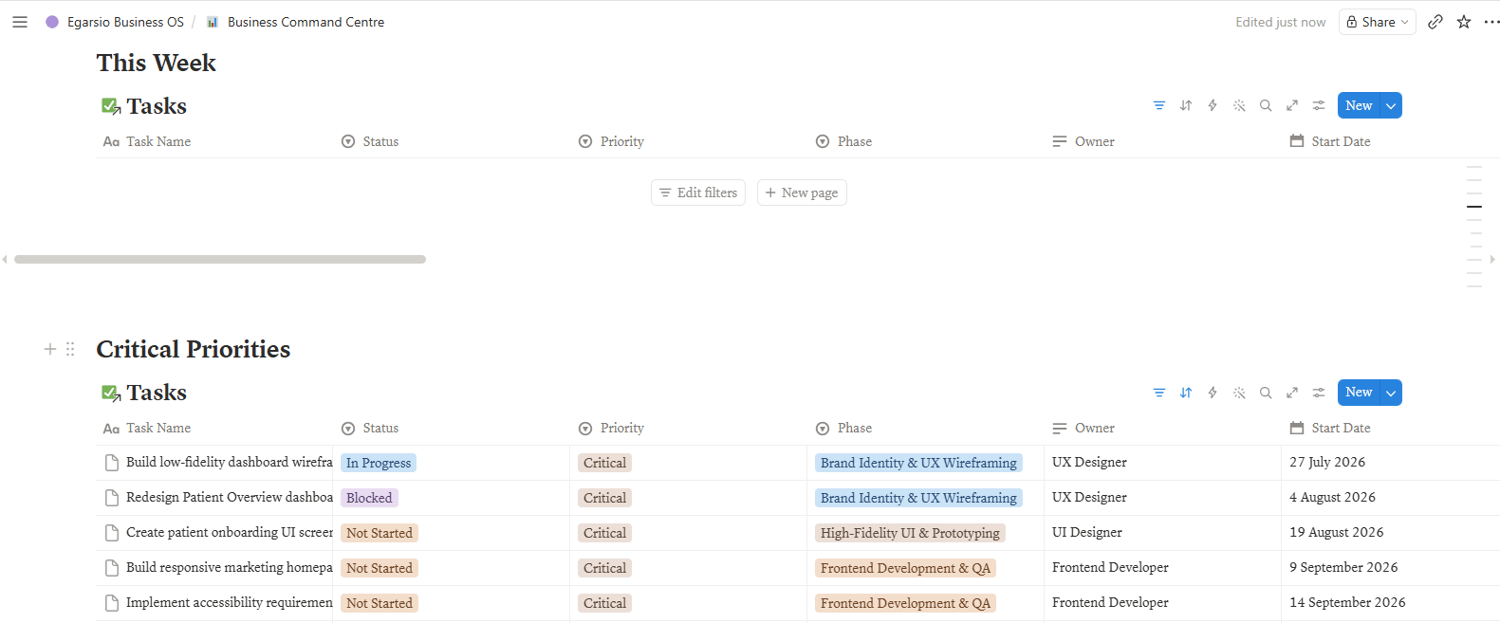
The Egarsio Business OS brings client information, projects, tasks, deliverables and weekly planning together in Notion. Use those connected records to review current commitments and choose the work for your week. The SOP Library provides a place to document recurring processes as you improve them.
Start with one active project. Add the client, record the deliverable and deadline, then identify the next tasks. Build your weekly plan from the work already entered. The included Quick Start guidance and FAQ support you as you learn the workspace.
Keep statuses and dates current during the week so your next review reflects what has changed.
If you want a ready-structured workspace for this routine, explore the Egarsio Business OS, Founding Edition.
Comments ()