
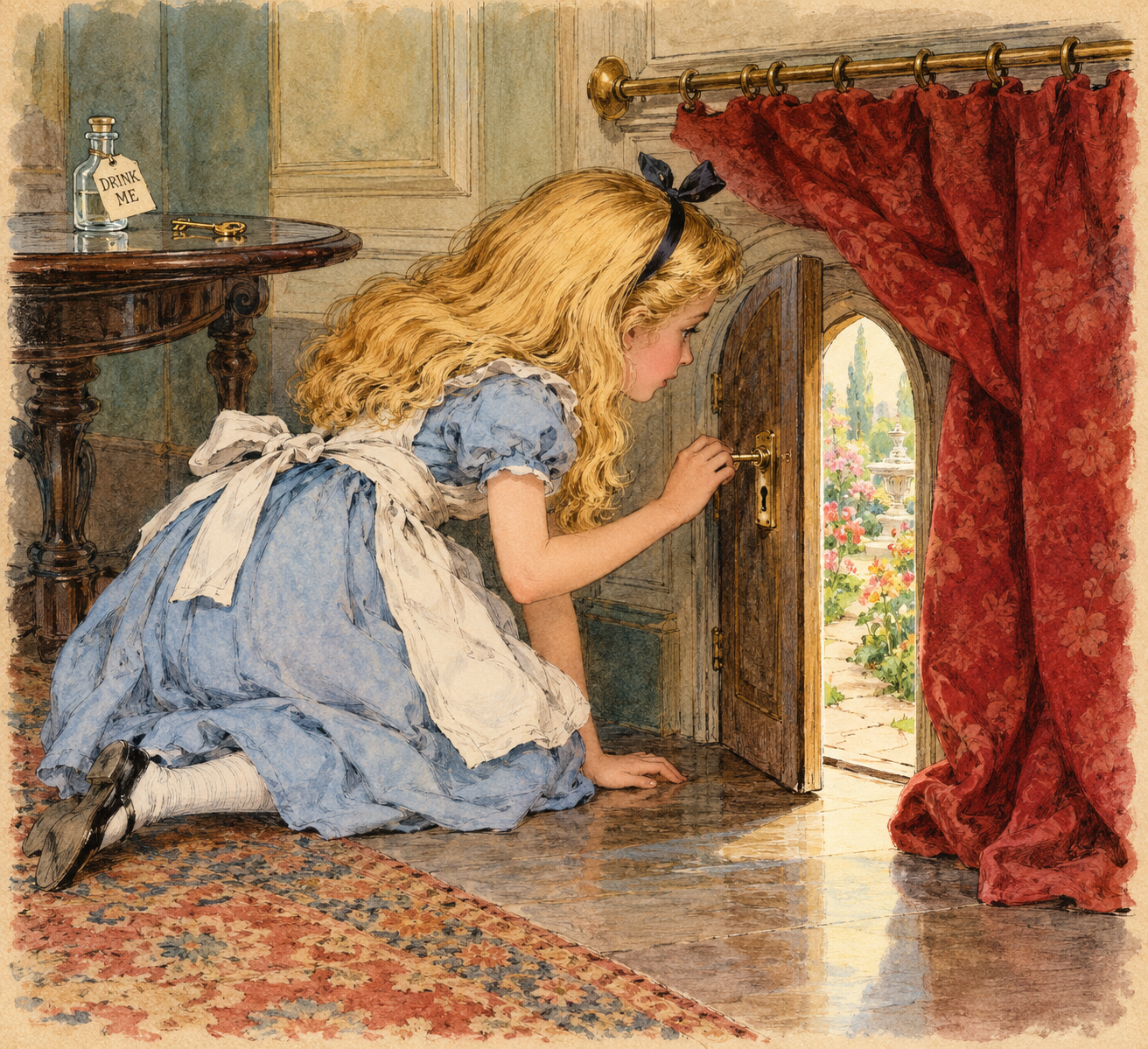
The Little Door
Doubt is one possible result of that interference. But the interference can begin long before you consciously doubt yourself.
Your reading of what is happening becomes disrupted, muddied, slowed or pulled off course. You may find yourself checking what you thought you understood, reinterpreting what happened, over-explaining, giving yet another benefit of the doubt, or searching for a kinder explanation.
Something that appeared quite simple becomes strangely difficult to assess.
Lewis Carroll gives us a rather lovely little door through which to look at this.
In Alice’s Adventures in Wonderland, Alice follows the White Rabbit and eventually finds herself in a long, low hall surrounded by locked doors. She tries them, but none will open.
Then she discovers a small glass table. On it is a tiny golden key.
At first, the key seems useless. It does not fit any of the doors she has already tried. But on going around the hall again, Alice notices something she missed before: a low curtain. Behind it is a tiny door, only about fifteen inches high.
This time, the golden key fits.
Alice opens the door.
Beyond it is a little passage leading to the most beautiful garden she can imagine, full of flowers and cool fountains. She desperately wants to enter it.
But there is a problem.
Alice is too big.
She has the right key.
She has successfully opened the right door.
She can even see exactly what lies on the other side.
And still she cannot pass through.
Later, after drinking from the little bottle marked DRINK ME, Alice becomes small enough to fit through the doorway. But now there is another problem: she has left the golden key on top of the glass table and, at her new size, cannot reach it.
Access in Wonderland turns out to be rather particular.
Having the key is not enough.
Opening the door is not enough.
Wanting to enter is not enough.
The conditions for entry still have to be met.
And perhaps there is something useful in that for us.
Contact Is Not Access
Someone can have a perfectly legitimate reason to contact you.
An arrangement may need changing. A practical question may need answering. Information may genuinely need to be passed between you.
The key may fit.
That does not mean the whole door has to be thrown open.
A legitimate reason for contact does not automatically restore a previous level of emotional or relational access.
This becomes particularly important when you have experienced manipulative relationships, because manipulation can interfere with your confidence in deciding where that boundary should sit.
A perfectly straightforward request can arrive surrounded by other material: explanations you did not ask for, justifications, personal disclosures, urgency, vulnerability, guilt, reassurance-seeking, self-presentation or reminders of the previous relationship.
Some of it may be entirely sincere.
You do not have to decide.
That is important.
You do not have to establish whether somebody’s explanation is genuine before deciding how much access to give them.
You do not have to work out their motive.
You do not have to determine whether their vulnerability is authentic.
You do not even have to decide whether you are being manipulated.
You can return to something much simpler:
What actually happened?
What is being requested?
Is there a legitimate reason for this contact?
What information or response is actually required from me?
Then the door can open exactly that far.
No further.
A practical request can receive a practical answer. A necessary arrangement can be made. Relevant information can be acknowledged.
And the door can close again.
Because the existence of a key does not confer unlimited access.
Alice discovered that more than 160 years ago.
Sometimes the key fits perfectly.
You still don’t have to let them all the way in.