
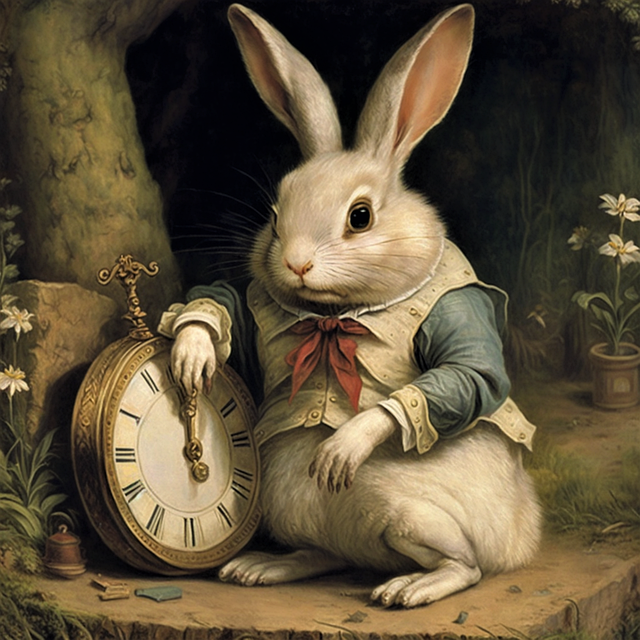
Following the White Rabbit
(5/6 minute read)
Alice did not intend to fall down a rabbit hole.
She saw something that caught her attention.
The White Rabbit was going somewhere. He was late. He had his own urgency.
And Alice followed him.
That is an interesting place to begin when we think about confusing, coercive or narcissistic relationships.
Because sometimes another person does something that immediately turns our attention towards them.
They criticise us.
They withdraw.
They become cold.
They suddenly become intensely affectionate.
They make an accusation.
They send a strange message.
They leave something unexplained.
Whatever the communication is, it becomes the White Rabbit.
Something has moved.
And now we are looking at it.
The Rabbit Keeps Moving
The important thing about the White Rabbit is that he does not stop and explain himself.
He does not turn around and tell Alice where he is going.
He simply keeps moving.
Alice has to decide whether to follow.
Something very similar can happen in difficult relationships.
A person withdraws.
We follow with:
What did I do?
They become angry.
We follow with:
How do I calm this down?
They criticise us.
We follow with:
How do I explain myself?
They change the subject.
We follow that too.
They alter what they previously said.
Now we are trying to reconcile the two versions.
The Rabbit moves.
We move.
The Rabbit moves again.
We move again.
And gradually, without necessarily noticing it, we begin relocating ourselves around somebody else’s behaviour.
Following With Your Attention
We do not have to physically chase anyone for this to happen.
We can follow them entirely in our heads.
Thinking.
Analysing.
Explaining.
Defending.
Reassuring.
Predicting.
Monitoring.
Trying to work out what they meant.
Trying to work out what they want.
Trying to work out what we should do next.
That is still following.
And often the more confusing the interaction becomes, the harder we try to catch up.
We assume that somewhere ahead there must be a point where everything will finally make sense.
If I can just understand what happened.
If I can explain it properly.
If I can find the right words.
If I can reassure them enough.
If I can work out what they want.
Then perhaps the whole thing will settle.
So we keep following the Rabbit.
Down the Rabbit Hole
At some point, following turns into work.
Someone stops speaking to you.
That may be all that has actually happened.
But once you begin following, the questions multiply.
Why are they quiet?
Are they angry?
Did I say something?
Was it yesterday?
Should I ask?
Should I wait?
Should I apologise?
Should I explain?
Should I give them space?
Should I check again?
One action has produced an enormous amount of work.
The Rabbit has gone down the hole.
And you have followed.
This is where something important happens.
The person who has supplied the least information can end up creating the most work for somebody else.
Every Chamber Creates Another One
Alice repeatedly arrives somewhere that looks as though it might provide an answer.
A room.
A doorway.
A conversation.
A clue.
But instead of reaching certainty, she encounters another puzzle.
That can happen in difficult relationships too.
You explain what you meant.
Now the problem is your tone.
You explain your tone.
Now the problem is that you are being defensive.
You stop defending yourself.
Now you are accused of not caring.
You reassure them.
Now they want proof.
You provide proof.
Now the question has changed.
Every time you think you have caught up with the Rabbit, he is somewhere else.
The subject may have changed.
The standard may have changed.
The expectation may have changed.
The emotional temperature may have changed.
So you move again.
This is why these interactions can become exhausting.
You are not simply dealing with one problem.
You are repeatedly reorganising yourself around movement.
The Moving Target
This is where the White Rabbit becomes very different from a healthy boundary.
A healthy boundary is more like a fence.
It stays where it is.
You can see where the line is.
You may like it or dislike it, but you can orient yourself around it.
A moving target is different.
You adjust yourself to one position and then discover that the position has changed.
You try harder.
You explain more carefully.
You become more accommodating.
You monitor more closely.
You learn to anticipate.
You begin scanning for movement.
Where is the Rabbit now?
What does he want now?
What am I supposed to do now?
The Rabbit does not have to physically drag Alice anywhere.
Her attention does the travelling.
The Blank Space
Sometimes the Rabbit is very obvious.
A criticism.
An accusation.
A demand.
Sometimes it is almost nothing.
A silence.
A change in tone.
Two question marks.
??
There is very little information there.
But the mind does not like a blank space.
So we begin filling it.
Perhaps they are angry.
Perhaps they want an answer.
Perhaps I have upset them.
Perhaps I should explain.
Perhaps I need to reassure them.
Now something interesting has happened.
The other person supplied the blank.
We supplied the meaning.
And the meaning supplied the task.
That is how a tiny communication can create a huge amount of work.
Not because the communication contained all that information.
Because we followed it.
Plausible Does Not Mean True
The difficulty is that the meaning we supply often sounds perfectly reasonable.
Maybe they are upset.
Maybe they do want reassurance.
Maybe we did say something they disliked.
But there is a difference between:
This is a possible explanation
and:
This is what I have actually been told.
Alice keeps following because she assumes the Rabbit must be leading somewhere.
We do something similar when we assume incomplete communication must contain a task for us.
But perhaps it does not.
Perhaps the silence can remain unexplained.
Perhaps the strange message can remain strange.
Perhaps the other person can be responsible for saying what they mean.
The Rabbit can keep moving.
Where Did the Work Go?
This gives us a very useful question.
Instead of asking only:
What are they doing?
Ask:
What am I now doing because of it?
Where did my attention go?
Where did my thinking go?
Where did my energy go?
What am I trying to fix?
What am I trying to understand?
What am I trying to prevent?
What am I carrying that I was not carrying before?
Then follow the workload.
Because often that tells us more than trying to guess another person’s intention.
We may never know exactly why they behaved as they did.
But we can see what happened to us afterwards.
The Rabbit moved.
And we started running.
Losing Your Bearings
The longer Alice remains in Wonderland, the harder it becomes to orient herself.
The rules keep changing.
Logic becomes slippery.
Ordinary expectations stop working.
And that can happen in relationships too.
At first we ask:
What actually happened?
Later we may find ourselves asking:
What do I need to do now?
That is a very important shift.
We have stopped looking at the original event and started organising ourselves around the other person’s movement.
Their mood.
Their reaction.
Their silence.
Their expectations.
Their next move.
We are no longer standing where we began.
We are somewhere down the rabbit hole.
The Way Out
The obvious temptation is to think that the way out is to finally catch the Rabbit.
To get the explanation.
To make the other person understand.
To resolve the uncertainty.
To say the perfect thing.
To reach the point where the whole strange journey finally makes sense.
But what if that is not the way out?
What if the way out begins when we stop following?
Before explaining.
Before defending.
Before reassuring.
Before chasing.
Before supplying missing information.
Before trying to solve somebody else’s silence.
We can ask:
What actually happened?
What was actually communicated?
What have I added?
What am I now being pulled into doing?
Where is the workload going?
Is that work actually mine?
And then perhaps the most important question:
Do I have to follow this?
The White Rabbit can keep running.
He can disappear around another corner.
He can be late for whatever he is late for.
We do not have to reorganise ourselves around his movement.
Sometimes the way out of the rabbit hole is not discovering where the Rabbit was going.
It is noticing that we are still following him.
And stopping.