
(3 minute read)
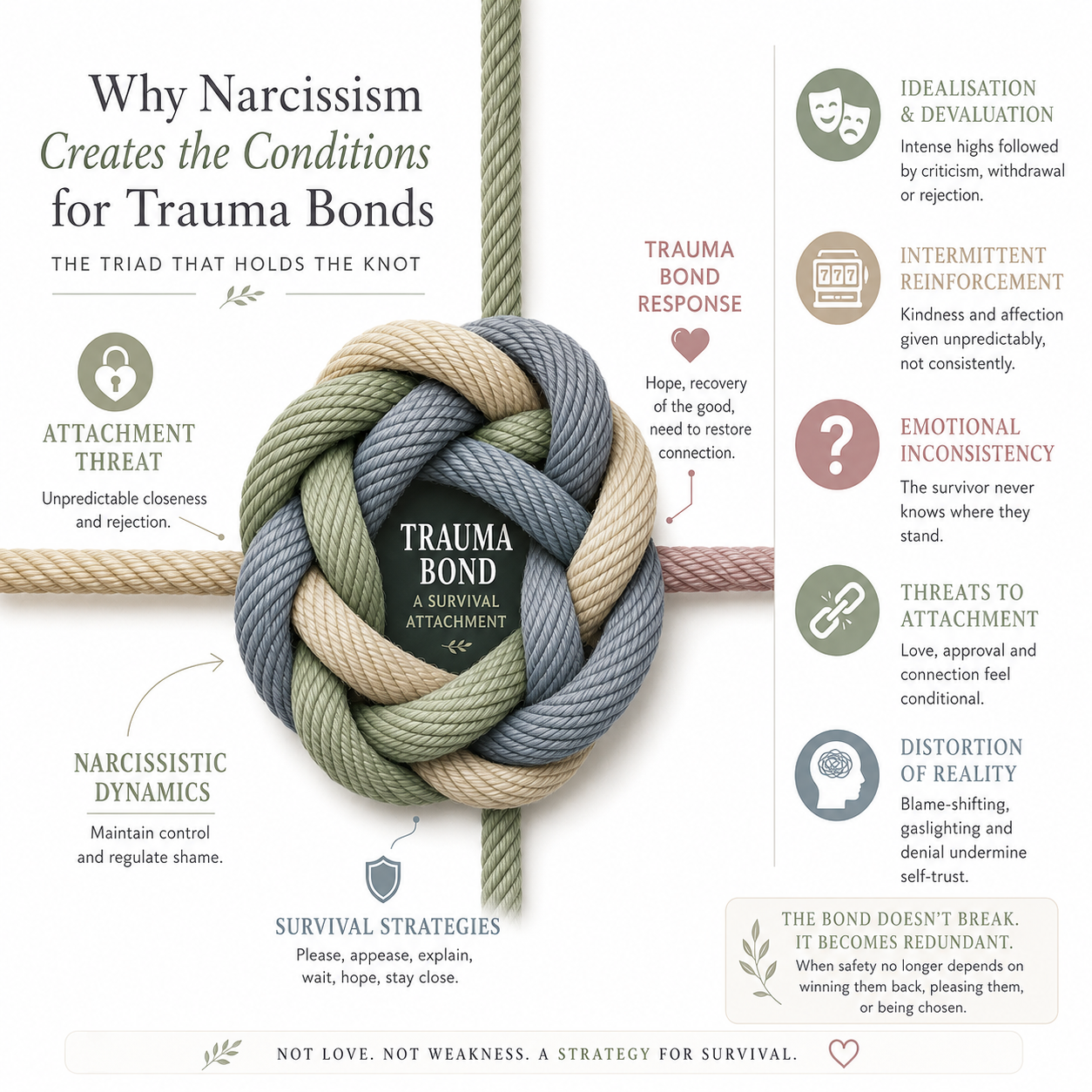
A trauma bond is not the same as love.
It may feel like love. It may feel urgent, consuming, painful, hopeful, addictive, and impossible to explain.
But underneath, a trauma bond is often a survival attachment.
I
In narcissistic relationships, the bond can form when warmth and harm become mixed together.
There may be affection, attention, charm, humour, intensity, or promises of change. Then there may be criticism, withdrawal, blame, confusion, silence, rage, or emotional abandonment.
The nervous system does not simply record the bad.
It also records the relief.
The apology.
The return.
The soft voice.
The message after silence.
The moment they seem to understand.
The tiny glimpse of the person you hoped they were.
This is part of why the bond becomes so powerful.
The body begins to attach not only to the person, but to the cycle itself.
Distress rises.
Relief follows.
Hope returns.
Then the pattern repeats.
Over time, the nervous system can begin to mistake relief for safety.
This is especially powerful when the roots are old.
Many trauma bonds do not begin in adult life. They often connect with earlier attachment patterns, sometimes formed before language. Before we could explain what was happening, the body was already learning how to stay close, stay alert, please, explain, wait, hope, and survive.
That is why knowledge alone does not always free someone immediately.
A person may understand the relationship is harmful and still feel pulled back.
They may know the pattern and still miss the person.
They may feel angry, grieving, ashamed, relieved, and desperate all at once.
This is not weakness.
It is conditioning.
It is the body trying to return to a familiar survival state.
Narcissistic dynamics strengthen this bond because they often disturb reality itself.
The person may be blamed for reacting to harm.
They may be told they are too sensitive, too demanding, too difficult, too emotional, or never satisfied.
The argument becomes less about what happened and more about whether the person is allowed to trust their own perception.
That confusion deepens the bond.
The survivor keeps trying to explain.
Trying to be understood.
Trying to find the good version again.
Trying to get back to the moment before everything changed.
But the bond does not usually break in one clean moment.
It becomes redundant.
Slowly, the nervous system learns that safety does not depend on winning them back, calming them down, pleasing them, or being chosen.
The person begins to notice the pattern rather than chase the relief.
They stop mistaking intensity for intimacy.
They stop confusing intermittent kindness with safety.
They begin to return to themselves.
The trauma bond loosens when survival no longer needs that particular strategy.
Not because the person was foolish.
Not because they failed to see clearly.
But because the body finally has enough safety, distance, support, and reality to stop reaching for what once felt necessary.
That is the link between narcissism and the trauma bond.
Narcissistic relationships can create the cycle.
The trauma bond keeps the person tied to it.
Healing begins when the cycle is seen clearly - and the body slowly learns it no longer has to live there.