
(3 minute read)
The internet likes certainty.
It likes neat explanations, clear villains, and tidy endings.
Spend enough time online and you might begin to believe that certain kinds of people are entirely one thing or entirely another. The narcissist becomes all bad. The empath becomes all good. Every behaviour has a hidden motive. Every action fits a formula.
Real life rarely works like that.
Over the years I have known people who were difficult, self-centred, manipulative, dramatic, tactless, controlling, or exhausting to be around.
They were not always easy company.
Some required strong boundaries. Some required distance. Some required both.
And yet, if I am honest, many of them also possessed qualities that are hard to dismiss.
Some were funny.
Some were intelligent.
Some were perceptive in ways that surprised me.
Some could see through pretence with remarkable accuracy.
Some offered insights that stayed with me long after the conversation ended.
The problem was never that there was nothing there.
The problem was that the good qualities did not cancel out the difficult ones.
This is where many thoughtful people become stuck.
They encounter something valuable in the other person and think:
“There you are.”
They find the humour beneath the bluster. The intelligence beneath the arrogance. The vulnerability beneath the bravado.
And because that part is real, they begin to hope the rest of the relationship can be built around it.
Unfortunately, people are not usually organised that neatly.
The insight may be genuine.
The humour may be genuine.
The warmth may be genuine.
The manipulation may also be genuine.
So may the unreliability, the self-interest, the volatility, or the need to dominate.
Human beings are rarely one thing.
They are often contradictory.
Perhaps this is why labels sometimes become limiting. A label may describe a pattern, but it can never fully capture a person.
Understanding the pattern is important.
Protecting yourself is important.
Maintaining boundaries is important.
But reducing somebody to a diagnosis, a category, or an internet stereotype can leave us blind to the complexity that exists alongside it.
I have known people who became gentler with age.
I have known people who became more difficult.
I have known people who remained gloriously themselves right to the end.
What strikes me now is that age often amplifies what was already there.
The funny become funnier.
The grumpy become grumpier.
The dramatic become more dramatic.
The tactless become spectacularly tactless.
Personality often grows louder rather than simpler.
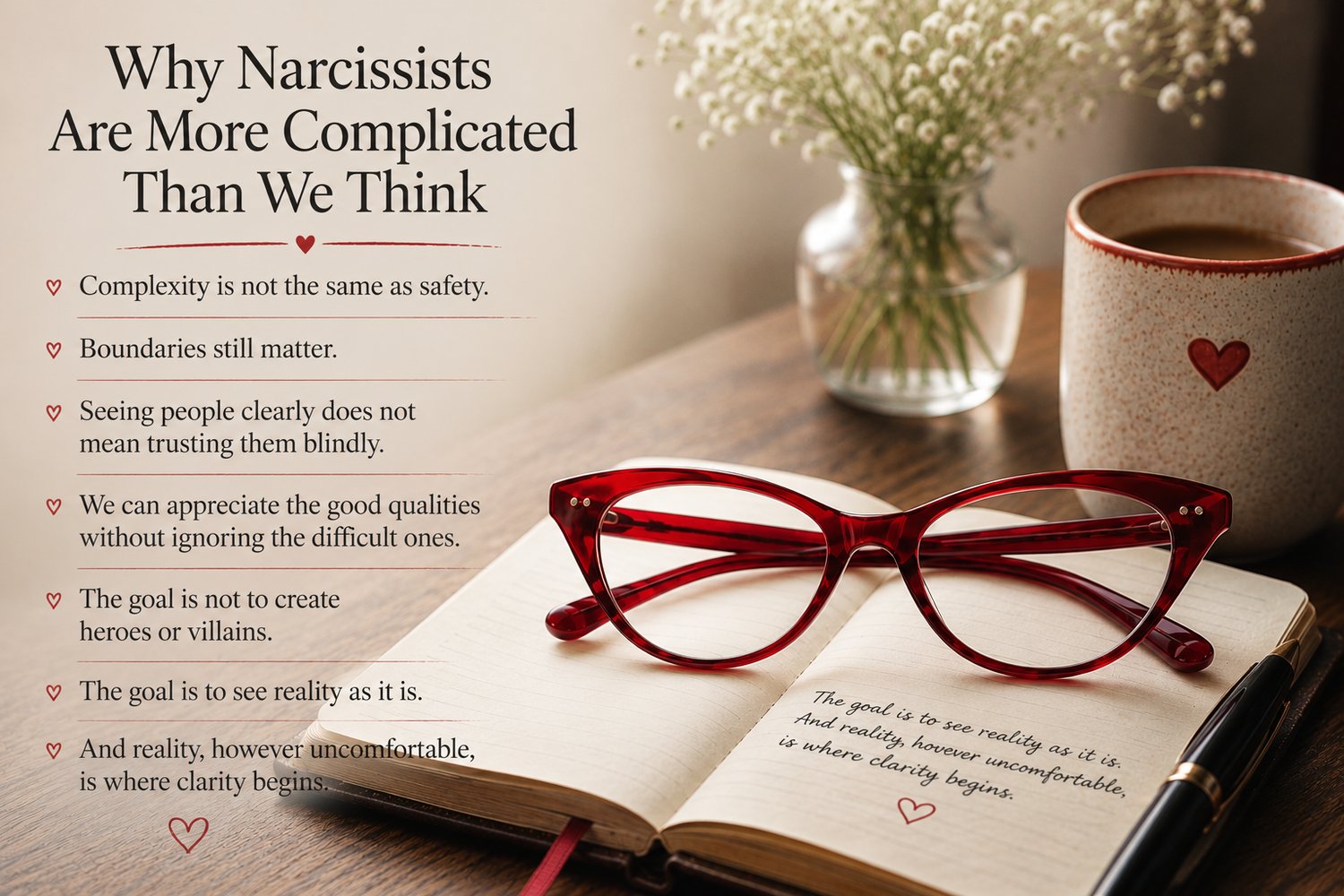
Perhaps the greatest freedom comes when we stop trying to decide whether a person is entirely good or entirely bad.
Instead, we can ask:
“Who is this person, really?”
Not who I hope they are.
Not who I fear they are.
Not who the internet says they are.
But who they actually are.
Sometimes the answer is uncomfortable.
Sometimes it is surprisingly compassionate.
Often it is both.
And that may be closer to the truth than any cartoon could ever be.