

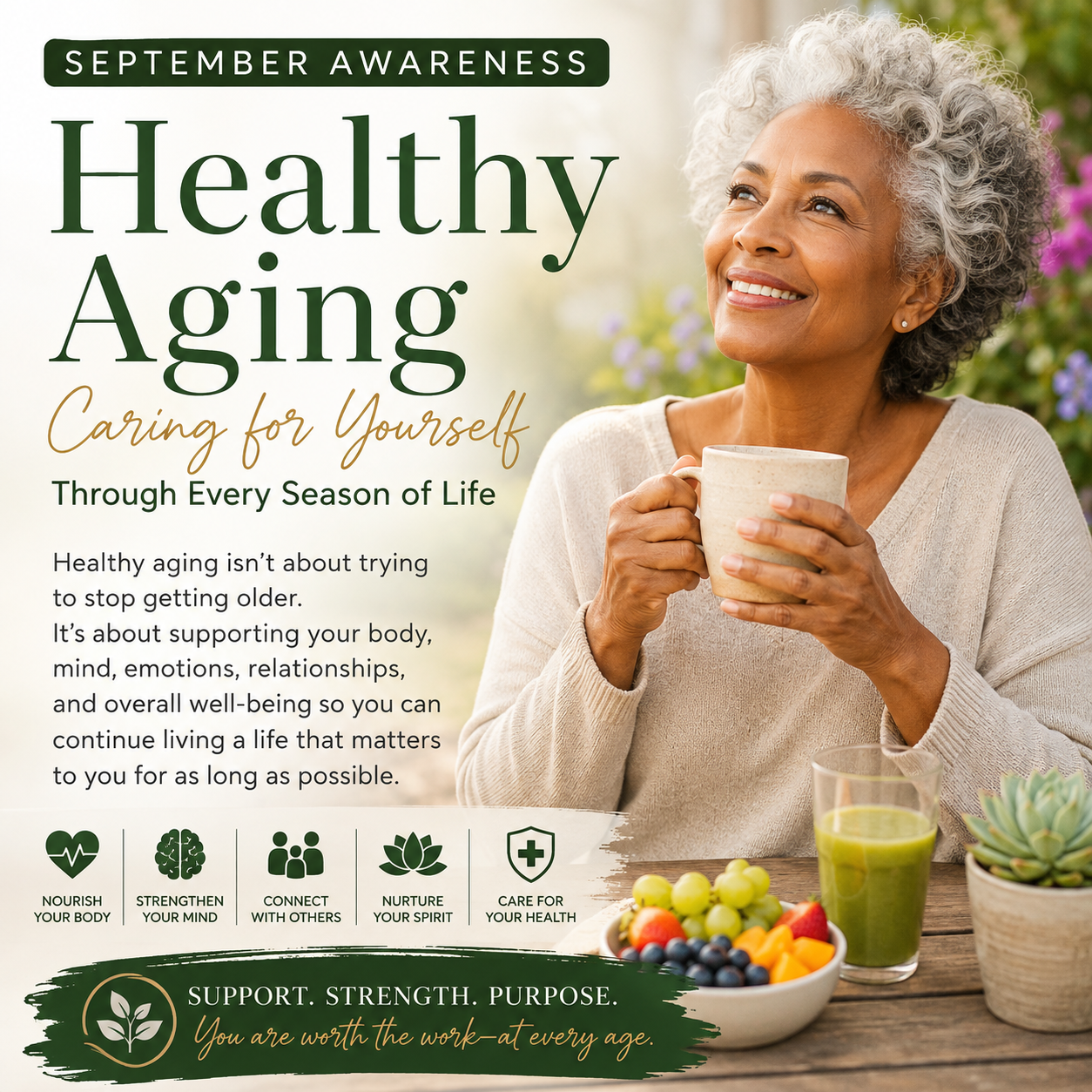
September is Healthy Aging Month, and this week we're bringing awareness to something that eventually touches every one of us—aging.
But healthy aging isn't about trying to stop ourselves from getting older.
It's about learning how to care for our bodies, minds, emotions, relationships, and overall well-being as our needs change.
We hear so much about anti-aging—how to look younger, hide the signs of aging, or somehow turn back the clock.
But what if we changed the conversation?
Instead of asking:
"How do I keep from getting older?"
Maybe we should be asking:
"How can I take better care of myself as I grow older?"
Because getting older isn't the problem.
The goal is to continue creating a life we can participate in, enjoy, and find meaning in for as long as possible.
What Does Healthy Aging Really Mean?
Healthy aging is about much more than eating vegetables and exercising.
The World Health Organization describes healthy aging in terms of maintaining the abilities that allow us to experience well-being as we grow older.
In everyday life, that can mean being able to prepare your meals, spend time with people you love, participate in your community, travel, garden, work, learn, make your own decisions, or simply move through your day with as much independence as possible.
And healthy aging doesn't mean living without health challenges.
People can live meaningful, fulfilling lives while managing chronic conditions, physical limitations, and changes that come with age.
Healthy aging is about supporting the whole person within the reality of where they are.
Nourish and Hydrate the Body You Have Today
Our bodies change as we age, and sometimes our care needs to change with them.
A balanced eating pattern with vegetables, fruits, whole grains, healthy fats, and quality protein sources can help provide the nutrients our bodies need.
Protein becomes especially important as we get older because, along with physical activity, it helps support muscle.
Fiber matters for digestive health.
And hydration deserves attention too. Our sense of thirst can change with age, making it easier for some people to unintentionally drink too little.
Rather than chasing a perfect diet, ask:
What can I add that will nourish me?
More vegetables?
More water?
Enough protein?
More whole foods?
A nourishing meal instead of skipping one?
For those who enjoy fresh juicing, a vegetable-forward juice can also add fluids and nutrients to an overall balanced eating pattern.
Juice isn't a replacement for whole fruits and vegetables, fiber, protein, healthy fats, or balanced meals.
Think of it as an addition, not the entire answer.
Healthy aging isn't about extremes. It's about creating supportive habits you can actually maintain.
Keep Moving, Building Strength, and Protecting Your Balance
Movement becomes increasingly important as we age.
Muscle mass and strength can gradually decline. Bones can become less dense. Balance and flexibility can change.
Regular physical activity can support strength, mobility, balance, cardiovascular health, and your ability to keep doing everyday activities.
And you don't have to live in a gym.
Depending on your health and abilities, movement might look like walking, swimming, dancing, gardening, stretching, chair exercises, strength training, or balance activities.
Strength deserves special attention because it helps us continue doing ordinary things we sometimes take for granted—getting out of a chair, carrying groceries, climbing stairs, and moving around independently.
Fall prevention matters too. Vision care, appropriate footwear, medication reviews when needed, good lighting, clear walkways, and making our homes safer can all become part of caring for ourselves.
The goal isn't to move as you did 30 years ago.
It's to keep moving in ways that work for the body you have today.
Pay Attention to the Health You Can't Always Feel
Healthy aging also means staying involved in your healthcare.
Blood pressure, blood sugar, cholesterol, heart health, bone health, vision, hearing, dental health, and other areas deserve attention even when we're feeling okay.
Keep up with appropriate checkups and recommended screenings.
Know the health numbers your healthcare team wants you to follow.
Keep an updated list of medications, supplements, and over-the-counter products you use.
And don't automatically assume every new symptom is "just getting older."
If something changes or concerns you, talk with an appropriate healthcare professional.
Preventive care isn't about living in fear of what could go wrong.
It's about giving yourself the opportunity to address concerns and make informed decisions about your health.
Your Brain and Your Rest Matter Too
Healthy aging includes brain health.
Keep using your mind.
Read.
Write.
Learn something new.
Take a class.
Try a hobby.
Create.
Have conversations.
Learn the technology you've been avoiding.
Stay curious.
Our brains also benefit from many of the same things that support the rest of us—movement, sleep, social connection, and attention to our overall health.
And while some changes can occur as we age, significant changes in memory, thinking, behavior, or the ability to manage everyday activities shouldn't automatically be dismissed as normal aging.
Sleep matters too.
Sleep patterns may change over time, but rest continues to support our overall well-being.
A calming evening routine, consistent sleep schedule, and addressing ongoing sleep problems with a healthcare professional when needed can all be part of healthy aging.
Rest isn't something you have to earn.
It's part of caring for yourself.
Take Care of Your Emotional and Spiritual Well-Being
By the time we reach later seasons of life, we've lived through some things.
Joy.
Loss.
Love.
Grief.
Accomplishments.
Regrets.
New beginnings.
Endings we didn't choose.
Growing older can bring retirement, caregiving, changing family roles, health concerns, financial changes, or the loss of people we love.
Those experiences affect us emotionally too.
Healthy aging means making room for that part of ourselves.
That might look like journaling, prayer, meditation, spending time in nature, talking with someone you trust, setting boundaries, managing stress, practicing gratitude, or getting professional support when you need it.
You don't stop needing emotional support because you've reached a certain birthday.
And you certainly don't stop growing.
Stay Connected and Keep Your Sense of Purpose
This may be one of the most overlooked parts of healthy aging.
People need people.
As life changes, our social circles can change too.
Children grow up.
People retire.
Friends move.
Loved ones pass away.
Without realizing it, someone's world can become smaller.
Staying connected matters.
Call someone.
Join a group.
Volunteer.
Take a class.
Spend time with family or friends.
Find people who share your interests.
And if you notice someone becoming isolated, reach toward them too.
Sometimes wellness looks like nutritious food and movement.
Sometimes it looks like sitting across from someone with a cup of tea and knowing you're not alone.
And along with connection comes purpose.
Retiring from a job doesn't mean retiring from life.
Children becoming independent doesn't mean you're no longer needed.
Physical changes don't erase everything you have to contribute.
You can learn.
Teach.
Mentor.
Create.
Serve.
Travel.
Volunteer.
Start something new.
Share your wisdom.
Love people.
Dream again.
Purpose doesn't have an expiration date.
Independence Doesn't Mean Doing Everything Alone
Most of us want to maintain our independence as we age.
But independence doesn't mean refusing help.
Sometimes accepting the right support is exactly what helps us remain independent.
That could mean using a mobility aid, installing a grab bar, getting help around the house, using hearing aids, asking someone to help organize medications, changing driving habits, or creating an emergency plan.
There is no shame in adapting.
Healthy aging isn't about proving you can still do everything the way you always did.
It's about finding ways to continue living safely, meaningfully, and as fully as possible.
Where You Are
After reading all of this, you might be thinking:
"Where do I even begin?"
Right where you are.
You don't have to change everything.
Maybe you haven't exercised in years.
Start with movement that's appropriate for you.
Maybe your eating habits aren't where you'd like them to be.
Improve one meal.
Maybe you're not drinking enough.
Fill your water bottle.
Maybe you've been putting everyone else's needs ahead of your own.
Give yourself some time today.
Maybe you've become disconnected.
Make one phone call.
Maybe you've been avoiding an appointment.
Schedule it.
Maybe you stopped dreaming because you thought that season of your life was over.
Dream again.
Consistency matters more than trying to do everything perfectly.
Your Healthy Aging Check-In
Take a moment and ask yourself:
Nourishment & Hydration: Am I consistently giving my body what it needs?
Movement & Strength: Am I moving in ways that support my abilities, strength, and balance?
Preventive Care: Am I keeping up with the healthcare and screenings recommended for me?
Brain & Rest: Am I staying mentally engaged and giving myself adequate opportunity to rest?
Emotional & Spiritual Wellness: Am I caring for what's happening inside me, not just what's happening physically?
Connection: Do I have meaningful relationships and regular interaction with other people?
Purpose & Joy: What am I looking forward to?
Independence & Safety: Is there support or a simple change that could make everyday life safer or easier?
You don't need perfect answers.
Choose one area that needs more attention.
Then choose one realistic action you can take.
That's enough to begin.
One Final Thought
There is something beautiful about reaching another season of life.
You know things you didn't know before.
You've survived things you once wondered if you could survive.
You've changed.
You've learned.
And you're still becoming.
Don't spend so much time wishing for the person you were that you forget to care for the person standing here today.
Nourish yourself.
Move in ways that work for your body.
Rest.
Stay connected.
Keep learning.
Protect your peace.
Ask for help when you need it.
Find things that make you laugh.
Keep discovering what gives your life meaning.
And don't decide that your best opportunities for growth are behind you.
Healthy aging isn't about chasing youth. It's about caring for yourself well enough to keep living your life.
This Week's Reflection
Instead of only asking:
"What do I want my health to look like as I get older?"
Ask yourself:
"What do I want my LIFE to feel like?"
Then ask:
"What is one choice I can make today to support that future?"
Start there.
One choice. One day at a time.
You are worth the work—at every age and in every season of life.
If you're ready to take better care of yourself but you're overwhelmed by where to begin, you don't have to change everything at once.
That's exactly why I believe in starting simple.
Begin here with Exploring New Blessings, and let's identify your first realistic steps together.
You don't need to do it perfectly.
You just need to begin.
Exploring New Blessings
Discover the blessing inside you.
Wellness Disclaimer
The information shared in this blog is for educational and informational purposes only and is not intended to diagnose, treat, cure, or prevent any disease or medical condition.
Always consult your physician or another qualified healthcare provider before making changes to your diet, exercise routine, supplements, medications, or healthcare plan.
Wellness coaching through Exploring New Blessings is designed to support healthy lifestyle habits and complement—not replace—the care of your licensed healthcare providers.