

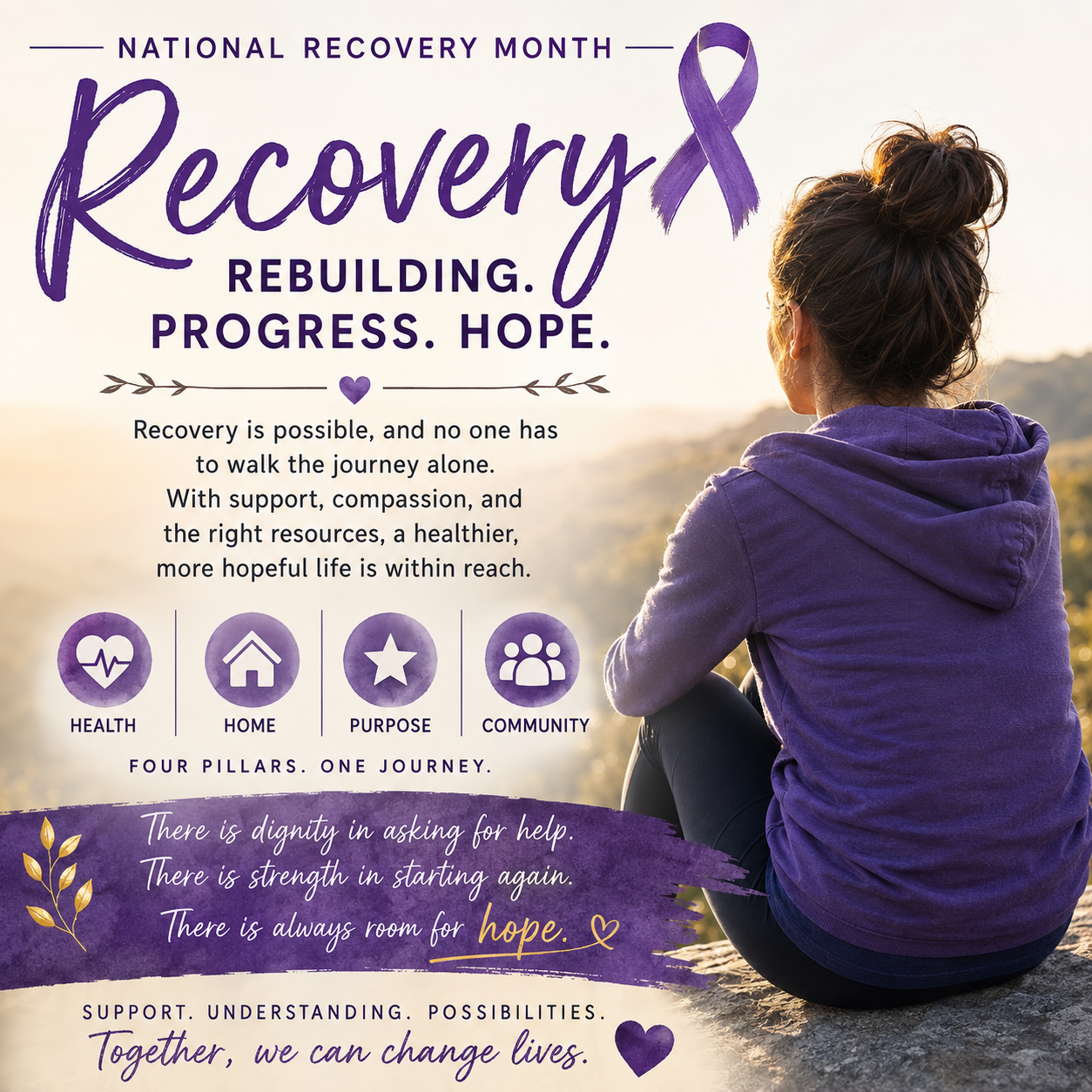
September is National Recovery Month, a time to celebrate people in recovery, recognize the people who support them, increase understanding of mental health and substance-use recovery, and remind people that recovery is possible.
But recovery isn't simply about stopping a behavior or reaching a finish line.
For many people, recovery is about rebuilding.
Rebuilding health.
Rebuilding relationships.
Rebuilding trust.
Rebuilding stability.
Rebuilding confidence.
And sometimes rebuilding an entire life.
That process takes courage, support, patience, and something we should never underestimate:
Hope.
What Does Recovery Really Mean?
When many people hear the word recovery, they immediately think about alcohol or drugs.
Substance-use recovery is an important part of National Recovery Month, but the observance also recognizes people recovering from mental health challenges.
Recovery is personal.
For one person, it may involve professional treatment or counseling.
For another, medication may be part of their care.
Someone else may find additional support through peer recovery programs, community organizations, family, faith, support groups, or a combination of resources.
There isn't one pathway that works for everyone.
And recovery isn't only about what someone stops doing.
It's also about what they're building.
Healthier coping skills.
Stable routines.
Relationships.
Self-respect.
A safe environment.
Purpose.
Community.
A future they can believe in again.
Recovery Supports the Whole Person
One helpful way to understand recovery is through four areas recognized by the Substance Abuse and
Mental Health Services Administration (SAMHSA):
Health. Home. Purpose. Community.
Health
Recovery includes making choices that support physical and emotional well-being and getting appropriate care for mental health or substance-use conditions.
Home
Having a stable and safe place to live can make a tremendous difference. It's hard to concentrate on healing and rebuilding when basic safety and stability aren't there.
Purpose
People need something that gives their lives meaning.
That may come through work, education, family, volunteering, creativity, faith, helping others, or personal goals.
Recovery isn't only about getting through today.
Eventually, it can also become about asking:
What do I want my life to become?
Community
People need connection.
Family, friends, treatment professionals, recovery organizations, support groups, faith communities, and peers with lived experience can all become part of someone's support system.
Sometimes knowing "I'm not doing this alone" can make an enormous difference.
Recovery Isn't Always a Straight Line
This is something we need to talk about openly.
Recovery can include tremendous progress—and difficult days.
There may be breakthroughs.
There may be setbacks.
There may be times when someone feels strong and other times when they need additional support.
A setback doesn't erase every step that came before it.
It can be a signal that something needs attention.
What happened?
What support is missing?
Does the treatment plan need to change?
Are old triggers resurfacing?
Does the person need to reconnect with professional or peer support?
Recovery isn't about never struggling again.
It's about continuing to find ways forward.
Progress still counts, even when it isn't perfect.
We Need to Talk About Stigma
Imagine working hard to rebuild your life while constantly being defined by the hardest chapter you've ever lived.
That's what stigma can feel like.
Words matter.
The way we talk about mental health and substance use matters.
A person is not their diagnosis.
A person is not their addiction.
A person is not their relapse.
A person is not the worst decision they have ever made.
We can acknowledge responsibility, consequences, and the need for change without taking away someone's humanity.
And we should never make someone feel ashamed for seeking appropriate help.
Counseling, medical care, medication when appropriate, treatment programs, recovery services, and peer support can all be legitimate parts of someone's recovery journey.
Asking for help isn't weakness.
Sometimes it's one of the strongest decisions a person makes.
The Power of Support
Recovery may be personal, but it doesn't have to happen alone.
Peer support can be especially meaningful because there's something powerful about hearing:
"I've been there. I understand. And recovery is possible."
Support from family and friends matters too.
But many of us don't know what to say when someone we love is struggling.
You don't have to have all the answers.
Sometimes support starts with listening.
Ask:
"How can I support you?"
"What do you need from me right now?"
"Would you like help finding someone to talk to?"
Celebrate progress.
Avoid shaming language.
Encourage appropriate professional help.
Learn about recovery from reliable sources.
And continue treating the person with dignity.
At the same time, supporting someone doesn't mean accepting harmful behavior, removing every consequence, or sacrificing your own well-being.
Healthy support can include boundaries.
Family members and caregivers may need support too.
You can love someone deeply and still recognize that you cannot do their recovery for them.
Caring for the Whole Person During Recovery
Recovery can require tremendous physical and emotional energy.
That's why everyday wellness habits can support appropriate treatment.
Regular meals.
Hydration.
Movement when appropriate.
Rest.
Healthy routines.
Time outdoors.
Journaling.
Mindfulness.
Prayer or spiritual practices for those who find strength there.
Connection.
Learning healthier ways to cope with stress.
These things don't replace mental health or substance-use treatment when treatment is needed.
But caring for the body, mind, and spirit can be part of caring for the whole person.
And this is another place where perfection isn't required.
Sometimes the next healthy step is simply:
Eat something nourishing.
Drink some water.
Attend the appointment.
Go to the meeting.
Call the person who supports you.
Take the medication prescribed to you.
Get some rest.
Ask for help.
Then take the next step.
Mental Health Recovery Deserves Compassion Too
Recovery isn't always visible.
Someone may be working through depression, anxiety, trauma, or another mental health condition while appearing perfectly fine from the outside.
They may be learning coping skills.
Working with a therapist.
Taking medication.
Creating boundaries.
Learning their triggers.
Rebuilding routines.
Trying to reconnect with people.
Learning how to ask for help before reaching a crisis.
We don't need to understand every detail of someone's experience to treat them with compassion.
Sometimes the most helpful thing we can do is stop asking:
"What's wrong with them?"
and start wondering:
"What might they be carrying that I can't see?"
If You're the One in Recovery
Maybe you're reading this and Recovery Month isn't simply an awareness topic.
Maybe it's personal.
If so, don't overlook your progress because it doesn't look dramatic from the outside.
The appointment you kept counts.
The meeting you attended counts.
The boundary you set counts.
The day you asked for help counts.
The healthy coping skill you're practicing counts.
The relationship you're working to repair counts.
The difficult conversation you finally had counts.
The day you chose to start again counts.
And those quiet decisions nobody else sees?
They count too.
Recovery doesn't require you to have everything figured out before you're allowed to be proud of how far you've come.
If You Love Someone Who Is Struggling
Recovery can be difficult for families too.
You may feel afraid.
Angry.
Confused.
Hopeful.
Exhausted.
Or all of those things at once.
Educate yourself.
Encourage appropriate help.
Listen.
Set healthy boundaries.
Take care of your own emotional well-being.
Find support for yourself if you need it.
And remember:
Supporting someone doesn't mean carrying everything for them.
Sometimes love means standing beside someone while they learn how to carry their own life again.
Recovery Deserves Hope, Not Shame
Imagine if saying:
"I'm in recovery."
was met with the same encouragement we give someone who tells us they're working hard to improve another area of their health.
Imagine if asking for help was viewed as courage rather than failure.
Imagine if people didn't feel they had to hide until they were "better" before they deserved belonging.
That's part of why Recovery Month matters.
Awareness can change the way we speak.
It can change the way we listen.
It can challenge assumptions.
And hopefully, it can help create communities where people feel safer asking for help.
This Week's Reflection
This week, ask yourself:
What assumptions do I carry about mental health or substance-use recovery?
Does the language I use communicate judgment—or hope?
Would someone I love feel safe telling me they were struggling?
And if you're in recovery yourself:
What is one piece of progress you haven't given yourself enough credit for?
Take a moment and acknowledge it.
Recovery isn't about perfection.
It's about continuing to move toward health, stability, purpose, connection, and hope.
One decision.
One day.
Sometimes one moment at a time.
There is dignity in asking for help.
There is strength in beginning again.
There is courage in rebuilding.
And no matter where someone is in the process—
there is always room for hope.
Exploring New Blessings
Discover the blessing inside you.
Wellness Disclaimer
The information shared in this blog is for educational and informational purposes only and is not intended to diagnose, treat, cure, or prevent any disease or medical condition.
Always consult your physician or another qualified healthcare provider before changing your diet, exercise routine, supplements, medications, or healthcare plan.
Wellness coaching through Exploring New Blessings is designed to support healthy lifestyle habits and complement—not replace—the care of your licensed healthcare providers.