

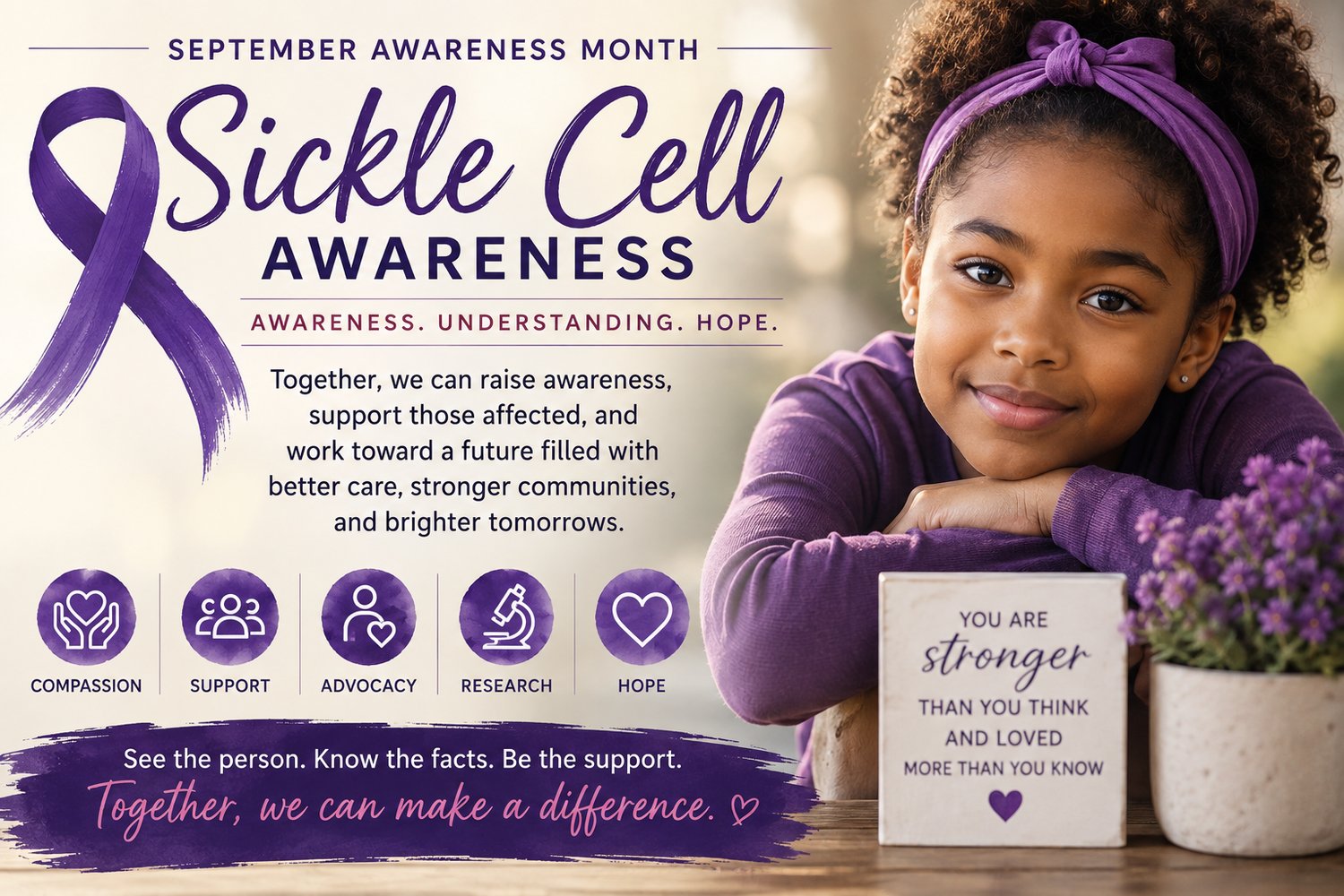
September is Sickle Cell Awareness Month, a time to increase understanding of sickle cell disease, recognize the people and families living with it, challenge misconceptions, and bring attention to continued research, treatment, and advocacy.
For many of us, sickle cell may be something we've heard about but don't fully understand.
And that's exactly why awareness matters.
Behind the words sickle cell disease are real people navigating a lifelong condition that can affect much more than what we see from the outside.
This week isn't about having all the answers.
It's about becoming more informed, more understanding, and more compassionate.
What Is Sickle Cell Disease?
Sickle cell disease, often called SCD, is a group of inherited blood disorders that affect hemoglobin—the protein in red blood cells that carries oxygen throughout the body.
Normally, red blood cells are round, flexible, and able to move easily through blood vessels.
With sickle cell disease, some red blood cells can become hard, sticky, and shaped more like a crescent or sickle.
These cells may have difficulty moving through small blood vessels and can block blood flow.
That can interfere with oxygen reaching tissues and can contribute to pain and other serious health complications.
And there's something important to understand:
Sickle cell disease is inherited.
It isn't contagious.
You cannot catch it from another person.
It is passed through genes from parents to children.
Sickle Cell Disease and Sickle Cell Trait Are Not the Same
This is one of the most important distinctions to understand.
Having sickle cell trait is not the same as having sickle cell disease.
A person with sickle cell trait carries one altered hemoglobin gene and generally does not have sickle cell disease.
However, that gene can be passed to their children.
This is why knowing family history and understanding genetic testing can be important, particularly when people are planning families.
If you have questions about your own trait status or what it could mean for your family, talk with an appropriate healthcare professional or genetic counselor.
Awareness begins with knowing the difference.
It's More Than a Pain Condition
One thing people may associate with sickle cell disease is pain.
Pain crises—also called vaso-occlusive crises—can happen when sickled cells interfere with blood flow.
The pain can be severe and may occur in different parts of the body.
But sickle cell disease can affect much more than pain.
Depending on the person and type of sickle cell disease, complications can include anemia, infections, stroke, lung problems, kidney problems, eye problems, and other serious health concerns.
Some complications require urgent medical attention.
This is why sickle cell disease needs ongoing medical care and shouldn't be minimized as someone simply having "another pain episode."
The Struggle Isn't Always Visible
Someone living with sickle cell disease may look completely fine to you.
That doesn't mean they're feeling fine.
They may be dealing with pain.
Fatigue.
Medical appointments.
Hospitalizations.
Medication.
Fear of the next crisis.
Missed work or school.
Emotional stress.
Or simply the exhaustion that can come with managing a lifelong condition.
This is where compassion matters.
We shouldn't require people to look sick before we believe what they're experiencing.
And we shouldn't assume we understand someone's health based on what we see from the outside.
Sometimes the most compassionate thing we can do is simply believe someone when they tell us what they're experiencing.
Treatment and Medical Care Matter
There isn't one treatment plan that fits every person living with sickle cell disease.
Treatment may include medications, pain management, blood transfusions, preventive care, and other therapies based on someone's individual needs.
For certain patients, blood and bone marrow transplantation or newer gene therapies may also be treatment options.
Medical advances have created new possibilities, but those decisions belong between individuals, their families, and specialized healthcare teams.
Regular healthcare is important because sickle cell disease can affect multiple parts of the body over time.
The goal isn't for someone to manage this condition alone.
The goal is appropriate medical care, support, and a plan that meets their individual needs.
Everyday Wellness Can Support the Whole Person
Because Exploring New Blessings focuses on whole-person wellness, I also want to talk about where healthy lifestyle habits fit.
They can support overall well-being, but they do not replace sickle cell treatment.
For people living with sickle cell disease, NHLBI includes healthy lifestyle practices such as staying hydrated, getting appropriate physical activity, choosing heart-healthy foods, getting quality sleep, managing stress, avoiding smoking or vaping, caring for mental health, and keeping regular healthcare appointments.
Hydration deserves particular attention because dehydration can be one trigger associated with sickle cell complications.
But individual needs can vary, especially when other health conditions are involved.
This is why I don't want anyone reading an awareness blog and thinking:
"If I just drink enough water, eat differently, or take the right supplement, I can treat sickle cell."
That is not what holistic wellness means.
Healthy lifestyle habits can complement appropriate medical care.
They don't replace it.
Mental and Emotional Health Matter Too
Living with a chronic condition doesn't affect only the physical body.
Think about what it might feel like to wonder when pain will return.
To miss school, work, family events, or activities because you're sick.
To spend time in hospitals.
To feel misunderstood.
To have people question whether your pain is really as severe as you say it is.
That can take an emotional toll.
NHLBI specifically encourages people living with sickle cell disease to care for their mental health, talk with family and friends about how they're feeling, and speak with healthcare providers when they're experiencing depression or anxiety.
Emotional support isn't an extra.
It's part of caring for the whole person.
We Also Need to Talk About Bias and Stigma
This is an uncomfortable part of the conversation, but awareness means being willing to talk about it.
People living with sickle cell disease have reported difficulty getting the care they need and feeling that healthcare providers don't always pay attention to their symptoms.
NHLBI notes that stigma, bias, and discrimination can affect medical care and may cause people to delay seeking treatment.
Imagine being in severe pain and also feeling as though you have to convince someone that your pain is real.
No one should have to prove that they deserve compassion.
This is where awareness needs to become advocacy.
Listen.
Believe people's experiences.
Learn.
Speak respectfully.
And support efforts that improve access to knowledgeable, compassionate sickle cell care.
Families and Caregivers Are Part of This Journey Too
Sickle cell disease doesn't affect only the person diagnosed.
Parents may be managing medications, appointments, school accommodations, and hospital visits.
Partners may become caregivers during difficult periods.
Children and siblings may have questions or worries.
Families may have to rearrange work, schedules, finances, and everyday life around medical needs.
Caregivers need support too.
Sometimes the best thing we can ask isn't:
"What can I do for the person who's sick?"
but:
"How can I support your family right now?"
A meal.
A ride.
Help with another child.
Sitting with someone during an appointment.
A phone call.
Or simply listening.
Support doesn't always have to be complicated to matter.
Awareness Should Lead to Advocacy
Wearing a ribbon or sharing a post can start a conversation.
But awareness can go further.
Learn what sickle cell disease actually is.
Know the difference between sickle cell disease and sickle cell trait.
Challenge misinformation when you hear it.
Listen to people living with the condition.
Support families and caregivers.
Encourage blood donation if you're eligible.
Support research and organizations doing credible work in the sickle cell community.
And perhaps most importantly:
See the person before you see the disease.
Someone living with sickle cell disease is still a whole person.
They have dreams.
Goals.
Relationships.
Careers.
Families.
Talents.
Plans.
Joy.
And a life that is much bigger than a diagnosis.
This Week's Reflection
This week, ask yourself:
Before reading this, how much did I really know about sickle cell disease?
Was it something I had heard about but never taken the time to understand?
Have I ever confused sickle cell trait with sickle cell disease?
Have I ever assumed that because someone looked okay, they must have been feeling okay?
And most importantly:
How can what I've learned change the way I support, speak about, or advocate for someone living with a condition I cannot see?
Awareness isn't about memorizing every medical fact.
It's about understanding enough to become more compassionate.
More willing to listen.
More willing to learn.
More willing to advocate.
And less likely to judge what we don't understand.
This September, let's make Sickle Cell Awareness Month about more than knowing the name of a disease.
Let's make it about seeing the people behind it.
Awareness creates understanding.
Understanding creates compassion.
And compassion can lead us toward advocacy and change.
Exploring New Blessings
Discover the blessing inside you.
Wellness Disclaimer
The information shared in this blog is for educational and informational purposes only and is not intended to diagnose, treat, cure, or prevent any disease or medical condition.
Always consult your physician or another qualified healthcare provider before making changes to your diet, exercise routine, supplements, medications, or healthcare plan.
Wellness coaching through Exploring New Blessings is designed to support healthy lifestyle habits and complement—not replace—the care of your licensed healthcare providers.