
Most lawn care pricing advice starts with "find out what others charge in your area." That tells you what the market might accept. It doesn't tell you whether a job makes you money. Before you look at anyone else's prices, you need to know what one visit actually costs you.
This guide walks through how to price lawn care per visit, per month and per season from your own labor, equipment, overhead and target margin. It's written by FieldReady Digital, a small spreadsheet template shop started by a former fleet, equipment and warehouse manager, not a lawn crew. So it sticks to the math and leaves the local know-how to you.
Step 1: Know your cost per crew-hour
Nearly every cost on a residential mowing job scales with time. Start by working out what one hour of a crew in the field costs you:
- Labor: what you pay each worker per hour, including payroll taxes, workers' comp and any other per-hour costs, multiplied by crew size. A two-person crew costs twice the per-worker rate for every hour.
- Equipment: an hourly figure for the mower, trimmer, blower and trailer that covers wear, repairs and eventual replacement. If you track maintenance costs by machine, use those numbers rather than a guess.
- Fuel: either a per-hour figure or a flat amount per visit, whichever matches how you actually fill up.
Those three numbers together are your direct cost per crew-hour. If you don't know them yet, that's the first thing to fix, because every price you quote depends on them.
Step 2: Measure the time per visit, including travel
Next, estimate how long the crew spends on the property. You can do this in two ways:
- By lot size: build a simple table of minutes per service (mow, trim, edge, blow) for a typical square footage, then scale it to each property.
- By measured time: time the crew on the first few visits and use that instead. Real time beats any table once you have it.
Then add travel time. Drive time between stops costs the same labor, equipment and fuel as time on site, so leave it out and every bid comes in low. Add any materials or disposal costs per visit as well.
Step 3: Add overhead
Overhead is everything you pay whether or not the crew is mowing: insurance, phones, software, the truck payment, office time and your own admin hours. A simple way to handle it is a percentage added on top of the direct cost of each visit. Work out the percentage from last year's books (total overhead divided by total direct job costs) and revisit it every season.
Step 4: Apply your margin the right way (margin is not markup)
This is where many bids go wrong. If you want a 20% profit margin, you can't just add 20% to your cost.
- Markup: cost × 1.20. On a $100 cost, that's $120, and your profit of $20 is only 16.7% of the price.
- Margin: cost ÷ (1 − 0.20). On a $100 cost, that's $125, and your profit of $25 is exactly 20% of the price.
The formula to remember is price = total cost ÷ (1 − target margin). Set a minimum charge too, so small lots and short stops still cover the cost of getting there.
Step 5: Turn the visit price into monthly and seasonal prices
Once you have a price per visit, the rest is multiplication:
- Monthly price = price per visit × visits per month. Weekly service averages about 4.33 visits a month (52 weeks ÷ 12). Biweekly averages about 2.17 (26 ÷ 12).
- Seasonal contract price = price per visit × visits in the season.
Billing a flat monthly amount based on the 4.33 average keeps invoices steady, even in months with five mowing weeks.
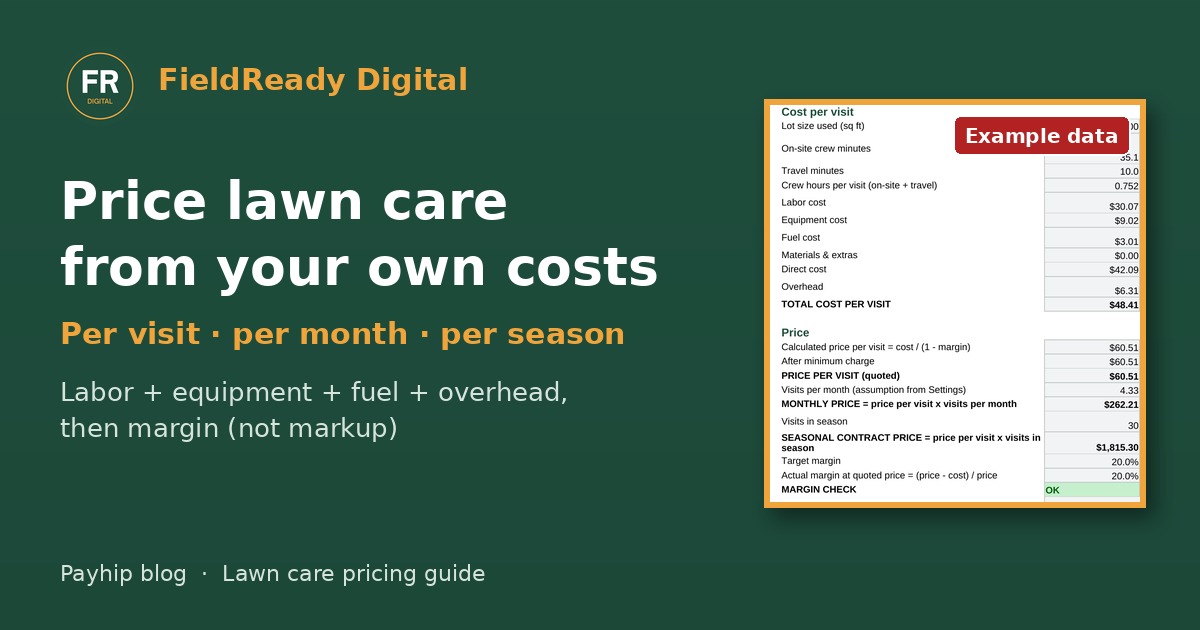
Worked example (fictional example numbers)
Every number below is made up for illustration. These are not market rates or recommended prices. Use your own costs.
A two-person crew, weekly mowing, a 30-week season:
- Labor per worker per hour: $20.00
- Crew size: 2
- Equipment per crew-hour: $12.00
- Fuel per crew-hour: $4.00
- Overhead: 15% of direct cost
- Target margin: 20%
- Time on site (mow, trim, edge, blow): 35 minutes
- Travel time: 10 minutes
Cost per visit:
- Crew time: 35 + 10 = 45 minutes = 0.75 crew-hours
- Labor: 0.75 × $20.00 × 2 = $30.00
- Equipment: 0.75 × $12.00 = $9.00
- Fuel: 0.75 × $4.00 = $3.00
- Direct cost: $42.00
- Overhead (15%): $6.30
- Total cost per visit: $48.30
Price:
- Price per visit: $48.30 ÷ (1 − 0.20) = $60.38
- Monthly (weekly service): $60.38 × 4.33 = about $261.45
- Season (30 visits): $60.38 × 30 = $1,811.40
If this fictional crew had used a 20% markup instead, the visit price would be $57.96, and the real margin would drop to about 16.7% on every visit, all season.
Check every bid against your target
Sometimes you'll quote below the calculated price to win a property or match a neighbor's job. That's your call, but do it knowingly. Work out the actual margin on the quoted price: (price − cost) ÷ price. If it's below your target, you'll know before you send the quote, not at the end of the season.
A few other habits help:
- Re-time properties after the first month. Early-season estimates are often off.
- Biweekly visits can take longer than weekly ones because the grass is taller, so don't just halve a weekly price.
- Update your labor, fuel and overhead inputs when they change, then recheck existing bids.
A spreadsheet that does the math
FieldReady Digital makes the Lawn Care Pricing & Bid Calculator ($15, one-time digital download). Full disclosure: we made it and we sell it. You enter your labor rate, crew size, equipment, fuel, overhead and target margin once. Then, for each job, pick the services (mow, trim, edge, blow, mulch, aeration, cleanup, plus 3 custom services), the lot size or measured time, and the frequency. It shows:
- Price per visit, monthly price and seasonal contract price
- A margin check that flags bids below your target
- A printable one-page quote with your business name (no FieldReady branding)
It comes with a workbook filled with fictional example data and a blank workbook for your own rates.
- Product: https://payhip.com/b/GRA7m
- It's also part of the Winter Ops Bundle ($35, or $49 if bought separately), with the Equipment Maintenance Log and the Snow & Ice Service Log + Pricing Calculator: https://payhip.com/b/FP3W2
- Code WINTER20 takes 20% off through Nov 15, 2026.
Good to know:
- All rates are your own inputs. No market rates are included or suggested.
- Results are estimates, not legal or financial advice. Always review a quote before you send it.
- It has been tested in LibreOffice only. It should open in Excel, but Excel hasn't been verified yet.
- There are no automatic alerts or notifications. Prices update when the file is opened or recalculated.