
There’s something I’ve been thinking about lately.
When people see the words “AI-assisted” attached to music, it can be very easy to imagine that the story started there — someone discovered a tool, pressed a button, and suddenly started making music.
My story didn’t start there.
Long before AI entered my studio, there was the music.
I studied Contemporary Music at the Western Australian Academy of Performing Arts (WAAPA), with drums as my principal instrument. But being a drummer didn’t mean studying only drums. Like the other musicians on the course, my training extended across composition, songwriting and arranging, piano, aural studies, electronic music, recording and sound engineering, professional performance, work within the Musical Theatre discipline, and other areas of contemporary musicianship.
In fact, as drummers we sometimes started a little behind. We could read rhythm, but many of us arrived without the same experience reading pitched notation as pianists, guitarists and other instrumentalists. So there was some catching up to do.
And we did it.
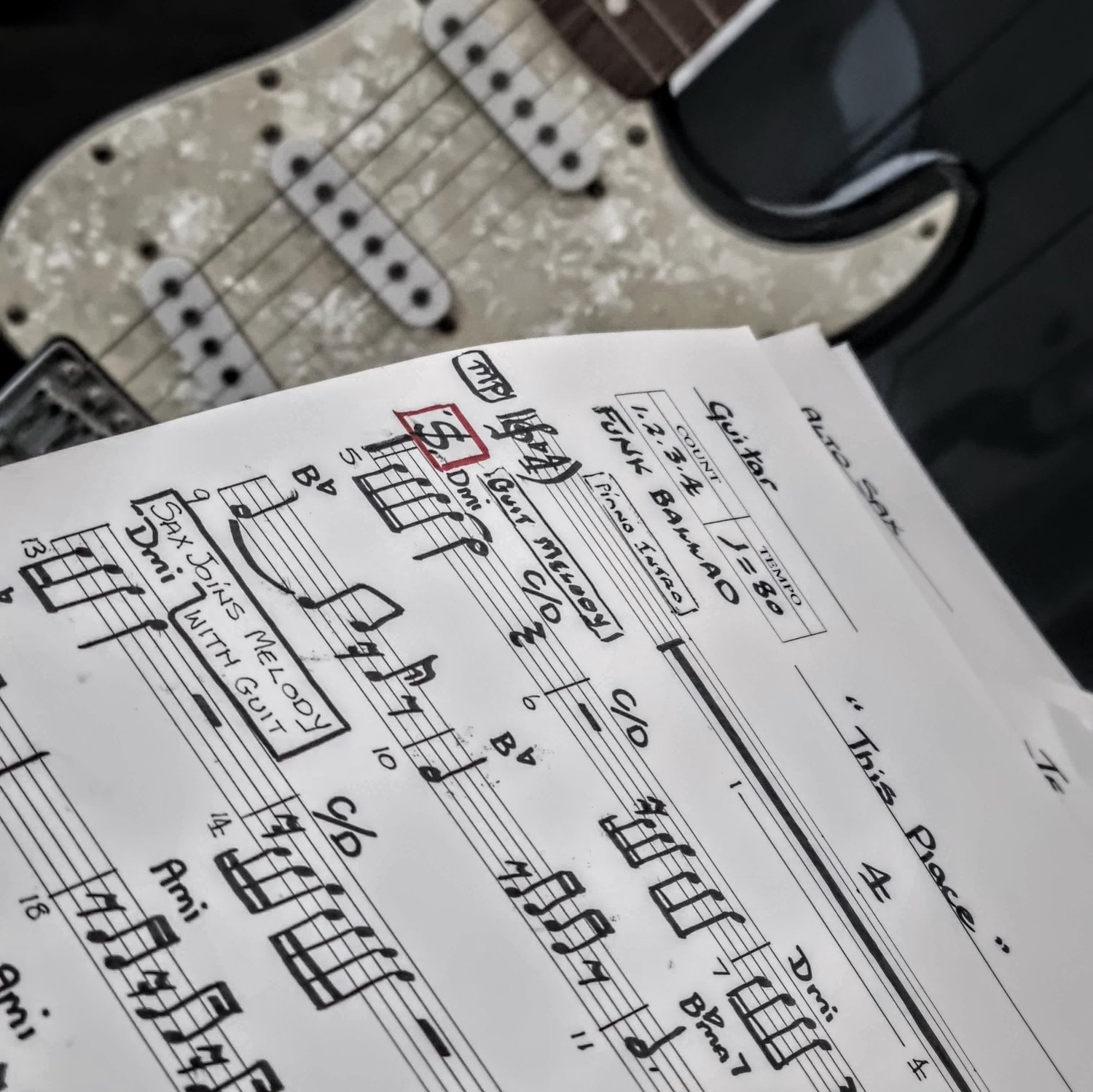
Throughout my studies, I chose to submit only completely original music rather than covers or arrangements of other tunes. Songwriting became particularly important to me, and I graduated with a High Distinction in that very subject — something I remain quietly proud of, especially given the standards expected of us. Writing wasn't simply about coming up with a tune; it included the craft and musicianship behind it, right down to preparing handwritten charts.
Music continued long after WAAPA.
Over the decades I've played, written, composed, recorded, experimented and occasionally become thoroughly exhausted by the whole process. Music has involved drums and percussion, guitar, piano, electronic tools, recording technology and whatever else helped me turn an idea or a feeling into sound.
And now, that toolbox also includes AI.
So where does AI fit?
Honestly, it depends on the piece.
Sometimes I begin with something of my own — a melody, chords, an instrumental idea or a musical direction. Sometimes I play material into the process. Sometimes I have a very clear idea of the mood, instrumentation, structure or feeling I'm trying to reach. Sometimes I've already completed every stem and use AI for production and polish.
And sometimes I deliberately give the technology more room to surprise me.
I don't think there's much value in pretending every Finnegan's Way track is created through exactly the same process. It isn't.
What remains consistent is the person making the creative decisions: listening, responding, choosing, rejecting, changing direction, recognising when something has feeling and recognising when it doesn't.
AI didn't make me interested in composing music.
It didn't teach me what a chord is, how rhythm works, how to listen critically, how to write a song or why sometimes the most important thing you can add to a piece of music is space.
Those things came first.
What AI has done is give me another way to explore ideas and, importantly, another way to finish them.
After decades of making music, I've reached a point where I'm less interested in proving that creativity must happen in one particular way. I'm interested in whether something moves me. Whether it creates an atmosphere. Whether it helps tell a story. Whether another creator can hear it and think, that's exactly what my film needed.
That's what I'm building with Finnegan's Way.
I'm not trying to hide the technology involved in making this music, and I'm not interested in pretending AI hasn't changed the way I work.
But I don't want the technology to erase the musician who was here before it, either.
I've spent a lifetime learning and making music.
AI didn't begin that story. It simply became another tool along the way.
And the music continues.
— Sue
Finnegan’s Way — Music for Life’s Journey
Comments ()