
Helping Children Notice What Is Happening Inside Before Emotions Take Over
Start With Yourself
Think about the last time you felt overwhelmed. Maybe you were rushing to get out the door. Maybe work was piling up. Maybe your child asked for something at the exact wrong moment. Maybe you were tired, overstimulated, or trying to hold too many things at once.
Most of us do not pause in those moments and say: “What am I feeling right now?”
We just react. Maybe we snap, shut down, rush, or over-explain. We try to control everything around us because something inside feels unsettled. The hard part is that emotions often build before we notice them. By the time we realize we are frustrated, anxious, embarrassed, or overwhelmed, the emotion may already be driving the moment.
That is why checking in with yourself matters. A check-in is not complicated. It is simply pausing long enough to ask and listen fully:
- “How calm am I right now?”
- “What am I feeling?”
- “What does my body need?”
- “What would help me respond instead of react?”
Connect To Your Child
Children need this same skill. The difference is that children often have even fewer words for what is happening inside them.
They may not say: “I am overwhelmed.”
They may say: “I don’t want to.”
They may not say: “I feel embarrassed.”
They may yell, cry, hide, or refuse.
They may not say: “I need a minute to calm down.”
They may melt down because they do not yet know how to pause.
From the outside, we usually see the behavior first. But underneath the behavior, something is happening inside. A feeling. A thought. A body signal. A need.
When children learn to check in with themselves, they begin to understand their inner world instead of being controlled by it.
Lesson Explanation
The lesson is not that children should always be calm. No one is calm all the time. The lesson is that we can learn to notice what is happening inside us before our feelings take over our choices. This is emotional awareness.
It starts with simple questions:
- “How calm do I feel?”
- “Where do I feel this in my body?”
- “What am I thinking about?”
- “What do I need right now?”
When children practice these questions during calm moments, they become easier to use during hard moments. And when parents practice them too, children learn that emotions are not something to hide or be ashamed of. They are something to understand.
Parent Application
The next time your child seems upset, try slowing the moment down.
Instead of starting with: “What’s wrong?,” or “Why are you acting like this?”
Try: “Let’s check in for a second.”
Then ask: “How calm does your body feel right now?" “Is your body tight, tired, wiggly, heavy, or tense?” “Do you need a breath, a break, a hug, or some space?”
You can also model it yourself.
You might say: “I’m noticing that I feel a little tense right now. I’m going to take a breath before I answer.”
Or: “I think I’m more tired than I realized, and that’s making me less patient.”
This helps your child see that emotional awareness is not just something kids need. It is something families can practice together.
Workbook Connection
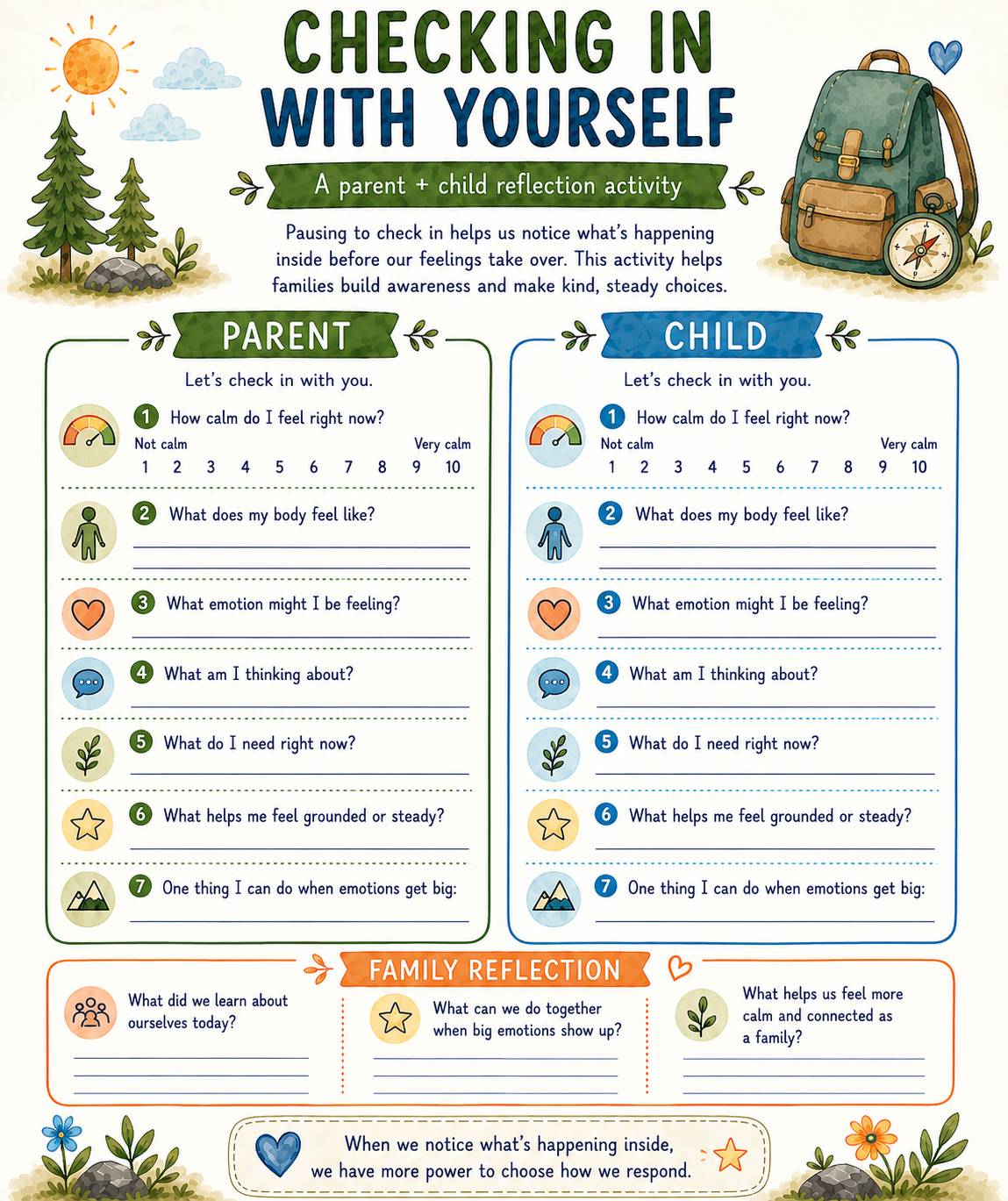
This week’s activity is called:
Checking In With Yourself
You and your child will each pause and reflect on how calm you feel, what is happening in your body, and what helps you feel steadier.
Together, you’ll explore:
- How calm you feel right now
- What your body feels like
- What emotion may be showing up
- What helps you feel grounded
- One thing you can do when emotions get big
The goal is not to force calm. The goal is to build awareness.
Before children can manage their emotions, they need to learn how to notice them. And sometimes the most powerful first step is simply asking: “What is happening inside me right now?”
Here's a feelings wheel to help your child learn and better understand their full range of emotions with three great questions to answer for each feeling.

Comments ()