
Helping Children Notice the Moment They Are Already In
Start With Yourself
Think about how differently time can feel depending on what you are doing. When you are rushing through the morning, time disappears. When you are waiting on important news, time crawls. When you are doing something you love, time seems to fly. When you are stuck doing something you do not want to do, every minute feels longer.
Time does not actually change. But our experience of time does.
As adults, we can move through entire days without really being present for them. We eat while checking our phones. We listen while thinking about what needs to happen next. We sit with our children while mentally planning tomorrow. We hurry from one thing to another and then wonder why the day feels blurry.
Sometimes the hardest part of slowing down is realizing how rarely we are fully where we already are.
Connect To Your Child
Children experience this too.
- A child playing a favorite game may feel like ten minutes lasted only one minute.
- A child doing homework may feel like five minutes lasted forever.
- A child waiting for something exciting may keep asking, “How much longer?”
- A child feeling bored, nervous, or impatient may struggle to stay connected to the moment they are in.
This is not because they are being difficult. It is because their attention is somewhere else.
They may be thinking about what they would rather be doing. They may be waiting for the next thing. They may be frustrated that time is moving too slowly. They may be so excited that they rush past what is happening right now.
Learning to be present helps children slow down enough to notice their own experience. It helps them recognize what they feel, what they enjoy, what they need, and what is happening around them.
Lesson Explanation
The lesson is not that children need to sit still all the time. The lesson is that they can learn to notice the present moment.
Presence is the ability to pause and pay attention to what is happening right now.
- What do I see?
- What do I hear?
- What do I taste?
- What do I feel in my body?
- What am I noticing?
This is why simple practices like mindful eating, slow breathing, quiet observation, or paying attention during an activity can be so powerful. They teach children that the present moment is something they can return to.
Not perfectly. Not all day. Just for a few seconds at a time. And those few seconds matter.
Parent Application
You do not need a perfect quiet space to practice being present with your child. You can practice during ordinary moments. At breakfast. On a walk. While eating a snack. During bedtime. In the car. Outside in the yard.
Try asking simple questions like:
- “What do you notice right now?”
- “What sounds can you hear?”
- “What does this food taste like?”
- “What does your body feel like?”
- “What is one thing you see that you didn’t notice before?”
You can also model presence yourself. You might say:
- “I noticed I was rushing through lunch, so I’m going to slow down and really taste this bite.”
- “I realized I was thinking about tomorrow instead of listening, so I’m coming back to this moment.”
This teaches your child that being present is not about being calm all the time. It is about noticing when your mind has wandered and gently bringing it back.
Workbook Connection
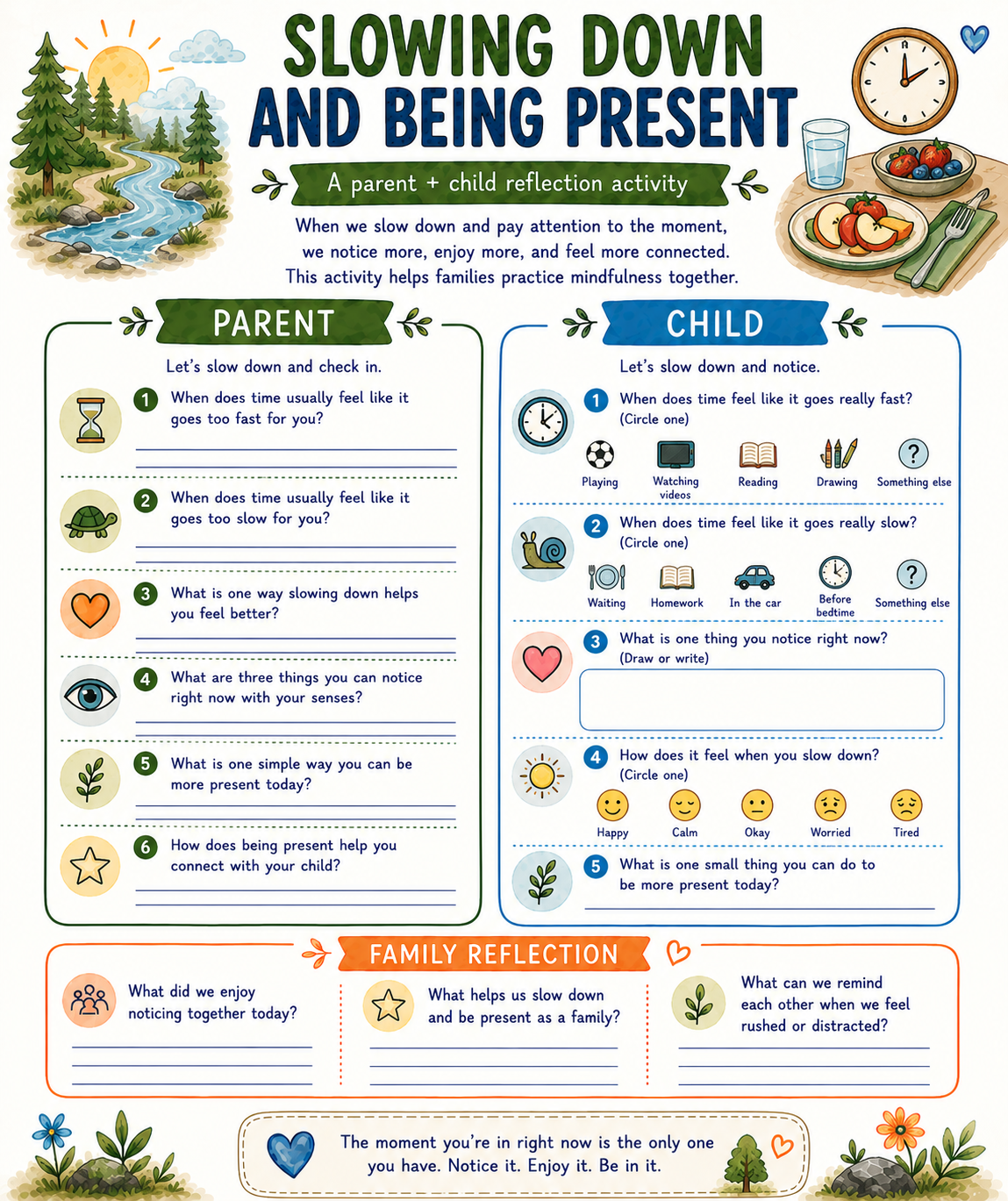
This week’s activity is called:
Slowing Down and Being Present
You and your child will each choose a simple activity and practice noticing what the moment feels like.
Together, you’ll explore:
- When time feels fast
- When time feels slow
- What it feels like to slow down
- What you notice through your senses
- How being present changes the experience
You may try this with a snack, a walk, a quiet moment, or something fun. The goal is not to make the moment perfect. The goal is to notice it.
Because life is not only happening in the big milestones. It is happening in the small moments we often rush past. And sometimes helping children understand their emotions starts with helping them slow down enough to notice what is already here.
Comments ()