
Helping Children Build Self-Worth Without Comparing Themselves to Others
Start With Yourself
Think about the last time you compared yourself to someone else. Maybe someone seemed more confident. More successful. More patient. More organized. More creative. More in shape. More put together.
Comparison has a way of making us forget what is already good and true about ourselves.
We may start with a simple observation: “They’re really good at that.”
But before we know it, the thought becomes: “I’m not good enough.”
That is the part that can hurt. It is not always the comparison itself. It is the meaning we attach to it.
- We see someone else’s strength and turn it into evidence of our own weakness.
- We see someone else’s confidence and start questioning our own worth.
- We see someone else’s progress and forget that our own growth still counts.
Most adults know this feeling. And many of us are still learning how to see ourselves with more kindness.
Connect To Your Child
Children compare themselves, too. Sometimes quietly. Sometimes out loud. They may compare grades, clothes, sports, friendships, talents, height, confidence, popularity, or appearance.
They may say things like:
- “They’re better than me.”
- “I’m not as smart.”
- “I’m not good at anything.”
- “Everyone else can do it.”
- “I wish I were like them.”
As parents, it can be painful to hear.
Our instinct may be to jump in quickly and say:
- “That’s not true.”
- “You’re amazing.”
- “Don’t compare yourself.”
Those words come from love. But sometimes children need more than reassurance. They need help understanding what comparison is doing to the way they see themselves.
Lesson Explanation
The lesson is not that children should never notice other people’s strengths. Noticing strengths in others can be healthy. It can inspire us, teach us, and help us grow.
The problem happens when children use someone else’s strength as proof that they are not enough. That is where self-esteem, self-worth, and self-acceptance become important.
- Self-esteem is how we think about ourselves.
- Self-worth is the value we believe we have.
- Self-acceptance is learning to see the whole picture of who we are: our strengths, struggles, differences, and growth, without believing we have to become someone else to matter.
Children need to know this: Someone else can be strong, talented, confident, or successful without it taking anything away from them.
Another person’s light does not make theirs smaller.
Parent Application
When your child compares themselves to someone else, try helping them slow down and separate the observation from the conclusion.
They might say: “She’s so much better than me.”
You could ask: “What do you notice that she does well?”
Then: “What is something you are learning or growing in?”
And then: “What is something good or true about you that does not change because of someone else?”
This helps your child move from comparison to awareness. You can also model this yourself.
You might say: “I caught myself comparing today. Someone else seemed really confident, and I started feeling like I wasn’t doing enough. But then I reminded myself that I’m still learning, and their confidence doesn’t take away from my progress.”
That kind of honesty is powerful. It teaches children that even adults have to practice self-kindness. It also shows them that confidence is not about pretending we never struggle.
Confidence is learning how to return to the truth of who we are.
Workbook Connection
This week’s activity is called:
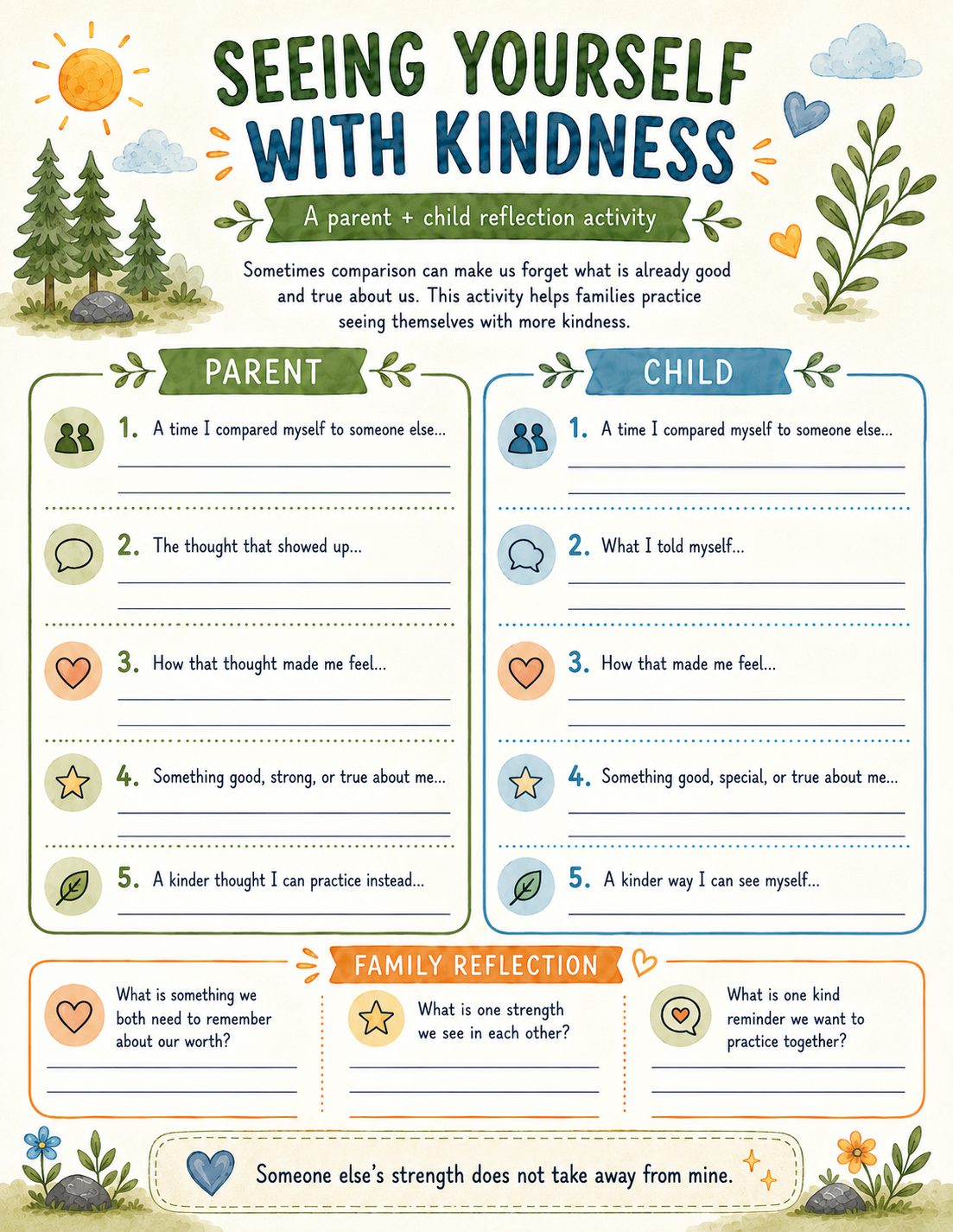
Seeing Yourself With Kindness
You and your child will each reflect on a moment when comparison made you see yourself less kindly.
Together, you’ll explore:
- Who or what you compared yourself to
- What thought showed up
- How that thought made you feel
- What is still good, strong, or true about you
- A kinder way to see yourself
The goal is not to pretend comparison never happens. The goal is to help children recognize when comparison starts turning into self-criticism.
Because every child will notice people who are different from them. Every child will meet someone who seems better at something. Every child will have moments when they question themselves.
But those moments do not have to become their identity.
They can learn to see others clearly without seeing themselves harshly. They can admire someone else’s strengths without abandoning their own.
And they can remember:
They do not have to become someone else to be worthy of love, confidence, and belonging.
Comments ()