
Helping Children Know Where to Go When Their Thoughts Feel Too Loud
Start With Yourself
Think about where you go when you need a moment to breathe. Maybe it’s a walk outside. Maybe it’s your car before you walk into the house. Maybe it’s your bedroom after a long day. Maybe it’s the shower, the porch, the kitchen before everyone wakes up, or a quiet chair where no one needs anything from you for a few minutes.
Most adults have places, routines, or small moments that help us reset. We may not call them safe places, but that’s what they are. They are places where we can pause. Where our thoughts slow down. Where our body settles. Where we can remember who we are before reacting to everything around us.
And when we don’t have those places, life can start to feel louder than we know how to handle.
Connect To Your Child
Children need safe places too. Not because they are trying to escape life. But because their inner world can feel big, fast, and overwhelming.
A child who is upset may not know the power of a safe place, or even how to say:
- “I need space.”
- “I need calm.”
- “I need a few minutes before I can talk.”
- “I need somewhere I can feel like myself again.”
Instead, they tell us through crying, yelling, shutting down, hiding, pushing people away, or saying things they don't really mean.
Sometimes what looks like “bad behavior” is actually a child who does not know where to put all of their feelings.
A safe place gives them somewhere to land.
Lesson Explanation
The lesson is not that we avoid hard feelings. The lesson is that we learn where to go when hard feelings show up.
A safe place is not a punishment. It is not a timeout. It is not sending a child away because their feelings are inconvenient.
A safe place is a "reset space."
It helps children learn:
- “I can feel overwhelmed and still take care of myself.”
- “I can step away before I react.”
- “I can calm my body before I choose what to do next.”
- “I can return when I’m ready.”
That is an important part of emotional growth. Because once children begin to understand how thoughts turn into feelings and feelings turn into actions, they also need tools for slowing the cycle down.
A safe place can become one of those tools. Find more tools at the bottom.
Parent Application
The key is to introduce the safe place when everyone is calm. Not during the meltdown. Not in the middle of an argument. Not when emotions are already running high.
Talk about it ahead of time.
You might say: “Everyone needs a place where they can feel calm and reset. I have places that help me, too. Let’s each think about what helps us feel safe, calm, and more like ourselves.”
Then let your child help choose what their safe place looks like.
It could be:
- A corner of their room
- A favorite chair
- A blanket fort
- A spot outside
- A reading nook
- A calming basket
- A picture of a favorite place
- A simple breathing space
The point is not how it looks. The point is how it feels.
You can also create a family language around it.
Instead of: “Go calm down.”
Try: “Would your safe place help right now?” Or, “Do you want a few minutes in your reset spot before we talk?”
This turns the safe place into support instead of shame.
Workbook Connection
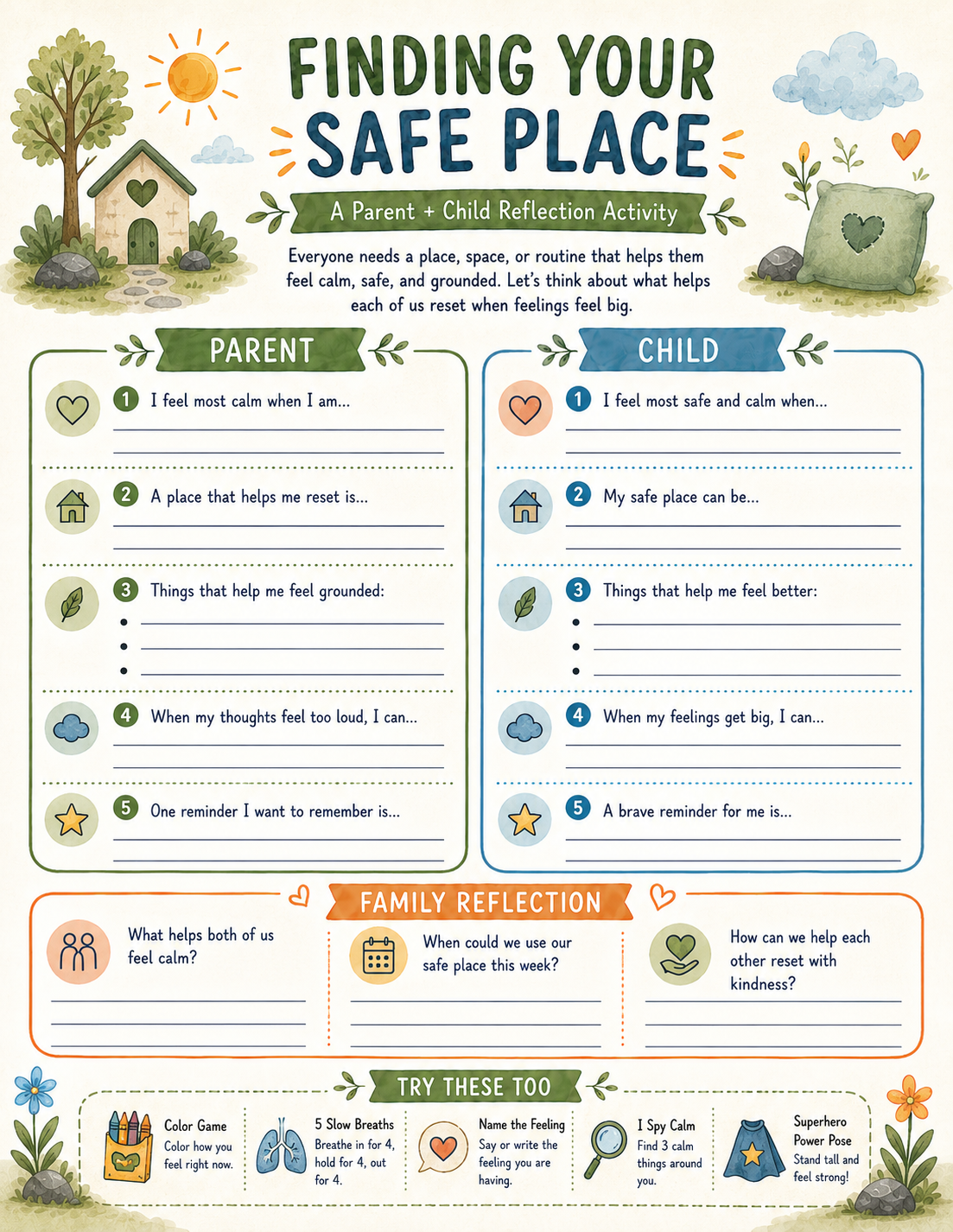
This week’s activity is called:
Finding Your Safe Place
You and your child will each think about a place, space, or routine that helps you feel calm, grounded, and safe.
Together, you’ll explore:
- Where you feel most calm
- What helps your body relax
- What sounds, smells, objects, or people help you feel supported
- When you might use your safe place
- What reminder can help you return when you feel overwhelmed
The goal is not to create a perfect space. The goal is to help your child know they have somewhere to go when their thoughts feel too loud. Because sometimes the next best action is not to talk, explain, fix, or decide.
Sometimes the next best action is to pause, breathe, and find your way back to yourself.
Extra Tools Parents Can Try
A safe place can be powerful, but it is not the only way to help a child reset. Here are five simple tools parents can try when big feelings start to take over:
1. Play the Color Game
Ask your child to find 10 things in the room that are red, blue, green, or whatever color stands out.
This helps bring their attention back to the present moment.
2. Take Five Slow Breaths
Breathe in together. Breathe out together. Count five slow breaths and let your child feel the rhythm of slowing down.
3. Name the Feeling
Try saying: “It seems like this might feel frustrating.” Or, “I wonder if you’re feeling nervous.” Naming the feeling can make it feel less overwhelming.
4. Play “I Spy Calm”
Ask your child to look around and find three things that feel calm, cozy, safe, or happy.
It could be a blanket, a stuffed animal, a favorite book, a pet, or even sunlight coming through the window.
5. Do a Superhero Power Pose
Have your child stand tall, put their hands on their hips, take a deep breath, and say one brave sentence out loud. Something like: “I can handle this,” or “I can take one small step.”
Keep it playful, not forced. The goal is not to make the feeling disappear right away. The goal is to help your child learn that big feelings can be noticed, named, and moved through with support.
Comments ()