
Helping Children See the Good in Themselves, Others, and the World Around Them
Start With Yourself
Think about the last time you had a hard day. Maybe work was stressful. Maybe the house felt chaotic. Maybe you were overwhelmed, tired, or frustrated.
When life feels heavy, it can become easy to focus on what went wrong.
- The unfinished tasks.
- The difficult conversation.
- The mess on the counter.
- The thing you forgot.
- The moment you wish you had handled differently.
Most of us do this without realizing it. Our attention naturally moves toward problems, responsibilities, and what still needs fixing.
But if we only notice what is wrong, we can start to miss what is good. The small smile from your child. The quiet cup of coffee. The friend who checked in. The moment outside when the air felt just right. The fact that you made it through another full day.
Noticing the good does not mean ignoring what is hard. It means making sure the hard stuff does not get the only voice.
Connect To Your Child
Children experience this too. A child can have a day filled with good moments, but one difficult moment may become the story they carry home.
- One bad grade.
- One disagreement with a friend.
- One embarrassing moment.
- One time, they felt left out.
Suddenly, the whole day becomes “bad.” That does not mean they are being dramatic. It means their brain, like ours, may be holding onto what felt uncomfortable or painful.
Children need help learning how to notice the full picture.
Yes, something hard happened. And something good may have happened, too.
Both can be true.
Lesson Explanation
One of the most important identity lessons we can teach children is this: What we notice shapes how we see ourselves and the world.
- If a child only notices mistakes, they may begin to believe they are a mistake.
- If they only notice rejection, they may start to believe they do not belong.
- If they only notice what they cannot do yet, they may forget how much they are already learning.
But when children practice noticing the good, they begin to see more than the problem.
- They notice their effort.
- They notice kindness.
- They notice moments of connection.
- They notice progress.
- They notice opportunities to help.
And over time, those small moments help shape how they understand themselves.
Parent Application
Instead of trying to force positivity, try helping your child widen the story.
If your child says, “Today was terrible.” You might respond with, “I’m sorry it felt that way. What was the hardest part?”
Start there. Let them feel heard first.
Then gently ask: “Was there one moment today that felt okay or even a little good?”
This is not about dismissing their feelings. It is about helping them build the skill of seeing more than one part of the day.
You can also model this out loud.
You might say...
- “Today was stressful for me, but I did enjoy our walk after dinner.”
- “I had a hard moment today, but I’m proud of how I handled it.”
- “I noticed someone was kind to me today, and I don’t want to forget that.”
When children hear us name both the hard and the good, they learn that life does not have to be all one thing.
A hard day can still hold good moments. A mistake can still hold growth. A challenging season can still hold connection.
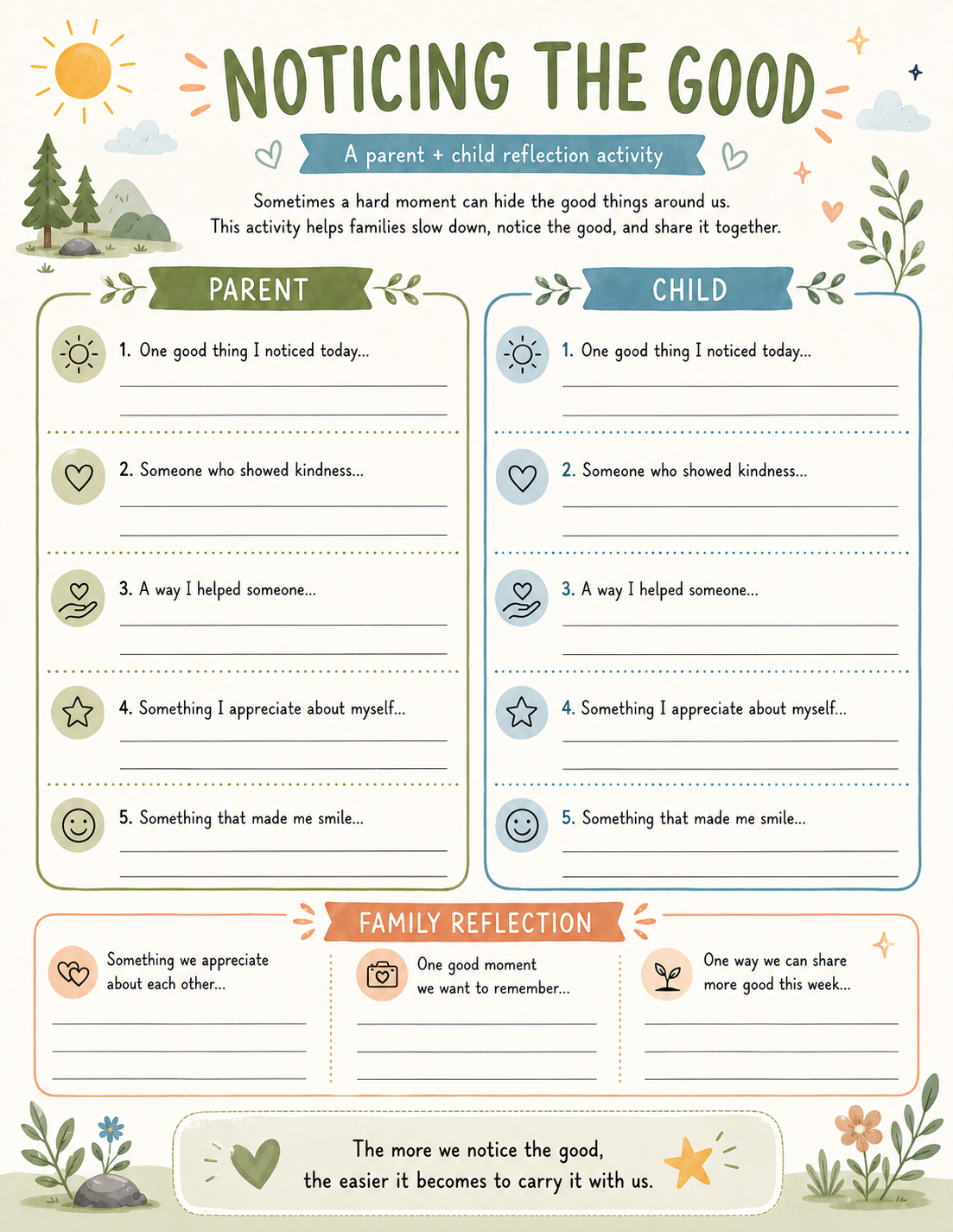
Workbook Connection
This week’s activity is called:
Noticing the Good
You and your child will each take time to reflect on:
- Something good you noticed today
- Someone who showed kindness
- A moment when you helped someone
- Something you appreciate about yourself
- Something you appreciate about each other
The goal is not to pretend everything is perfect. The goal is to practice seeing what is good, meaningful, and worth remembering.
Because the more we notice the good, the easier it becomes to carry it with us. And sometimes, helping a child build confidence starts with helping them notice the good that was already there.
Comments ()