
Helping Children Notice the Present When Their Mind Is Stuck in the Future
Start With Yourself
Think about the last time you were worried about something before it even happened. Maybe you had a meeting coming up. Maybe you were waiting on test results. Maybe you had to make a big decision. Maybe you were worried about money, work, your child, your health, or a difficult conversation you knew was coming.
When worry takes over, it can feel like your mind has already left the room. Your body is here. But your thoughts are somewhere else.
- You may be sitting at dinner, but mentally replaying what could go wrong tomorrow.
- You may be driving, but your mind is already building a worst-case scenario.
- You may be with your family, but you’re not fully present because your attention is stuck on something that hasn’t happened yet.
Worry can make us feel like we’re preparing. But sometimes, worry does not prepare us. It actually pulls us away from the life happening right in front of us.
Connect To Your Child
Children experience this too.
- A child worried about summer camp may miss the fun of the night before.
- A child worried about a test may miss the encouragement sitting right in front of them.
- A child worried about whether someone will like them may miss the friend who is already trying to connect.
When kids are worried, they may not say:
- “I’m stuck thinking about the future.”
They may say:
- “I don’t want to go.”
- “What if something bad happens?”
- “I can’t sleep.”
- “My stomach hurts.”
- “This is going to be terrible.”
Their worry can become so loud that it blocks out everything else. They may miss comfort. They may miss excitement. They may miss support. They may miss the small, good moments that could help them feel more grounded.
Explain The Lesson
The lesson is not that worry is bad. Worry is human.
Worry often shows up when something matters to us. But worry becomes a problem when it takes over the present moment.
Children need to learn that they can notice worry without letting it control everything. They can say:
- “I’m worried about tomorrow.”
- “I can still enjoy tonight.”
- “I’m nervous about camp.”
- “I can still pack my bag, eat breakfast, and listen to my favorite song on the way.”
- “I don’t know what will happen.”
- “I know what is happening right now.”
This is a powerful shift.
Because when children learn how to come back to the present moment, they begin to realize they are not powerless against their thoughts.
They can notice worry. They can name it. And they can gently return to what is real right now.
Parent Application
When your child is worried, it can be tempting to jump straight into fixing.
- “You’ll be fine.”
- “Don’t worry.”
- “It’s not a big deal.”
But worry usually does not disappear because someone tells us not to worry. Instead, try helping your child separate what might happen from what is happening.
You could ask: “What are you worried might happen?”
Then ask: “What do we know is true right now?”
This helps bring their mind back from the future.
You might say: “I hear that you’re worried about tomorrow. That makes sense. Let’s also notice what’s happening right now. We’re home. We’re safe. Your bag is packed. I’m here with you.”
You can also model this from your own life.
You might say: “I was worried about something at work today, and I noticed I wasn’t really paying attention at dinner. I’m going to take a breath and try to be here now.”
That kind of honesty teaches children something important. Even adults get pulled into worry. And even adults can practice coming back.
Workbook Connection
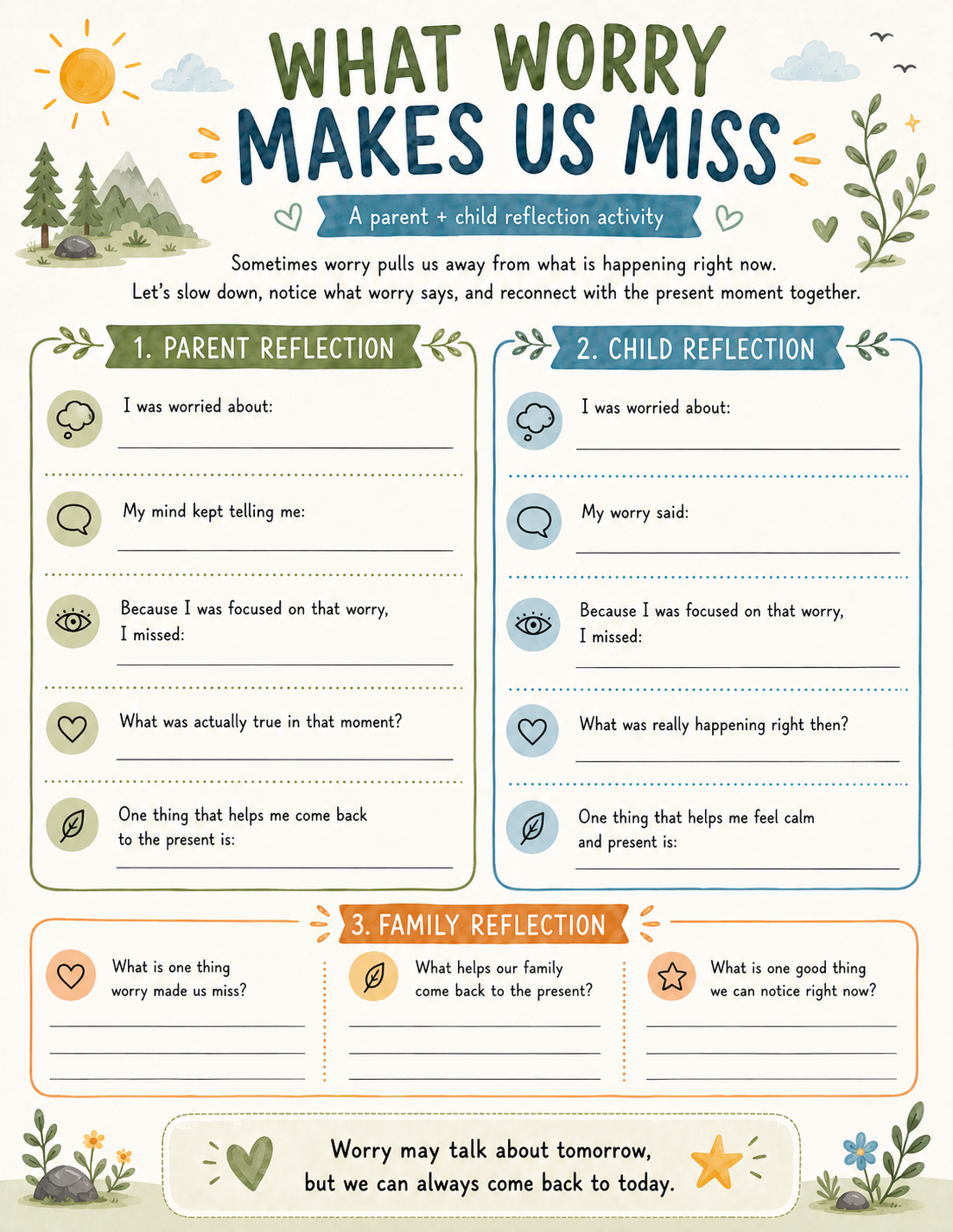
This week’s activity is called:
What Worry Makes Us Miss
You and your child will each think about a time you worried about something before it happened.
Together, you’ll explore:
- What you were worried about
- What your worry made you focus on
- What good things you may have missed
- What was actually happening in the present moment
- What could help you come back to the present next time
The goal is not to pretend worry is not there. The goal is to help your child understand that worry is only one part of the story.
There is also the present moment. There is also support. There is also joy. There is also something good happening now.
Because sometimes the bravest thing we can do is not predict the future. Sometimes it is simply learning how to come back to the moment we are already in.
Comments ()