
Helping Children Pause Before Big Feelings Take Over
Start With Yourself
Think about a time when you chose from a big emotion. Maybe you were angry and said something sharper than you meant to. Maybe you were overwhelmed and shut down. Maybe you were embarrassed and got defensive. Maybe you were afraid and avoided something important. Maybe you were frustrated and reacted before you had time to think.
Most of us have been there.
In the moment, the emotion feels powerful. It feels urgent. It feels like it needs to do something right now.
- Anger wants to speak.
- Fear wants to run.
- Frustration wants to push back.
- Embarrassment wants to hide.
- Sadness wants to withdraw.
And sometimes, when an emotion is loud enough, it can feel like it is making the choice for us.
We don’t always choose poorly because we don’t know better. Sometimes we choose poorly because we didn’t pause long enough to let the feeling settle.
Connect To Your Child
Children experience this all the time. A child may...
- Hit because they feel angry.
- Yell because they feel unheard.
- Quit because they feel embarrassed.
- Lie because they feel afraid.
- Refuse because they feel overwhelmed.
From the outside, we often focus on the behavior. The yelling. The stomping. The attitude. The refusal. The choice we don’t like. But underneath that choice is usually a feeling that became too big for the child to manage in the moment.
That does not mean the behavior is okay. It means the behavior is information. It tells us there was a feeling your child did not yet know how to carry.
Lesson Explanation
The lesson is not that emotions are bad. Emotions are human. Anger, fear, sadness, frustration, jealousy, and disappointment all have something to tell us.
The problem is not having the emotion. The problem is letting the emotion make the choice.
Children need to learn that there is a small space between what they feel and what they do next. At first, that space may feel tiny. Almost invisible. But with practice, it can grow.
Pause --> Name the feeling --> Take a breath --> Decide what choice would help.
That small pause can change everything. It gives a child time to move from reaction to response.
Parent Application
When your child reacts from emotion, try helping them look back after the moment has calmed. Not in the heat of it. Not while the emotion is still huge. Later, when they are more regulated, you can ask:
- “What were you feeling right before that happened?”
- “What did that feeling make you want to do?”
- “What happened after you made that choice?”
- “What could we try next time?”
This helps your child understand the pattern without feeling attacked. You can also model it yourself.
You might say: “I was frustrated earlier, and I spoke too quickly. I should have paused before I answered.”
Or: “I noticed I was getting overwhelmed, so I took a minute before I made a choice.”
That kind of modeling matters. Children need to see that self-control is not about never feeling big emotions. It is about learning how to pause before those emotions choose for us.
Workbook Connection
This week’s activity is called:
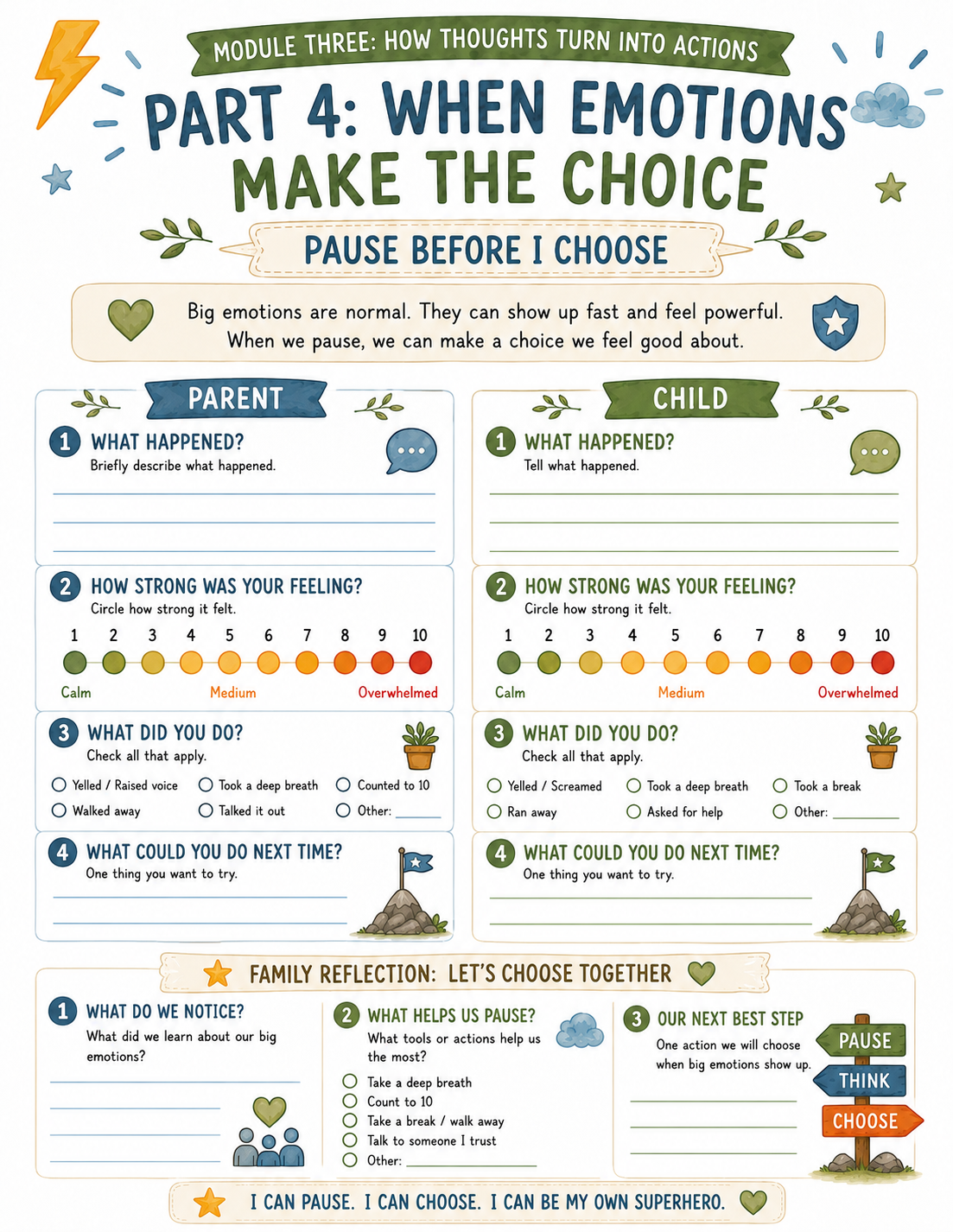
Pause Before I Choose
You and your child will each think about a time when a big emotion influenced a choice.
Together, you’ll explore:
- What happened
- What feeling showed up
- What that feeling made you want to do
- What choice you made
- What happened next
- What better next step you could try in the future
The goal is not shame. The goal is awareness. Because once children can see the connection between emotion and action, they can begin to practice the pause.
And sometimes one small pause is enough to help them choose a better next step.
Comments ()