
Helping Children Understand How Thoughts Turn Into Feelings and Feelings Turn Into Actions
Start With Yourself
Think about a recent moment when you reacted faster than you wanted to. Maybe you snapped at someone. Maybe you shut down. Maybe you avoided a conversation. Maybe you assumed the worst. Maybe you said something you later wished you had said differently.
Most of us have moments like that. And often, by the time we notice our reaction, it feels like the feeling came first.
- I was angry, so I snapped.
- I was anxious, so I avoided it.
- I was frustrated, so I raised my voice.
But underneath many reactions is a thought that arrived first.
Maybe the thought was:
- “They don’t respect me.”
- “I’m going to mess this up.”
- “This is too much.”
- “I can’t handle this.”
- “This always happens.”
That thought created a feeling. The feeling influenced a behavior. And suddenly, the thought was driving.
Connect To Your Child
Children experience this same pattern, but they usually don’t have the language to explain it. A child who refuses to try may be thinking: “I’m going to fail.”
A child who yells may be thinking: “No one is listening to me.”
A child who hides may be thinking: “I’m not safe.”
A child who quits may be thinking: “I’ll never be good at this.”
From the outside, we often see the behavior first.
- The attitude.
- The tears.
- The refusal.
- The meltdown.
- The silence.
But underneath the behavior, there is usually a feeling. And underneath the feeling, there is often a thought. When we only respond to the behavior, we may miss the story driving it.
Lesson Explanation
The lesson is not that every thought is bad. Thoughts help us understand the world. But not every thought is true. And not every thought needs to be in charge.
A thought can show up quickly. A feeling can follow. A behavior can happen before we even realize what is going on. That is why awareness matters.
When children learn to pause and ask:
- “What was I thinking?”
- “What was I feeling?”
- “What did I do next?”
They begin to understand themselves more clearly. They learn that emotions and behaviors do not come out of nowhere. They are connected.
And once children see the connection, they can begin to make different choices.
Parent Application
The next time your child reacts strongly, try looking beneath the behavior. Instead of starting with: “Why did you do that?”
Try asking: “What were you feeling when that happened?”
Then: “What was your mind telling you?”
This helps your child slow down and connect the dots. You can also model this in your own life. You might say: “I noticed I got frustrated earlier. I think the thought I was having was, ‘I have too much to do, and no one is helping.’ That thought made me feel overwhelmed, and then I got short with everyone.”
This kind of honesty teaches children that reactions can be understood. And once we understand them, we can choose a better next step.
Not every time. Not perfectly. But with practice.
Workbook Connection
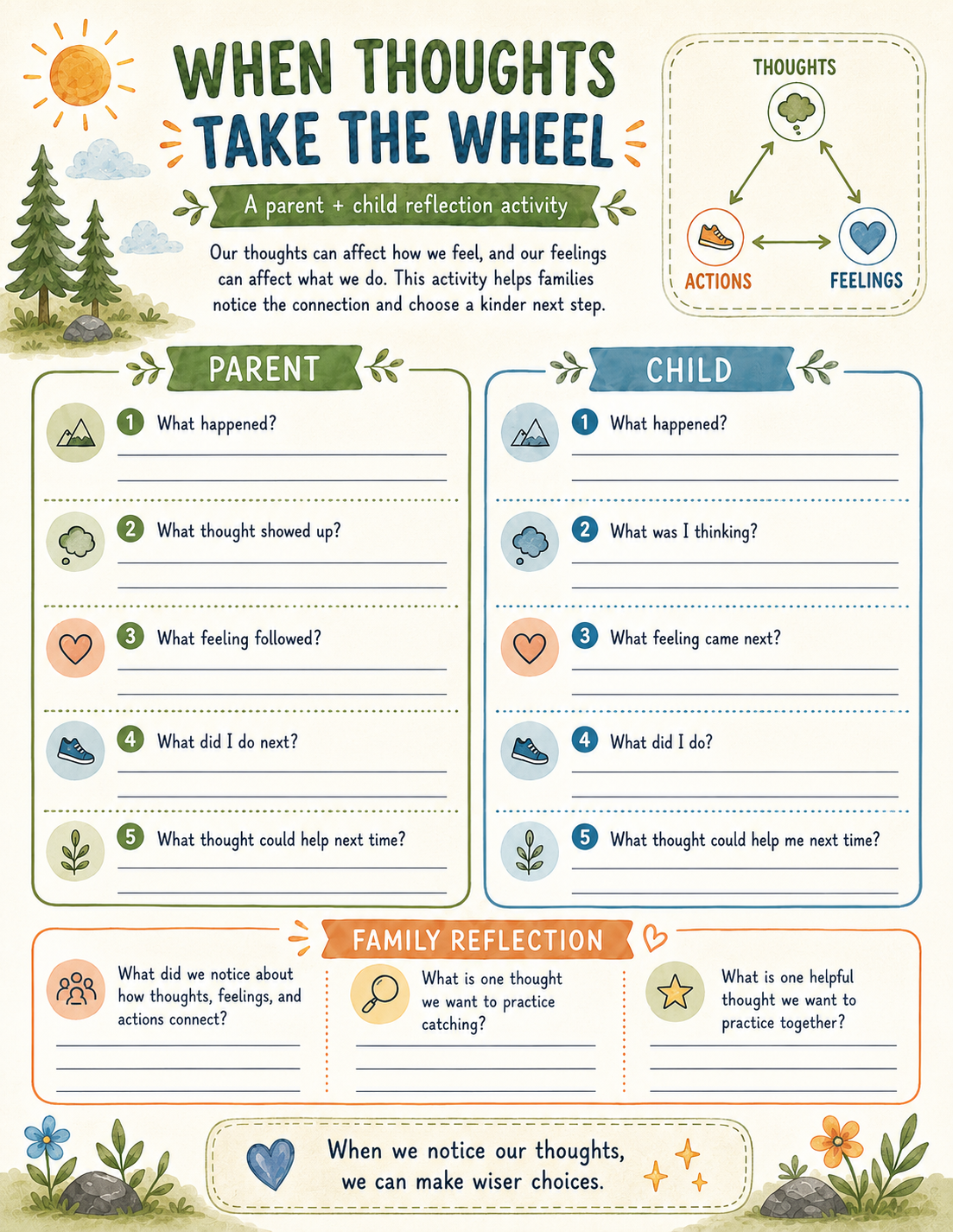
This week’s activity is called:
The Thought–Feeling–Action Triangle
You and your child will each reflect on a moment when you reacted strongly.
Together, you’ll explore:
- What happened
- What thought showed up
- What feeling followed
- What action came next
- What thought could help next time
The goal is not to blame the thought, the feeling, or the behavior. The goal is to understand the connection.
Because when children learn how thoughts turn into actions, they begin to see that they have more power than they realized. They may not be able to control every thought that appears. But they can learn to pause, notice, and choose what happens next.
Comments ()