
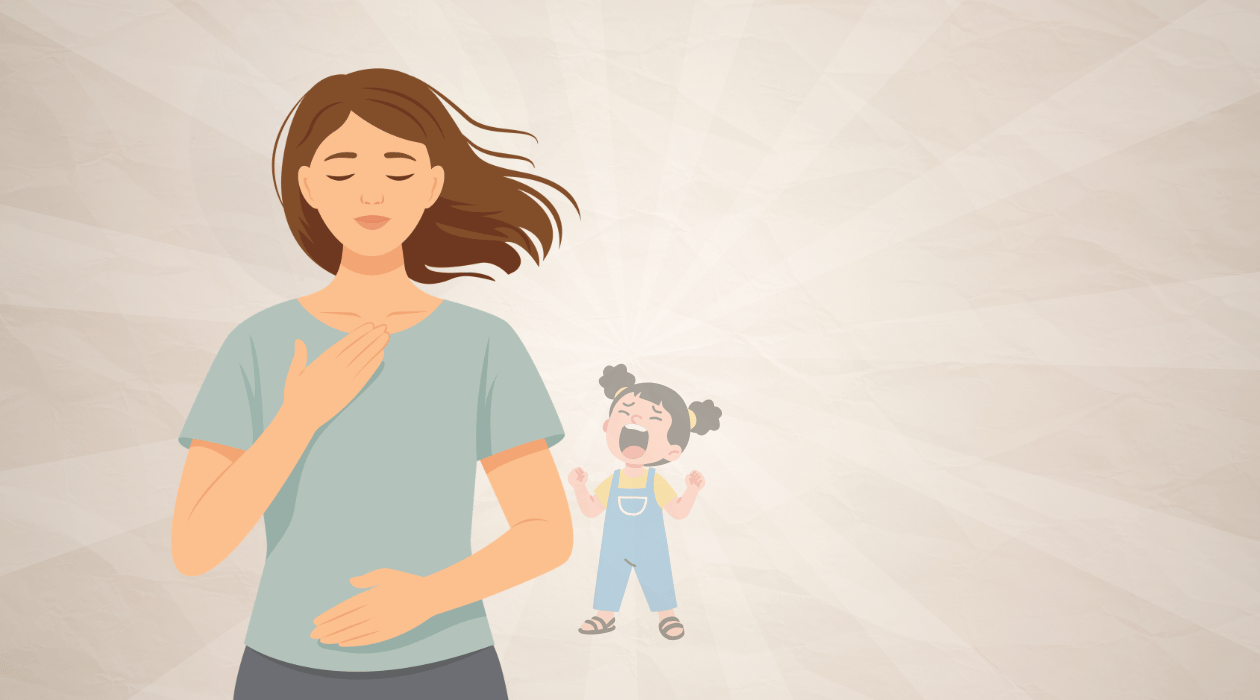
Let’s get one thing straight right away: toddlers cry because they’re toddlers, and trying to prevent it is like trying to stop the wind—it's impossible, exhausting, and, honestly, unnecessary.
It’s part of your child's age, part of their growth, and part of the learning they’re doing right now.
If it feels like you can’t control it—that’s because you can’t.
And it's not because you’re doing anything wrong—you’re not failing.
Crying is literally part of your child’s job description at this stage.
So, take a moment to breathe and let that sink in.
Feel better?
Good. ❤️
But don’t get too comfortable because even though you can't control it, you will have to respond to it, and that's what will make or break your child's behavior in the short and long term, because these are teachable moments.
And every meltdown tells its own story.
If you can learn to decode what’s really happening in each situation, you'll be able to handle them in a way that reduces your stress and sets your child up for long-term success.
🚨But beware: treating meltdowns purely as behavior problems puts your child at risk of learning that acting out should be their go-to strategy for getting attention or results.
Because here’s the hard fact: not all toddler tears are created equal.
First, let’s talk about the real thing — the moments when crying is an emergency signal or when true comfort is needed.
If your child is genuinely hurt, like the kind of hurt they can't shake off, or when they're actually in danger, or when they're sad, overtired, hungry, having growing pains, or something big has happened, they'll need comfort.
It's your job to be there for those moments, and I'd never encourage you to be unkind or neglectful towards your child — but that's not what this is about.
I'm talking about the moments that are simply a part of growing up, learning boundaries, and figuring out how to be a person.
And if you can learn to tell the difference, instead of just reacting out of anger, embarrassment, or stress, you'll become a calmer, more powerful parent overall.🧘♀️
I’m sharing this not just as a mom, but as someone who ran home daycares for over a decade.
I’ve seen hundreds of tantrums, watched toddlers use their tears to negotiate, push limits, and manipulate (yes, they do that). And the patterns are pretty clear.
So this is my gift to you, an insider’s guide to your toddler's tears. 👇
But First, Why Do Toddlers Cry? 😭
Well, toddlers cry for almost everything. In addition to the real reasons mentioned above, they might just cry when:
- They’re mad
- They want something
- They don't want something
- They want to leave somewhere
- They don't want to leave somewhere
- They think they should get something
- They’re frustrated
- You pick them up
- You don’t pick them up
- Anyone or anything else needs your attention
- Something changes
- The wind blows the wrong way
So, the thing to understand here is that the crying itself is rarely the issue.
What matters is why they’re crying — and how you respond.
Because toddlerhood is the time when personality, behavior patterns, and emotional habits get baked in, you are literally inputting the data they’ll use for the rest of their life, right now.
No pressure. 😅
But here’s the good news!
When you learn to step back, untangle emergencies from non-emergencies, and parent more effectively for the non-emergencies, everything gets easier.
An Uncomfortable Truth (Said With Love)💛
I fully understand that your child's cries activate that ancient protective switch in your brain.
Lots of people think it's their "duty" to freak out whenever their toddler cries (it shows they care). I get it.
But here's the reality: A Lot of Toddler Crying After 18 Months Is Strategy.
A lot of toddler crying is:
- 👉 self-interest
- 👉 manipulation
- 👉 testing
- 👉 seeing what works
Why? Because they're starting to understand, more consciously, the connection between the behavior and the result.
And toddlers want what they want.
And if crying gets the job done?
Well, that's good enough for them.
And sometimes they just randomly want to see what you'll do.
I’ve had kids walk into daycare shrieking like they're being m*rdered, clinging to their mothers, only to stop the instant the door closes behind them.
I’ve literally had to send parents videos of what happened behind the scenes because they were sitting in their cars, sobbing, believing their child was being traumatized from being dropped off at daycare. It wasn't that they didn't trust me personally; it was more like they thought there was some sudden, traumatic separation anxiety happening out of nowhere.
I've offered to have parents sneak back in the back door to see what happens when they leave.
Because as soon as they're gone, the curtain comes down and toddlers say "scene," and it's over.
Ask any full-time toddler caregiver if they've seen this. Most will undoubtedly say yes.
Why? Because it happens — and it's common.
🚨Now I'm obviously not talking about situations where there might be actual bad things happening, if you even so much as suspect your child is unsafe with somebody — and I mean anybody — it's your job to stop your child's contact with that person immediately. You always err on the side of your child's safety.
(I will write a blog about what I think are good signs and bad signs when choosing a daycare, so keep your eye out for that.)
What I'm talking about is the crazy, manipulative toddler cry, the one that ends as soon as you've gone —or they've gotten whatever else they wanted.
The kind that's intended to traumatize you into submission.
I can think of two different times that this happened with my own daughter when she was little.
- The first time it happened, I was dropping her off at the YMCA She was probably about 2 1/2 or 3 years old. For years, she went to day programs when she was a baby and a toddler; they were free with the membership and a great way to socialize as an only child, and she loved them. One day, I dropped her off, and she just lost her mind. I was heartbroken; it shook me to my core, and I almost took her back home. But the person who worked the program just rolled her eyes and told me to hand her over and leave asap without hanging around. I didn't understand it at the time and was reluctant, but I did what she asked. And guess what, I stayed back out of the way where my daughter couldn't see me, and watched as she ran right in, to her waiting friends and had a great old time.
- Then, in her first year of kindergarten, she'd just turned four, and had gone to about her first 6 weeks of junior kindergarten just fine, as usual, she loved it, and I was, of course, smugly proud of my perfectly well-adjusted child, and then one day it just happened. As I went to put her in line, she lost her mind. She just started screaming and clawing at me. I was mortified and my smug satisfaction evaporated pretty fast. Of course, by the time I picked her up, she was her happy self again, and the teacher said she had a fine day. So, of course, when it happened the next day and the next, I questioned everything I'd ever done as a parent. It was so bad that the teacher asked me to start dropping her off 15 minutes early so she could get her settled into the class without disrupting the other kids lining up outside. This went on for about 4 weeks and then just stopped as suddenly as it had started.
So even though I've seen this behavior as a caregiver, I've also been on the receiving end of it as a parent, and even though the caregivers and teachers at the time acted like it was no big deal — because to them, it wasn't — nobody ever explained it to me, and that left me feeling really confused and upset in those moments.
And I don't want that to happen to you, so I'm going to help you learn to anticipate some of these tricky toddler behaviors that revolve around crying so you can handle them more calmly and confidently.
So the million-dollar question is...
When Is It Okay to Let A Toddler Cry?
It might not feel like it, but there will be times when your toddler’s crying is more a part of the learning process than an outright emergency— and when stepping back instead of getting drawn into it can be part of good, healthy, loving parenting. ❤️
I’m sharing these scenarios so you can recognize the behaviors in advance and feel less confused and intimidated than you might if you didn’t recognize the “why” behind them.
My hope is that you’ll learn to spot them when they come up, so you can make more mindful, intentional parenting choices in those moments.
So, here are some common situations that are going to make your kid cry, and I hereby give you permission not to feel bad:
1️⃣ When They Want Something Right Now (and You Say Wait or No) 🍪
We all want to give our children everything they want, and we hate to disappoint them, but sometimes you just can't manage it, you can't do what they want when they want it (and also, you're their parent, not their Butler).
Maybe, just maybe...
- You're at the door
- You're making a meal
- You're feeding a baby
- You're on the toilet
- Or it's just not the time for whatever that "thing" they want is
- Or maybe you just don't have it
But toddlerhood is the "need-it-now/gotta-have-it" phase.
So, toddlers scream for what they want because they’re just learning to change gears from being a newborn (who cried for survival) to being an older child (who understands patience).
But they're not there yet, they still want everything instantly, and they think they deserve everything instantly. So, they'll do everything they can to convince you that you must give it to them now.
When you say:
- “Not right now.”
- “You need to wait.”
- “No.”
They'll act like their world is collapsing (because they're trying to convince you that it is).
But you know it's not.
So here's my advice to you: Let it collapse. 🌪️
Your child is not dying; they're waiting, and they need to build up a tolerance for it by practicing doing it.
I know, it sounds crazy, but toddlers have to practice behaviors to get good at them and to understand they're safe, and this is especially true for patience. (👉Get my FREE resource, "The Grounded Toddler: 6-Step Patience Plan FREE Download" for help with this if you're not sure how to get started, or how to approach it.)
If screaming and crying make you move faster, that's what they'll do, and if you do that enough, the behavior will carry over as they get older.
At two, it’s “aww, terrible twos.” You're kind of sheepishly embarrassed, but everybody goes through it, right? 😅
At ten or fifteen, and beyond, it’s straight-up entitlement and bullying — and not so easy to explain away.
My daycare motto was always: “He who screams the loudest waits the longest.”
And I stuck to that no matter what.
I built up a tolerance for that kind of screaming, the mean, aggressive, "I-want-it-now!" screaming, and I never let it faze me.
Because I knew if I did, they'd never stop (and remember I had five children that I was dealing with every day).
So, letting them scream at me (in a time-out if necessary) while I got on with my day and co-regulating my calm with the other children so they wouldn't get dragged into the behavior — (read more about co-regulation HERE) — was how I allowed the children to process those big feelings and learn to be more patient.
If I'd panicked every time they screamed at me for something, my job would have been unbearable, and I'd have been a nervous wreck.
Understanding why the tears were happening allowed me to look past the behavior and teach the lesson.
2️⃣ When There's Danger Involved 🔪
You already know this one.
- Knife?
- Drill?
- Glass vase?
- Running into the road?
- Something clearly unsafe?
You're going to have to take it away from them or stop them from doing it.
And they might cry.
So, let them cry.
Walk away if it's safe.
Let them have their moment; it will pass.
Don’t soften the message by offering a replacement toy as an apology for doing your job.
You don't owe them an apology for keeping them safe or teaching them a lesson.
When you “make up for” good parenting, you train them to expect compensation for listening to you.
But that's not how life works.
You're the adult, you have the life experience, you make the call, and don't apologize.
Remove them from danger, make sure they're safe somewhere safe, and if they don't like it — tough.
The less drama you invest in the process, the less drama they'll learn to put into it.
Period.
Now, this next one is really hard for most moms.
It's...wait for it...
3️⃣ When Your Child Loses It in Public 😳
This is a timeless classic for every toddler, because it makes you really uncomfortable, and that's exactly what your little angel😈 is going for.
You know:
- The grocery-store meltdown.
- The restaurant flop.
- The playground protest.
Toddlers are masters at reading the room.
They know when you feel watched.
They know when you’re embarrassed.
They know you want the screaming to STOP.
If you’re a “public caver,” they will figure this out early.
When my daughter was in this phase, I’d calmly step back and say, “Everyone’s looking at you.”
Then I’d look away and ignore her.
I remember doing this in the mall once, when she decided to throw herself on the ground for whatever reason. I guess she wanted something that she wasn't getting, so she threw a fit.
But I knew from my Montessori training that toddlers are extremely socially aware; they're in a phase where they're extra sensitive to social cues, and their brains are soaking up things like reactions and responses, because this is the time of life when they're learning how to fit into society.
So as she was on the ground making her displeasure known, I calmly leaned down and said to her, "Everybody's looking at you."
Then I stood up and took a step back so she would feel alone in her ridiculous behavior. (Don't worry, I was still close by, but I took a step back about a foot or two out of her orbit deliberately so she would "feel" alone.) I remember an older gentleman kind of scowling at her, and she caught his eye.
And then she stopped, pulled herself together, and came back to me.
I asked her if she was done, and she said "yes," and we went on with her day.
I do believe that it's important to let the village help raise our children.
Allowing your child to feel the social consequences of antisocial, unnecessary behavior can do that.
Sometimes, toddlers need to feel the sting of social judgment, and we, as parents, shouldn't get defensive when others are annoyed by our toddler's inappropriate behavior.
What we need to be doing is showing our children, starting at that age, that there is a level of respect we show each other in public, and that screaming and yelling aren't included in that social contract.
So, reframing those judgmental onlookers as helpful resources and allies can be useful when combating deliberate public meltdowns.
Embarrassment is a natural social emotion.
Toddlers will feel it if you let them.
And it helps them learn to recalibrate.
4️⃣ When They Don’t Want to Leave / Stop / Start Something 🚫
Sometimes you need your child to do something they simply don't want to do. After all, you can't live at the park. You can't eat only treats, and you can't leave them at home while you run errands.
So:
- Leaving the park?
- No junk food today?
- Taking them along on an errand they don't want to do?
Expect tears, and stand your ground.
Because you can't create a life for your child where everything always goes their way, that's impossible, and you shouldn't feel like you have to just because that's what they want in the moment.
🔆Yes, timing is everything, and if you're dragging them around during what should be nap time, or if you haven't brought snacks and they're hungry, then that kind of acting out is definitely a problem you've created.
But under normal circumstances, you shouldn't feel bad for making them do the odd thing they don't feel like doing, and you shouldn't feel like you have to bribe them or reward them either.
It's okay to have an expectation for them to just learn to go along, because that's what people do for each other.
We make accommodations for each other, not for a reward, but because we learn to understand that other people's agendas are also important, and sometimes ours has to take a back seat.
And that's okay.
Because nobody gets everything they want in this life.
- Nobody gets to do everything they want.
- Nobody gets to eat everything they want.
- Nobody gets to have everything they want.
That's just the way it is.
It's okay for your child to be disappointed, and for a toddler, that might mean melting down, but instead of giving in to the emotion, you can take that moment to teach them that it's okay to feel big emotions and still not get what you want.
It will still all be okay.
Getting to the other side of that emotion and still feeling loved and safe is a priceless lesson that will contribute to your child's future happiness, and one you can teach with compassion and love when you recognize the moment as an opportunity rather than an obstacle.
The last cry we're going to explore is...
5️⃣ When A Behavior Needs To Be Addressed 😐
Sometimes, the only way to address a certain behavior is to give a consequence or allow it to happen naturally.
And don't underestimate the crazy stuff your kid might do if it gets a reaction or if they're genuinely trying to figure out if it's a good idea or if you do nothing about it.
Here's a list of stuff kids have done that I've seen firsthand or heard about from other people:
- Banging their head on the wall.
- Throwing up on purpose.
- Peeing on the floor.
- Randomly breaking things.
- Physical violence towards parents/others.
While these might be extreme, they're also common toddler behaviors.
And if you don't find a way to nip them in the bud, they can become big problems.
Here are a few reasons why your kid might be doing these things (give this list a look and see if you recognize any of these patterns in your parenting):
- It works — it gets your attention and causes a big reaction.
- Because you're trying to impose rules and boundaries where none existed before, this is behavior extinction. (Read about that HERE and find the FREE resource, "The Grounded Toddler: Meltdown Management Manual" HERE)
- Because you do nothing about it.
- Because it gets them what they want.
And it's important to remember that toddlers can’t really grasp the concept of limiting their behavior unless you teach that to them or they figure it out on their own. So, they’ll keep using whatever works for them and will amp it up if they need to.
True story...
My husband still remembers being two years old and banging his head on the wall for attention. He remembers that his mom would stand by, freaking out, begging him to stop, and he liked the way that felt. (Because remember, toddlers see any attention as a win; it reinforces that they're being seen.)
Then grandma stepped in and told his mom, “Just let him do it.” (And no, I'm not saying this was right or wrong, it's just a true story that illustrates a point.)
Because my husband actually remembers that exact moment (it's one of his earliest memories).
As soon as his mom stopped reacting and the payoff stopped, he realized two things:
- His actions weren't accomplishing anything anymore.
- It actually hurt.
So he stopped.
What he was doing was a bad idea, and he learned that lesson in about five seconds.
And yes, it's an extreme story, but it makes a good point.
Because when allowed to feel consequences, lessons sink in fast, and when a bad behavior loses its power over you, it will stop. Especially if it's unpleasant for the child.
👉For everyone who might get fired up in the comments, just remember to use your judgment as a parent. If something seems too risky, definitely step in and find a different way to teach the lesson. I’m assuming we’re all adults here, so just to be clear: I’m not saying you should let your kid do anything too harmful or dangerous.
And I do have one more personal story to help you understand how this works:
I had a daycare kid who was extremely strong-willed and very smart, and he went through a period of extreme boundary pushing.
It was like a game for him to see if he could get the adult in the room to lose their cool. Mom and Dad had been having issues with him at home as well. This is a normal phase, but he'd taken it to a new level.
One day at nap, he decided that he wasn't going to put his pants back on after going to the bathroom, and also he wasn't going to get into his cot.
The basement of our side-split, where the daycare was located, was chilly, so the children always got nicely snuggled up in blankets for a nap.
But this day, this child refused to get into his cot. Every time I picked him up and put him back in, he climbed out and ran into a corner.
Finally, I said, "Okay, do you want to sleep on the floor?" and he thought he was being super clever and said yes, because he thought that would keep me engaged.
But I decided to let him "win," and he was really pleased with himself.
So I grabbed his pillow and blanket and said, "Okay, this is where you can sleep from now on," and then went through my naptime routine. I turned off the lights and sat on the couch where I always sat for about 10 minutes as the children fell asleep.
As a bit of time went on, I could tell that napping on the floor wasn't feeling like the win he'd hoped it would be.
Eventually, he asked if he could get into his bed.
I said, "No, this is what you chose, so this is where you're sleeping."
Then I heard him start crying; clearly, he regretted his life choices in that moment.
But I didn't rush over to comfort him; I let him marinate in his regret for a little while. (Probably about 5 minutes or so, but I'm sure it felt like an hour to him.)
Then I went over to him and whispered, "Should I put your bed away, so you can sleep here? Or would you rather get into your nice cozy, comfy cot?"
He opted for the cot, and I said okay, but I told him that if he ever did this again, the cot would go away for good, and he would have to nap on the floor.
I will tell you that when he finally got back into his cot and got all wrapped up, warm, and comfy, he appreciated what he had and never got out of bed at naptime again.
Instead of losing my mind, chasing after him, begging him, bribing him, or letting him control the narrative, I let him feel the consequences. I created a learning experience and made him feel good about making the right choice in the end.
I gave him a consequence he could remember and draw on for the next time that thought crossed his mind.
I created an opportunity for critical thinking next time.
When I tucked him in, I whispered to him, "This is better than the floor, don't you think?", and he agreed.
And did you notice something about that story?
I didn't get mad. I just allowed a consequence to play out and teach a lesson.
So the moral of the story is this...
Toddlers learn lessons fast when given logical consequences that they can feel. (And no, spanking and screaming aren't logical consequences; those things will end up traumatizing a child and backfiring when it comes to behavior — keep your eye out for a blog on this subject coming soon.)
But if your child is crying, tantruming, or acting out just to get your goat or to win a power struggle, sometimes you just need to let them feel the consequences, even if it's upsetting.
That might be a time-out or letting a situation play out in a way they won't like, and if that upsets them, let them cry.
Because if they're upset, you know they've gotten the message.
Consequences Are Not Cruel When Mindfully Applied — They’re Actually An Act Of Love ❤️
In my mind, when it comes to toddlers, consequences aren't cruel when given properly, intentionally, mindfully, and thoughtfully.
And I’m not talking about hitting, spanking, screaming, toxic shaming, or anything harmful that you might do in the heat of the moment out of anger.
❗Those things may feel like consequences to your adult brain, but they aren't. 🚫
They're damaging and unhelpful.
And that's why it's so important to learn to read the situation beyond the behavior, so you can reinforce an impactful consequence that teaches the lesson.
So you can learn the difference between emergency crying or tears that need comfort, and tears that need to be shed to learn lessons.
Toddlers learn from discomfort — small, safe doses of it.
If they don’t learn these lessons from the people who love them, they'll end up learning them from the world, and the world is much harsher than your heart and home.
Letting them cry through a consequence now is far kinder than raising a child who thinks they can live without boundaries, respect, or empathy.
That’s good parenting.
Even if there are tears.
Even if strangers glare.
Even if it feels awful in the moment.
You’re not being cold.
You’re being wise.
You’re loving them enough to do the hard thing.
Final Thoughts 💛
Letting your toddler cry sometimes doesn’t make you a bad parent — allowing it in the right moments makes you a strong one.
It means you’re guiding your child with long-term love instead of short-term relief.
So the next time you find yourself faced with toddler tears, ask yourself:
Is this a crisis — or is this a teachable moment?
If it’s a crisis, you already know what to do: Give them your all — don’t skimp on the love and care you have so much of, to give.💗💗💗
But if it’s a teachable moment:
- Step back.
- Stay steady.
- Don’t buy in.
Try to teach the lesson in the most compassionate way you can.
And if it involves a few tears, then you're not being mean, you're being effective.
If you can master this, they’ll learn faster, behave better, and grow into kinder, more patient human beings.
And one day, you’ll look back and think: “Thank goodness I didn’t cave.”
Because you've got this, Toddler Mama!💛
And I've got you.