
Let me guess...
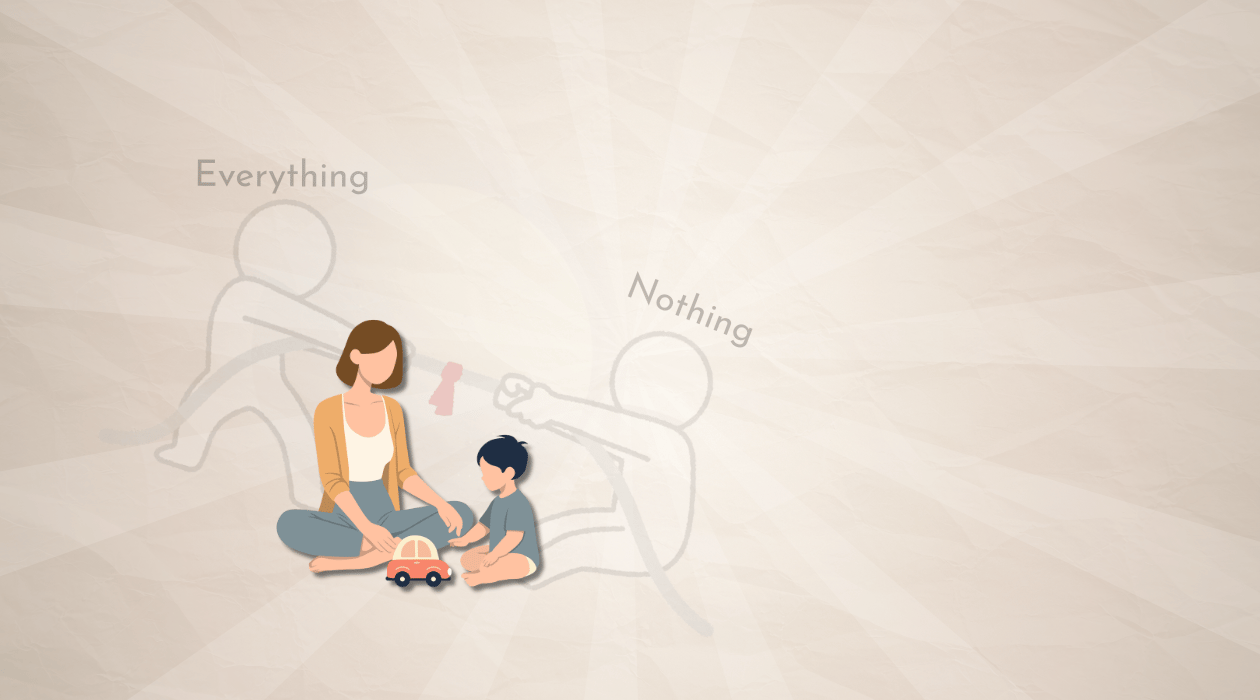
You've got one group of friends still baby-wearing their 4-year-olds, and another group who've decided that toddlers can pretty much get by on their own.
Neither approach feels quite right, and you wonder: How much should you actually be doing for your toddler?
You want to protect them; their pain is your pain. (But at the same time, you want them to grow up strong, resilient, and capable enough to survive the roller coaster of life on their own. 💪👶)
You want them to know you love them fiercely and that you’ll always have their back. (But negotiating snack requests every five minutes can feel like a full-time job, and honestly, it gets on your nerves. 🍎🚗)
So here’s the big question: Is being micro-involved in every aspect of your child’s life really the best way to show them you love them? Or does embracing “neglect” actually make you a better parent?
Spoiler alert: The answer isn’t black or white.
It lives in that gray area called common sense—a place a lot of people like to visit these days, but nobody seems to live there.
Because the truth is, parenting is always a balancing act.
On one hand, there’s helicopter parenting—hovering so closely over every move and emotion that your toddler never gets a chance to figure things out for themselves. Every scrape is a crisis; every frustration needs an instant fix.
It’s exhausting, overwhelming, and leaves both parent and child less able to cope.
On the other hand, there’s what some call "unparenting"—stepping so far back that kids are left unsupported and adrift, trying to navigate life without guidance.
It might look like the “easy (or fun?) way out,” but it sets everyone up for problems later, when that child becomes an adult who struggles with the things that were never taught or modeled.
But what if there was a middle ground? A way to be present, loving, and involved—without micromanaging every second?
A parenting "sweet spot" that gives everyone breathing space to do the work they need to do.
This isn’t about neglecting your child or trying to be Supermom. It’s about pulling the best ideas from both sides and landing somewhere smarter.
This is about being there when it counts but stepping back to give space, and trusting that struggle, when experienced in the right measure, can lead your child to independence and self-confidence.
It's in this space between hovering and disappearing that your toddler learns resilience, emotional regulation, and confidence. This is where they can dip their toes in the independence pool, without having to jump right in.
That parenting sweet spot you're looking for is "Loving Detachment", and it's what we’re diving into today.
🤔 What Is Loving Detachment?
Loving detachment means staying emotionally available and deeply connected to your child, without getting hyper-involved in every little moment.
It lives somewhere between helicopter parenting and not parenting at all. Think of it like this...
🚁 You’re not the puppet master pulling every string, but you’re also not the janitor who only shows up after the show’s over.
You’re the stage crew—quietly making sure everything’s in place while your toddler takes the spotlight to figure things out on their own. 🎭✨💖
And let’s be honest—that’s not always easy.
Especially when your toddler's melting down over the sock, they can't get over their pinky toe. 🧦😫
But stepping back doesn’t mean you’re abandoning them. It means you’re giving your child something sacred: a space that belongs to them, where they get to do the hard, important work of growing. 🌱
You’re creating a safe space where they can try and fail, and you’re right there—offering just enough help to keep the learning alive—while tapping into one of your most powerful parenting tools: co-regulation.
🧬 Where Did the Idea Come From?
Loving Detachment has deep roots in psychology, parenting research, and developmental theory.
We know from science that toddlers thrive when they feel securely attached to a caregiver who is consistently warm and responsive. That secure base helps them internalize a sense of safety.
But we also know that your toddler’s brain is still wiring itself, and those connections form through effort.
From movement to emotion, these systems need practice, struggle, and repetition. It’s work only your toddler can do themselves, and your job is to step back just enough to let it happen.
And, as kids grow, they naturally move toward independence—you see this in full force during the teen years. But micro-versions of that process actually begin in toddlerhood, and that’s completely normal.
Think of it like offering child-sized bites of the independence cake 🍰.
When they hit their teenage years, they'll be ready for full slices, but now is the perfect time to let them snack on smaller pieces so they can get used to the taste.
And it’s not just about the taste (if we’re sticking with the cake🍰 theme)—it’s also about learning to digest it.
🔌 Brain-Body Connections Are Still Wiring Up
When your toddler feels big emotions—like frustration, disappointment, or anger—it might look like chaos, and when you look at it through your eyes (with your emotional baggage at the wheel), it's easy to think that all toddler outbursts are bad or unhealthy, but this is how the brain does its most important work at this age. 🎯🧠
It's through these intense feelings that the brain starts wiring up the systems that handle things like emotional regulation, impulse control, and decision-making.
But here’s the catch: that development depends on your response.
If you jump in too quickly to fix every feeling—calming them before they’ve even had a chance to feel it—you may accidentally rob their brain of the practice it needs.
Think of it like building muscle: if someone else lifts the weight for you every time, you don’t get stronger. 🏋️♀️
On the other hand, if you're too hands-off—leaving your child with no emotional support or guidance—they can end up feeling overwhelmed or unsafe. That stress can actually shut down the learning part of the brain, and instead of wiring up healthy emotional circuits, they just get stuck in survival mode.
So you're aiming to come in somewhere in the middle, present and emotionally available, without taking over.
You’re not fixing the feeling—you’re witnessing it, staying calm, and showing them that big emotions aren’t dangerous or shameful while allowing them to feel and process.
💪 The Struggle Isn’t the Problem—It’s the Solution
Every time your toddler struggles putting on their own shoes (even if they’re on the wrong feet), and then calms down without being distracted, or figures something out after getting frustrated, they’re learning something powerful:
“I can do hard things.” 💥👟💪
As that feeling grows into a belief, it lays the groundwork for self-confidence and pride.
Psychologists call it self-efficacy, but all it really means is that your child starts to believe they’re capable. And that belief can only develop when they actually get to do hard things and come out the other side.
But like most parts of parenting, there’s a balance.
👉 If you’re too involved—always stepping in to fix things, soothe every emotion, or do tasks for them—they may start to believe they can’t do things on their own. Over time, this can lead to something called learned helplessness: when a child gives up trying because they’ve learned someone else will always do it for them.
They stop asking, “How can I do this?” and start thinking, “Why even try?”
👉 On the other hand, if you’re not involved enough—leaving them totally on their own with no support—they may feel overwhelmed, abandoned, or even ashamed if their struggles often end up in failure. That kind of pressure can make them afraid to try at all.
🧠 And here’s the interesting thing...
Both extremes—over-helping and under-helping—can lead to the same result: a child who’s afraid to try.
- One learns to give up because someone always steps in.
- The other learns to give up because no one ever does.
✨ Loving detachment lives in the space between those extremes.
😟 But Won’t They Feel Abandoned?
Nope.
Not if they feel seen and heard.
Because loving detachment isn’t about turning your back—it’s about being present without taking over.
So...
Instead of jumping in to stop a meltdown, you say: “I’ll be back when you calm down.” 🌊🧸 Then go to a room that's close enough for you to see them, but don't let them see you (otherwise, they might try to manipulate you into giving them more attention by turning up the drama, but that's the subject for another time) and, when they've pulled themselves together, you come back and have a little heart-to-heart. Acknowledge those big feelings, and move on.
Or...
Instead of saying, “Here, let me do it,” you say, “You can try. I’ll be just over here if you need me.” 🧩 (Then give them minimal help, maybe pulling a sock over that annoying baby toe that it keeps getting stuck on so they can pull it up the rest of the way.)
Doing things like this teaches your toddler that:
- ✅ Their emotions are safe, and they can handle them on their own.
- ✅ They are capable of working through hard things on their own.
- ✅ You trust them to do things on their own.
All the while, you're standing by like the safety net under the trapeze. They feel safer knowing you're there, even if they don't fall.
And that builds emotional safety. 🔐
⚠️Extreme Parenting Is Risky Business Both Ways
But let's take a few minutes to go back and recap some of the common downsides of extreme parenting, just in case you're not convinced.
Over-Parenting: Why Hovering Isn't Helpful🚁
You might think that being involved and on guard in every moment is helpful, but helicopter parenting—being hyper-vigilant and constantly fixing problems—can hold your child back.
Research shows that over-involved parenting can:
- 😬 Increase anxiety and lower self-confidence in children
- 🧠 Reduce their ability to think creatively and solve problems independently
- 😢 Prevent the natural development of emotional resilience
- 🤷♀️ Lead to learned helplessness, where kids believe, “I can’t do anything on my own.”
And toddlers don’t just absorb these messages like sponges—they become them.
Their brains are wiring up fast right now, and the messages they take in—spoken or unspoken—get built into how they see themselves and the world.👓
So when a toddler is repeatedly "overhelped"—even if it's well-meaning—the message they absorb is, “You’re not capable.”
Even if no one says it out loud, they feel it. And once that belief takes hold, it can stick for life.
Under-Parenting: Abandonment Isn't Independence
On the flip side, pulling away too much—or what some call “unparenting”—leaves toddlers without the support they need to navigate big emotions and challenges.
Without consistent guidance and emotional connection, kids may:
- 🌀Feel abandoned and overwhelmed
- 😕Develop insecurity or mistrust toward caregivers
- 👀Miss out on learning important social and emotional skills
- ⛈Struggle later with boundaries, rules, and self-regulation
Science tells us that young children need a warm, responsive adult to help them make sense of the world, especially when emotions run high.
🏝Too little involvement can leave them adrift and insecure rather than empowered.
So where's the sweet spot?
You guessed it, it’s right in the middle—where you’re close enough to offer love, support, and guidance, but with enough space so your child can learn and grow on their own.
👀 What This Looks Like In Real Life
Here are a few simple ideas to show you how you can start practicing loving detachment today (and don't worry, if it's not something you've ever done before, it might feel weird and take some practice):
❌ Instead of…✅ Try this…
- ❌Jumping the second your toddler gets frustrated about something,
- ✅wait a minute and say, “Hmm. That’s tricky. How about you keep trying for a bit more, and if you really can't do it, I'll give you a hand.” 🧠 (Then get the task started, but let them finish it.)
- ❌Putting their socks and shoes on for them every time
- ✅Set extra time aside before you leave the house and let them try themselves. Maybe put their socks on over their toes the first few times so they can pull them up themselves (it's harder than you think for them), and then open their shoes up as much as you can so they can slide their feet in by themselves. 👟🧦👏
- ❌Distracting them from a tantrum with a song or a snack
- ✅ say, “You’re really upset. I’ll go in the kitchen while you figure it out. I'll be back when you're quiet.” 🗯️🤍 (Then let them get to the end of their meltdown before re-engaging.)
- ❌Saying “Be careful!” every 3 seconds
- ✅Let them explore within safe boundaries. Stay close, but don’t hover 🌳👣and manage your own anxiety, yourself.
🗣️ 5 Simple Phrases to Help You Step Back (With Love)
Things you can say to show your child you support them when you're hanging back:
- “You’ve got this. I’m here if you need me.” ✨
- “I can tell that’s hard. Keep trying.” 🛠️
- “I'm going to let you work this out. I'll be here when you're ready to talk.”
- “Let me know when you’re ready for help.” 🤝
- “That's frustrating, but you can do hard things.” 💪💖
🧸 If you love someone, set them free...
Letting go, even just a little, can be hard, especially if you're not used to it, but it's one of the most loving things you can do for your toddler 💞.
They don’t need you to fix everything.
But they do need you to acknowledge and believe in them while they learn how to manage frustration, solve problems, and bounce back from small struggles 🧗♂️💫.
🧭Trusting Common Sense As Your GPS
If you’re feeling worn out from trying to make everything perfect for your toddler and protect them from every little thing—here’s your permission to take a breath and stop hovering. 😮💨
And if you’ve already checked out because you're overwhelmed, you’re not broken. You’re exhausted, and you can still parent effectively even when you’re not 100%.
For both of you moms, loving detachment might just be what makes life manageable again.
Because here’s the truth:
Parenting doesn’t mean doing everything for everybody or doing nothing for anyone.
The truth lies somewhere in between—in that space held by the eternal wisdom known as common sense.
All you have to do is show up with love, stay connected, and give your child enough space to figure things out—with you right there in the background.
- You don’t have to do everything to be a good mom.
- And you don’t have to shut down when it all feels like too much.
There’s a middle ground—and it’s not just okay to live there, it’s smart.
Because loving detachment helps you raise a calm, confident child, without draining your emotional bank account.
And the best part?
These everyday moments where they struggle a little, feel their feelings, and then try again—are exactly how their brains learn to regulate emotions, solve problems, and build lifelong confidence.
So if you feel stretched thin between these parenting extremes, maybe it’s time to come back to the middle.
That calm, grounded place in the valley of common sense, where loving detachment quietly does its work.
It’s calmer here. It’s lighter.
And it's better for everyone. ✨
You’ve got this, Toddler Mama.
And I’ve got you. 💛
Read this 5-minute article next to learn exactly how to start empowering your toddler today, complete with a three-step method and a free printable cheatsheet!
How To Help Your Toddler Be More Independent
If you want to dive deeper into how to support your toddler through those big feelings without losing your cool, check out this post on co-regulation—it’s basically your parenting superpower. 💥🧠
And if you’re curious about how this all ties into brain development and why what you do right now really matters long-term, you’ll love this post on toddler brain wiring, too.
Try these FREE resources for extra parenting support:
- Shift your parenting habits from enabling to empowering with 🌱 The Grounded Toddler: 5-Step Empowerment Plan
- Learn to create strong routines that give your toddler the consistency they can rely on with The Grounded Toddler: 7-Day Routine Reset Plan.
Strengthen and reinforce good parenting skills with these 5-Minute Morning Journal Pages:
- Empowerment Plan Edition
- Skilled and Centered Parent Edition
- Learn to Observe Your Toddler Edition