
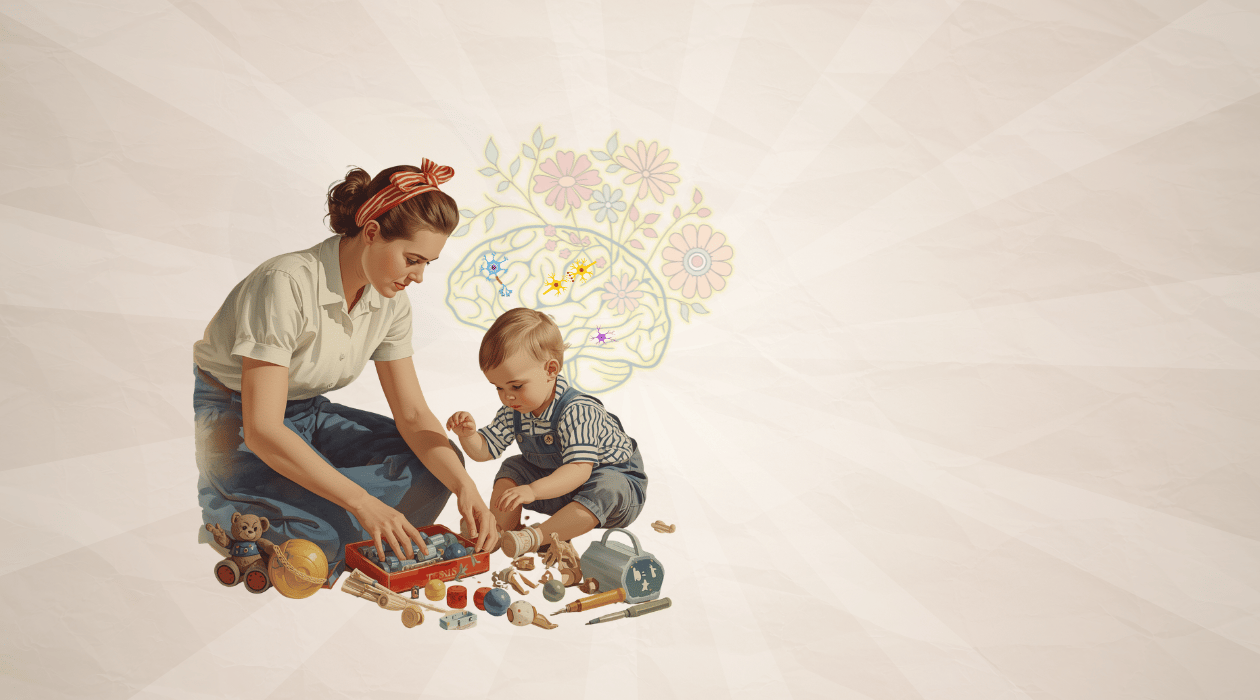
Parents tend to write off toddlerhood as messy, loud, and exhausting (because it is). But underneath that wild toddler chaos, a once-in-a-lifetime growth spurt is happening that you might not know about.
This is a huge, important moment for them—but it's also your time to shine!
Because right now, in this moment, is your greatest opportunity to influence how they'll think, feel, and show up in the world - for life.
If you're not totally aware of how important this developmental stage is, don't feel bad; you're not alone.
Most nights, by the time your kid finally crashes, you’re probably so mentally fried you can barely remember your own name, much less plan for tomorrow's breakfast or research preschool neuroscience.
That's what I'm here for.
☕So grab your tea, sit back, and enjoy this little tidbit of interesting information as you get to know your toddler better.
It's All About The Brain🧠
From about 1½ to 5 years old, your toddler’s brain is growing at lightning speed—by the time they start kindergarten, it’ll be nearly 90% the size of an adult’s (up from about the 25% it was at birth).
And it’s not just the size that's increasing — it’s complexity.
Every experience, every emotion, every interaction they have right now is literally shaping how their brain is wired.💻
This is the stage where they’re learning how to be human.
Right now, your toddler is forming the core of how they’ll understand and interact with the world, building the subconscious framework that will influence them for the rest of their life.
🎉🎉And here’s the exciting part: once you understand what’s happening in your toddler’s brain, you’ll begin to see their behavior in a whole new light because a lot of things that you might have found confusing will start to make sense.
And when the behavior makes sense, you’ll be able to respond to it instead of just reacting.
Maybe not perfectly (because nobody's perfect), but hopefully, you'll be able to parent with more intention and clarity once you unlock this information.
Because this stage can be so much more than just something to survive.
It can be the beginning of a really powerful time in your parenting journey.💪
And I promise, staying present and engaged as a parent becomes much easier once you understand what’s going on inside your child’s growing mind.
🚀 A Brain in Overdrive
Your child’s brain grows from about 25% to about 90% of its adult size between the ages of one and a half and five.
But it’s not just growing—it’s wiring itself.
Neurons are firing at lightning speed, forming new connections by the billions—over a million every second!
The big word for this is synaptogenesis (which just means the brain is creating new synapses—connections between neurons).
This is the stage when your child’s brain is literally building the foundation for all future learning, behavior, and emotional development.
And the incredible superpower behind it all?
Neuroplasticity.🧠
You’ve probably heard the term “neuroplasticity”—the brain’s ability to adapt and change by forming new neural connections. This adaptability is at its peak in early childhood.
Think of your toddler’s brain like the ultimate sponge—but more powerful.
It absorbs everything it encounters: language, emotional cues, social behavior, and everything in between.
But it's more than just a sponge.
Because your toddler’s brain doesn’t just soak things up and then let them go, in the way that water can be wrung out of a sponge.
It’s more like mixing flour and water to make dough. Once they’re combined, you can’t pull them apart again.
That’s how your toddler takes in the things they experience: everything they experience sinks to form new neural connections, to actually change the structure of the brain itself.
Their brain is constantly becoming something new with everything that happens in every moment.
Every single thing your toddler experiences - what they see, what they hear, what they touch, what they taste, everything they come in contact with, every person they interact with, and how those people act towards them and around them, and the experiences they have in society with groups and everything else - is helping wire their brain—literally shaping how it works.
Every. Single. Thing. 👀🔁
What this means is that everything your toddler experiences shapes their development in real time.
For toddlers, life feels like a full-on virtual reality experience—and their brains are recording it all.
Every moment is being built into the structure of their brain, creating the patterns they'll use to think, feel, and understand the world.
So, if their behavior seems chaotic, that’s often just a reflection of how much information they’re taking in and trying to process all at once.
They’re constantly working to organize, sort, and store everything into their growing and developing brains.
And if you think your toddler seems a little zoned out or extra dreamy, you're not imagining it; that's a toddler thing.
🧘♂️ Theta Brainwaves: The Hypnotic State of Toddlerhood
Your toddler’s brain is literally on a different wavelength than yours.
Toddlers operate mainly in what’s called the "theta" brainwave state, which is totally different from the faster-paced "beta" waves adults run on during our waking hours.
Theta waves are slower and more dreamlike - and incredibly receptive.
Adults can usually only get into theta during deep meditation, hypnosis, or right before falling asleep.
But between the ages of 2 and 6, your toddler’s brain spends most of its time in this slower, dreamier state that’s super open and absorbent. 📥💡
This kind of wide-open brain activity is exactly why toddlers often seem so spaced out.
But theta isn’t the only state they experience.
As they grow, their brains start dipping into what's called "early alpha"—a calmer, more focused state where they begin to take in the world with just a bit more awareness.
Alpha is the beginning of reflective thinking, the kind of brain activity that leads to focus, attention, and, eventually, self-control.
Early on in toddlerhood, these shifts don’t happen too often, but they do happen— and over time, especially when properly supported, as they happen more and more, they lay the groundwork for the more grown-up thinking patterns that come later.
So, while it might seem like your toddler is "zoned out" and unaware of what's going on around them, they're actually "super-plugged-in" to everything, and their brain is busy doing some very big, important work.
Now, let's get back to those "theta" brainwaves because we're not quite finished with that yet.
💡We know that in theta, the brain is in a dreamy, super absorbent mode.
This means that when your toddler hears, sees, or feels something, it goes straight into their subconscious, shaping their beliefs, emotional responses, and behavior patterns. (Remember: synaptogenesis)
They’re encoding everything around them into their brains, and it's going in deep, and just like mixing that flour with water, they're not just storing this information, they’re transforming it into who they’re becoming.
And here’s something really important to remember—toddlers don’t have a filter. They’re not thinking critically or asking themselves, “Does that seem right?”, “Should I believe this?” or "Does this make sense?" They have no way of doing this because their brain has no data stored to answer those questions (that's the database they're building now).
That little inner voice we all have as adults—the one that helps us pause, question, or double-check things?
They don’t have that yet.
Instead, they just take everything in exactly as it comes, soaking it all up while trying to figure out how the world works and how they’re supposed to be in it.
And while their brain is wiring up all those connections, at the exact same time, they’re also trying to understand what things mean.
They’re not just noticing what’s happening. They’re trying to figure out why it’s happening. Who does what? What gets a reaction? How words correspond to meanings and how actions cause other people to respond.
They're processing an unbelievable amount of information, and it's sinking in deep.
They’re always searching for little clues and patterns, constantly picking up on the “rules” of life—even if no one ever says those rules out loud.
So it’s not just that they’re absorbing facts or copying behaviors.
They’re continually trying to make sense of what things mean and stash that meaning deep in their subconscious, laying down the brain pathways they’ll use later on.
But they’re doing it all with no filter, no context, and zero life experience to help them figure out what actually makes sense.
That’s where you come in.
You might not realize it, but you are constantly and continually shaping how your toddler understands the world, just by what you say, how you act and react, and what you expose your toddler to in everyday life.
So you’re always parenting—even when you don't think you are. If your toddler's there, they're soaking it all in and wiring their brain around whatever's going on.
Whether you're having a great day or a nervous breakdown, they're taking it all in—turning your outer experience of the world into their inner blueprint. (Just like you did in the home of your parents.)
And it makes sense when you think about where we came from.
Not that long ago—even just a few hundred years ago and for all of time before that—life was harder and more dangerous for people, and there wasn’t much room for mistakes. Kids had to pick things up fast in order to survive in such a brutal world.
So, our brains adapted. They learned to take in information quickly—especially the rhythms of daily life and the rules for staying safe.
That’s why the brain is wired to spot patterns.
Nature runs on rhythms and patterns—sunrise and sunset, the changing seasons, hunger followed by eating, rest followed by renewal. Whether you notice it or not, the world runs on patterns.
Because we evolved in this natural world full of rhythms and predictable cycles, our brains became wired to spot patterns—it’s how we learned to survive. And right now, your toddler is in the most intense stage of that pattern-recognition process.
Your toddler’s brain is doing exactly what it’s supposed to—it’s constantly watching, listening, and soaking in patterns to figure out how the world works and what to expect.
That’s how they start to create safety in their lives.
Their brain is trying to lock those patterns in as fast as it can because once it does, life gets easier for them—they don’t have to think about every little thing all the time. In toddlerhood, this is where our habits and automatic behaviors start.
By around age six, that early wiring gets locked in as your child shifts out of the super-absorbent 'theta' state and into the more focused and imaginative 'alpha' state. That’s when their brain starts leveling up—so they can start to focus on the "higher" human behaviors, the things that hold a society together, like the more mature forms of emotional control, empathy, social skills, and problem-solving.
But these higher-level abilities grow best if there’s a strong foundation already in place.
Right now, during the toddler and preschool years, their brain is locking in the basics of emotional safety, cause and effect, empathy, and how to respond to the world around them. It's like they're taking the introductory course of "Life 101."
That’s why this stage matters so much—it’s not just cute chaos. It’s the construction zone for who they’re becoming and the core of their subconscious database.
But first, the brain just wants to know: what happens around here, and can I count on it?
This means that for your toddler, pattern-spotting isn’t some "party trick"—it’s their brain doing what nature built it to do.
🔁 Why Clear, Consistent Parenting Matters
Inside your toddler’s brain, there are billions of neurons—these are tiny cells that send electrical signals to each other.
When specific neurons fire together again and again, they form strong connections called “neural pathways.” An example of this in adulthood is when someone gets better and better at an instrument as they practice again and again over time.
Your toddler is creating billions of these pathways around everything in their life right now - language, movement, corresponding emotions to concepts, understanding social cues and rules, if you can name it, they're creating a pathway for it.
The more a thought, feeling, or action gets repeated, the smoother that pathway becomes and the faster and easier it is to follow. Think of it like carving out different trails to follow through the brain..
These paths become the brain’s go-to routes for how to think, act, feel, and respond.
🧠 One of the key players helping with this is something called the hippocampus, yet another part of the brain that's having major development during the toddler years.
The hippocampus is the brain’s inbox 📥—gathering experiences and emotional moments before sending the important ones off to long-term memory in the cerebral cortex.
The hippocampus processes short-term memories—especially the kind that link multiple bits of information together—and then sorts them into patterns. It also links experiences to emotions, and it's in charge of spatial memory, like remembering where the park is or where the toys are hidden. It's their personal GPS system, keeping track of where things are around them physically. 💾❤️
So, every time your toddler goes grocery shopping with you, or you read the same book at bedtime, or snack time comes after outdoor play, the hippocampus gets to work—holding on to that short-term information and preparing to transfer the important stuff into long-term storage.
Once a pattern has been identified and confirmed, or the emotion has tied itself to the experience, it gets classified as important and gets sent into long-term storage, kind of like moving files from your computer’s RAM to its hard drive.
That’s how your toddler begins building a deeper understanding of how life works.
So when you parent consistently, you’re helping your child’s brain understand what to expect, giving the hippocampus clear information it can organize and then save.
Every time you handle a situation the same way—calm voice, clear routine, consistent response—you’re teaching your toddler’s brain how to deal with the world.
At first, your toddler's reactions about lots of things will naturally come straight from the amygdala (that’s the panic part of the brain), but when you stay steady, their hippocampus (the part that builds memories and connects them to feelings) starts to step in and say, “Hey, mom’s not too worried about this, so I probably shouldn’t be either and besides, it also went okay last time.”
If that experience keeps happening the same way, the brain will start to believe it. Eventually, the hippocampus will take that calm, safe feeling and tag it to the experience, sticking a “this is fine” label onto the moment. When the pattern gets confirmed, it gets passed over to long-term memory—kind of like filing it away in the brain’s permanent records.
Now the prefrontal cortex (that thoughtful, decision-making part) has something to work with. It can say, “We’ve been here before. It’s not a big deal,” and help your toddler stay calmer next time.
But it’s a process, and something that needs to be built from the ground up.
This is how your child creates a sense of internal safety that’s strong enough to override and quiet that amygdala, which is the part of the brain that’s in charge when they’re a baby and always ready to scream “danger!” even when there isn’t any. When the hippocampus has enough data stored about different situations, the amygdala learns to chill out and save its energy for actual emergencies. 🚨😮💨🧠
The more this happens, the more their prefrontal cortex — the part that helps them think things through — can start to take the lead.
Bit by bit, they learn to respond instead of just react.
For example, take something simple, like getting your toddler into new shoes. 😱
If your toddler screams the first time you try to put new shoes on them, and you calmly follow through and make them wear them anyway, of course, making sure they actually do fit and are comfortable. When the experience is over, and they come back in the house and take them off after playing in them with no problems, their brain starts building a memory.
“The shoes didn’t hurt me. That was okay.”
The next time it happens, if you respond the same way, their brain reinforces that pattern. After a few rounds, their memory of safety and predictability helps quiet the fear, and the screaming stops.
They “get used to” the new shoes.
That’s the brain rewiring itself in real time.
Here’s another example: If your child gets a time-out every time they try to run into the road, their brain starts to connect the behavior (running into the road) with the consequence (the time-out).
This causes the hippocampus to make a note of the emotional discomfort tied to the experience, like frustration or disappointment, because they can't play with their friends.
If this happens the same way every time, that emotional memory gets filed into long-term storage as: “Running into the road = unpleasant outcome.”
Then the prefrontal cortex gets in on the action. 👀
It starts working with the hippocampus by creating a stronger link between the behavior and the memory. Neurons that connect the action with the consequence begin to fire together more easily, reinforcing the pathway.
As these neural pathways become smoother and faster, it gets easier for your child’s brain to connect the dots.
The connection gets deeply embedded (remember those theta waves? 🧠✨), and voila! Avoiding the road eventually becomes automatic—a habit they don’t even have to think about because their brain has wired it right in.
But to build clear, strong pathways, your child needs consistent, repeated experiences, and this is where a lot of parents drop the ball (and I've noticed this happens a lot with sleep training.)
They try something once, and if it doesn’t work instantly (if their child reacts from the amygdala🚨, which let's be honest, will probably happen), they interpret their child crying or resisting as failure, so they give up and switch strategies immediately.
They try something else, and when that doesn’t work straight away, they switch again... and again. You get the idea, but this type of parenting actually makes life harder for your toddler.
Think of your toddler’s brain like a computer running essential software updates. 🖥️
If those updates keep getting interrupted—or worse, if they contradict each other—the whole system starts to glitch.
The same thing happens in your child’s brain.
If the messages and experiences they’re getting are inconsistent or constantly changing, the brain struggles to find the clear patterns it needs to understand how the world works.
And when there’s no predictable pattern to hold onto, their sense of safety takes a hit.
That’s when you start seeing more acting out, more frustration, and more emotional chaos—not because your toddler is “bad,” but because they’re overwhelmed and unsure. Without clear and consistent signals, they just can’t figure out how the world is supposed to work.
The tricky part? 😳
As a parent, you might be misreading their behavior as rebelliousness or stubbornness or thinking they're just a bad kid with something "wrong" with them, when really, it could be a signal that they need more consistency and clarity from you.
Some parents get so overwhelmed by their toddler’s big reactions—like screaming, tantrums, or hitting—that they end up giving in just to keep the peace. But when that becomes the pattern, the child internalizes that panic, aggression and chaos are the way to get what they want. Over time, this can create an unhealthy dynamic where the child’s stress response ends up running the show.
That’s why it’s so important to pay attention to how you’re responding when your toddler acts out.
If you’re getting caught up in the chaos—changing your approach every time or reacting out of panic (and letting your toddler bully you)—you might accidentally be making things harder for both of you and actually creating more problems in the process.
The good news? 🎉😁
You can choose to do better from this moment on, now that you've got some new information.
You don’t have to be perfect, just intentional, because when it comes to your toddler’s rapidly growing brain, even small, consistent efforts can go a long way.
💛 Remember, the window is still open, there's still time to influence their subconscious and embed more clarity and better patterns.
So it's important to remember that life will feel overwhelming and frustrating for most toddlers until they develop the emotional skills to manage those big feelings and control their reactions. Right now, their brains are working really hard to make sense of everything in the world while learning how to handle it all emotionally, based entirely on the experiences and responses they get from the adults around them.
So understanding what they're going through from a brain perspective can be helpful, because ignorance is not bliss when it comes to parenting.
When parents misunderstand the science behind the behavior and misread the cues, it can lead to reactive parenting—responding out of frustration or panic instead of calm, intentional guidance, but when parents do understand this, they can take control of their parenting choices and start to parent with confidence.
And part of that means recognizing that not every toddler meltdown is an emergency.
Teaching your own 🚨amygdala to take a step back when your toddler is having a tantrum, and allowing your prefrontal cortex🧘♀️ handle it, might be helpful.
In my 10 years of daycare, I often saw parents treating every toddler meltdown like a crisis that needed immediate fixing.
But toddlerhood is naturally frustrating, sometimes discomfort is just part of the process and toddlers are still learning to handle big emotions.
Your role is to:
- Stay grounded and guide them through those choppy moments,
- Not to lose control every time they get upset, and
- Try to understand that even though reacting by screaming was your baby’s first go-to behavior, your toddler is in the process of learning to shift away from that. But they won’t always get it right.
🧠 Toddlers React, But They're Learning To Respond
Right now, your child’s brain is running the show from the amygdala—the part responsible for emotion, instinct, and keeping them safe.
That’s why so much of toddler behavior feels reactive: because it is. The amygdala reacts first and fast.
Meanwhile, the prefrontal cortex—the area that helps with reasoning, empathy, and self-control—is still under construction.
Their brain won’t be fully developed until their mid-20s, but right now, about 90% of that growth is happening. So, no, your toddler can’t think ahead or connect actions to consequences just yet. But this is the phase where they're learning and embedding the basics of all of those things.
And that’s not easy, because a lot of these important lessons won’t feel good in the moment, and they’ll come with big, dramatic reactions that can feel totally out of proportion. So when your toddler screams for a snack, melts down over the wrong socks, or clings to you like Velcro, that’s just their survival mode kicking in.
But that doesn’t mean you’re off the hook.
Because what many parents don’t realize is that your toddler’s brain doesn’t know it needs to learn to be a person who fits into society.
It just notices what gets the quickest response.
👉 So if yelling gets them what they want faster than waiting calmly, their brain thinks: “Great! That works. Let’s keep doing this.”
The brain doesn’t stop to question if that’s polite or sustainable—it simply chooses what gets results. And because toddlers absorb everything without filters or second-guessing, whatever works is what gets wired in as a go-to response.
This is where your role becomes incredibly important and powerful because how you respond, support, and guide them shapes their brain in real-time.
Think of yourself as the lead software engineer of your toddler’s brain.
The hardware’s there, but the operating system is still uploading.
Everything you model, repeat, and reinforce shapes their internal code, and you’re working with one of nature's most powerful and efficient little systems.
And when it comes to emotions, the real work happens when your toddler is feeling those big feelings.
🚨How Your Toddler Learns To Manage Big Feelings
When your toddler's upset or overwhelmed, it’s not just a meltdown—they’re literally in the middle of a brain development storm.
At this stage, their emotional reactions are mostly driven by a small part deep inside the brain called the amygdala. I've mentioned it before, but let's have a refresher.
Think of the amygdala as the brain’s early-warning system—always on high alert, ready to react to anything that feels uncomfortable, including feelings that are scary, frustrating, or overwhelming.
It’s fast and automatic and not very good at calming down once it’s triggered.
The part of the brain that helps us think things through, make calm decisions, and control our impulses, the prefrontal cortex, is still in "growth mode." If you'll remember, at birth, it’s only about a quarter of its adult size, and this is the time when it's growing and developing fast.
What This Looks Like In Everyday Life 👀
When your toddler gets upset, it’s that amygdala kicking into high gear because their prefrontal cortex isn't ready to step in and help them calm down and respond thoughtfully.
This is why toddlers often react with big emotions that seem way out of proportion—they don’t yet have the brain tools to handle those feelings in a calm, controlled way.
Yes, over time, they will get better at processing those big emotions as the growing prefrontal cortex gets stronger and more capable of helping your child manage them. But that kind of brain growth doesn’t just "happen"—it needs real-life, hands-on practice from the inside out.
Toddlers can only learn how to handle their big feelings by actually feeling them. They need to practice riding those waves of intensity and learning how to rein things in on their own.
That’s where you come in.
Your job right now—hard as it may feel—is to give your toddler the space to practice handling their emotions, and that can mean stepping back, letting the feelings run their course, and resisting the urge to jump in and "fix" it all right away.
This is why you give a time-out and let them cry it out.
Why you wait until they stop screaming before you give them what they asked for.
Why you walk away from a tantrum and only talk about it after they’ve calmed themselves down.
It’s also why begging, bribing, or pleading just to get them to stop doesn’t help and actually interrupts the emotional learning they need to do.
Your ability to stay calm and let them ride the wave matters more than you think. And yes, that’s a skill you may need to work on because, like any skill, it might just take some practice. 💪
Because when you allow them to do that emotional work on their own, you’re actually helping their brain build and strengthen the pathways they’ll need to handle things like frustration, disappointment, and stress as they grow.
In other words, your toddler’s big emotions aren’t a sign that they’re “bad” or “difficult” or even that they're being traumatized if it's happening in a normal situation where you know they're safe and nothing's wrong.
For example, if you put your toddler in a time-out and they cry because they don’t like it, that’s not trauma, that’s learning. It’s learning to sit still, deal with a consequence, and begin to understand that actions have outcomes.
Letting them sit until they calm down—without jumping in—gives them the chance to start managing those big feelings on their own.
📥📍It also gives the hippocampus something valuable: a moment it can sort, attach emotion to, and begin preparing to store as a memory that shapes how they'll respond to whatever gave them the time out (and other similar experiences) in the first place, in the future.
(Of course, I'm not telling you to turn a blind eye to actual trauma or real problems, but I am saying use your common sense.)
Sometimes, crying and acting out is simply a natural part of how the brain learns how to grow, develop, and eventually take charge of big feelings, and if you can start to see it as the work that your child needs to be doing right now, you'll be able to calm that reactive instinctual "mom feeling" you get when you see your child in distress and appreciate that they're doing the hardest work of their little lives when big feelings hit.
But there's a lot more to their emotional growth than you may have realized.
Up until now, we’ve talked a lot about how your toddler’s brain is being shaped by routines, repetition, and the patterns they experience in everyday life.
But there's another kind of pattern that matters just as much, that we haven't really explored in depth, and that's emotional patterns.
Because it’s not just what you do that wires your child's brain. It’s also how you communicate your feelings while you’re doing it.
This is because your emotional state has a direct impact on your toddler’s developing nervous system. One of the biggest ways toddlers learn how to handle their emotions is by watching how you handle yours.
It’s called co-regulation, and you’ve been doing it all along—probably without even realizing it, so let’s break it down.
🧠 Co-Regulation: How Your Emotions Shape Theirs
At this stage in your toddler’s development, they can’t really understand or manage their emotions on their own yet. So instinctively, they rely on the emotional cues they get from you.
They watch you closely to figure out how to react and respond in different situations, kind of like starting a new job and watching how everyone else acts to figure out what's expected.
Your toddler’s brain is still wiring up the systems that will one day help them both understand and manage their emotions. But until that happens, they rely on something called co-regulation—a biological process where a more mature nervous system helps shape and stabilize a developing one, guiding emotional responses in real time.
Your child uses your emotional state like training wheels for their nervous system—borrowing from the emotional signals you're sending to help them learn to match their own emotions to actions and situations.
This is real science, and I saw it play out over and over in my daycare. The kids with calm, steady parents always found their emotional footing faster, while the ones with anxious or overwhelmed parents struggled more emotionally.
When your toddler gets upset or overwhelmed, their nervous system sends out distress signals, and they look to you for guidance.
Say they melt down because they got the blue plate instead of the red one they were expecting at lunch. That’s their amygdala in action—the part of the brain that was in charge when they were a baby. It still reacts fast and big, especially when things don’t go as expected.
And right now, it still wants to run the show.
But when you stay calm and hold the boundary—sticking with the blue plate and letting them melt down until they get themselves under control (without you freaking out or panicking)—they start to learn that getting the "wrong" plate isn’t actually a crisis.
In that moment, your steady, calm response helps soothe their nervous system. You’re showing them there’s nothing to panic about—and giving them the chance to feel panicked, work through it, and realize that there's nothing to freak out about as well.
And their developing hippocampus and prefrontal cortex take note, building the connections they need to handle it better next time.
Every time this happens, it gives those thinking parts of the brain a chance to step in and start steering through frustration, disappointment, and life’s curveballs.
Think of it this way: every time you stay calm while they’re losing it, you’re teaching because their brain is watching and learning what calm looks and feels like.
By letting them freak out and then calm down themselves, you’re helping your child's brain practice returning to a steady baseline.
But here’s the flip side: every time you don’t respond calmly—if you yell, shut down, or explode—that gets wired in, too, because their brain is always scanning for emotional patterns and examples to follow.
Whatever responses they’re exposed to most often—good or bad—become the emotional template they’ll start to internalize.
So when you’re frustrated and reactive, your toddler doesn’t just notice it—they absorb it and become it. (Remember, those theta brainwaves that make them super open to taking everything in around them deeply? They're still at work here.)
Because their brains are still in a state of high plasticity, they are especially sensitive to emotional input.
This is why your mood, tone of voice, and body language all have a powerful effect on how your child learns to process emotions, manage stress, and interact with the world.
They need your nervous system as a guide. You’re their external regulator while they build their internal one.
And here’s the best part: you don’t need to be perfect. You just need to be consistently calm enough that your toddler learns, “When I’m overwhelmed, I can look to Mommy to help me find my calm.”
Everybody loses it once in a while, but if you're mainly calm and steady, your toddler will pick up the strongest pattern.
So remember, the emotional signals you send now lay the foundation for your child’s ability to self-soothe, bounce back from challenges, and develop real emotional coping skills later on. The calmer and more in control you can appear in stressful situations, the better it is for your child.
But emotions aren’t the only thing wiring up in these early years—there’s one more big piece of the puzzle.
Because, while your toddler’s brain is busy developing emotional and social skills, it’s also hard at work bringing the rest of the body online as well—laying down the pathways that support movement, coordination, and physical control.
So let’s take a quick look at how that brain-body connection is coming together—and the importance of your child's need to move, play, and explore.
Brain & Body: The Big Developments Hiding in Plain Sight🧠💪
While tantrums and social skills often steal the spotlight during the toddler years—and for good reason—there’s another crucial area of development happening right in front of you that often gets overlooked: the brain-body connection.
And just like emotional and social development, this system also needs to be fed.
Toddlers don’t just want to move, touch, climb, and explore—they need to. It’s how their brain wires itself to the body, and without that hands-on experience, vital parts of their development can lag behind.
Let's go back to the idea of a brand-new computer that’s still setting up all its systems.
Right now, it’s busy installing the software that helps their body move—coordinating big movements like jumping and running, and fine-tuning smaller ones like gripping a crayon.
Every time they climb the stairs or pick up a crayon, when they're balanced on one foot or even struggling to zip their coat, their brain is wiring up the pathways needed for muscle coordination, balance, and control.
And it’s not just about gross motor skills (like running and climbing) or fine motor skills (like holding a spoon or picking up tiny objects).
It’s about building a massive, complex communication network between the brain and every part of the body through trillions of signals flying between neurons and muscles, building the internal maps that make everything from walking to writing and everything in between possible later on.
Just like emotional growth and language skills, motor development also needs real-world practice to take root.
Your child needs plenty of chances every single day to move their body, test their strength, explore different textures, and use their hands and fingers. And in my experience running a daycare, the very best place for that kind of development is outside, in nature.
Whether it’s a trip to the park, a slow walk around the neighborhood, or a few hours in the backyard (and yes, this really does need to happen every single day for at least an hour), these simple moments create the experiences your toddler’s brain needs to grow strong and well-connected.
Yes, getting your child outside regularly, bundling them up for the weather, or setting up a sensory play area at home might feel like one more thing on your already full plate. But for your toddler, this kind of movement and hands-on exploration is essential.
It’s how the brain learns to connect with the body and is a key part of healthy development.
Toddlers constantly crave it, and when they don’t get enough, they will instinctively find a way to make it happen.
So a lot of the things they might do that drive you nuts—like being restless, climbing on furniture, touching everything, or getting into stuff they shouldn’t—these might actually be their brain's way of telling you, “I need more physical stimulation!”
The brain doesn’t know these behaviors are going to get them in trouble or wear you down—it’s just doing its job: wiring up connections by fueling your child’s urge to move, touch, and explore.
So what you may see as annoying from an adult perspective are probably the behaviors that are helping to wire the systems that control movement, coordination, focus, and even emotional regulation in your toddler (because there is a connection between small motor refinement and emotional regulation).
Play can't be the reward after the "real" stuff gets done—it is the real stuff. It's just as important as things like brushing their teeth, regular baths, and getting enough sleep, and it needs a permanent spot on the daily checklist.
And I don’t mean paid, organized sports.
I’m talking about free play: the kind where your child gets to move, explore, and follow their curiosity without a schedule or structure (or you interfering.)
This matters.
Physical activity in early childhood supports not only coordination but also cognitive skills like focus, memory, and problem-solving, and it is one of the most overlooked and misunderstood parts of modern toddlerhood.
People seem to think they can throw money at a sport their toddler does once or twice a week for 1/2 an hour, and that's enough, or they think giving them a device to keep them quiet is a good thing. Those things might make you feel better, but they're not good for your toddler's brain development.
The more your toddler moves and uses their hands (in the real world, NOT on devices), the more brain pathways they build and reinforce.
So go ahead—let them climb, jump, wiggle, balance, lift, throw, and slide. Let them fall down and then get back up and then fall down again.
It might look chaotic, but it’s exactly the kind of “messy magic” their brain and body need to build a solid foundation for life.
💡 The Last Word...
Understanding what’s going on in your toddler’s brain won’t magically stop the tantrums or make every day feel easy—but it will change how you see things.
You’ll start to recognize what you used to think was bizarre or infuriating behavior for what it truly is: signs of a brain under construction, working overtime to wire itself for life.
🦺🔨Right now, your toddler’s brain is:
- building its emotional toolkit
- locking in habits
- learning how the world works
- and getting its brain-body connections sorted out
And you?
You’re the manager of this incredible project—guiding, supporting, and shaping the systems that will carry your child through life.
With every:
- Calm boundary you hold
- Big emotion, you let them work through
- Moment you model strength and integrity
- Clear, consistent pattern you build into their day
- Hour you spend on a park bench so they can play or walking around the block with them
You’re giving them the opportunity to lay the foundations for a happy life.
Because all of it—the calm, the boundaries, the patience, the play—it all adds up to the greatest gift you can give your child: a strong, well-wired, and resilient brain.
My hope for you is that the more you understand what’s happening beneath the surface, the more clearly, confidently, and intentionally you can show up for your child in these formative years.
So take a deep breath, and remember: You’re not just surviving the toddler years—you’re actively helping to build a human.
And that makes you a powerful part of something truly incredible.
Because you've got this, Toddler Mama!
And I've got you!
💛 Ready to level up your parenting skills?
If this blog post touched upon some parenting abilities you'd like to strengthen, maybe these can help:
Check out this resource I designed especially for toddler moms who want to work on creating stronger routines and better consistency:
Read the blog post that inspired the resource here:
Check out this resource I created especially for toddler moms who want to work on co-regulation skills:
Want to read more about Co-Regulation?
- Can Toddlers Absorb Their Parents’ Feelings? How your emotions shape your child’s behavior and nervous system🧠
Want to understand your toddler's tantrums better?
Check these out:
- Why Do My Toddler's Tantrums Get Worse When I Try To Discipline? The Science Behind Those Big Reactions and How to Parent So They Stop
And...
And...
😱😱😱And if you want some help dealing with tantrums, check out this FREE resource I've created just for you, Toddler Mom:
🎉🎉🎉Feel free to check out all of the FREE RESOURCES I've created to support you on this journey.