
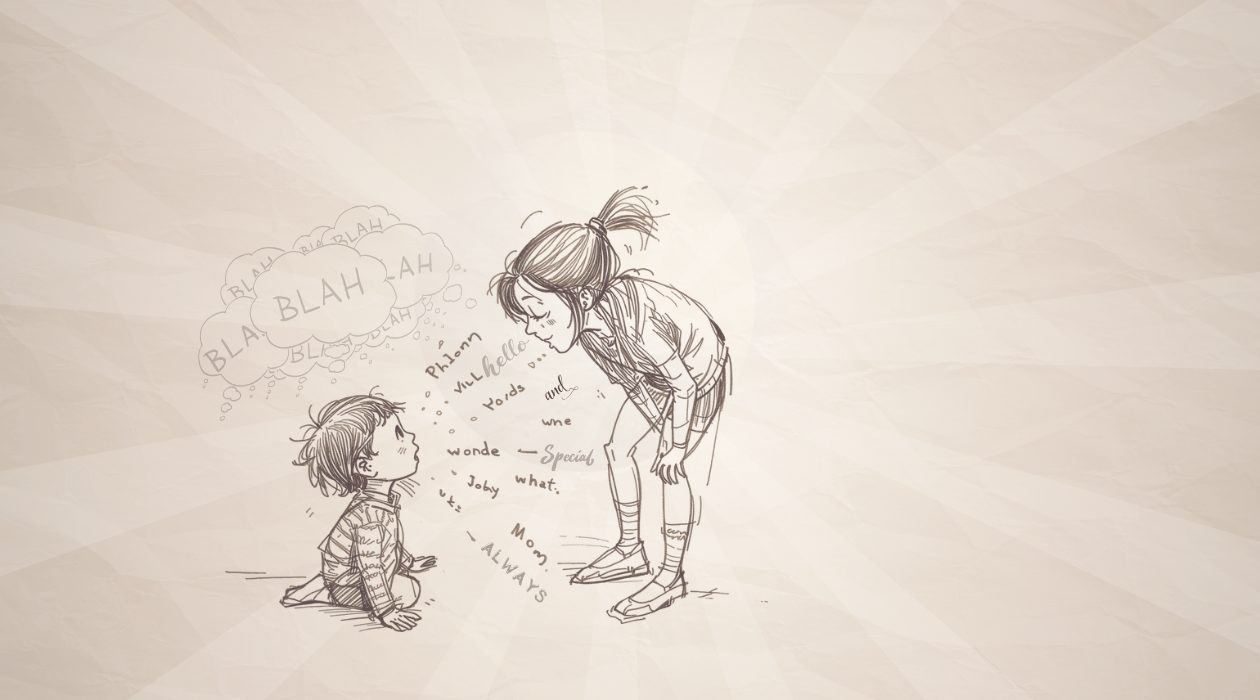
Tell the truth — does “I JUST told you!” feel like your catchphrase?
If it does, you’re not alone — and your child isn’t broken.
In fact, it’s quite the opposite — and I’ll tell you why. But first, a walk down memory lane (from this morning 😉):
You’re standing in the kitchen. It’s 8 a.m., you’re already tired, and somehow also overstimulated (maybe because you’re on your fourth cup of coffee☕).
You’ve said it three times now.
“Put your cup in the sink, go brush your teeth, get your backpack and then get your shoes and coat on.”
Your toddler looks at you.
Nods.
Then walks away.
Not to the sink.
Not even in the right direction.
Five minutes later, the cup is still on the table. They still have cereal breath. The shoes are nowhere to be seen.
“Come on! We’re going to be late. Put your cup in the sink and get your shoes and coat on — there’s no time to brush your teeth now.”
You’re irritated — because now you’re late, and this happens every morning.
To make it worse, your toddler is melting down now, so you repeat yourself — again — but this time at a higher volume. Because now you’re in a rush.
You start to feel that familiar pool of sweat forming in the small of your back — that mix of anger, disbelief, and "why is this so hard?" rising in your chest.
Because now, it feels personal:
- They heard you.
- You speak the same language.
- They’ve done this before.
So what gives?
From where you’re standing, it looks like your child is ignoring you, being lazy, or just… bad.
And if you’re being honest, a very real part of you is probably thinking: "Why are they being such a jerk right now?"
But before you commit to that viewpoint, I want to explain something about your child’s developing mind that might shift your perspective — and open the door to a little more compassion — because what you’re seeing might not be bad behavior at all.
It might be the signs of a developing brain hitting a very real limit.
The Secret Truth Behind This Toddler Behavior
One of the hardest parts of parenting toddlers is that developmental limits don’t announce themselves.
Your toddler can't look at you and say, "I'm having growing pains," or "I'm sorry, mommy, when I'm overtired, I just can't hold my sh*t together."
These things show up as behaviors.
Because your toddler can't analyze what they're experiencing and then explain it to you.
They can only react to how it's making them feel.
And when you can't see what's going on behind the behavior, it can get frustrating and annoying.
In my 10 years in daycare, I noticed that the limits of the toddlers' working memory led to some of the most misunderstood—and emotionally triggering — behaviors for parents.
What Working Memory Is Not
Before I dive into what working memory is, let's talk about what it's not:
- Working memory is not about intelligence.
- It’s not about willingness.
- And it’s not about respect.
Working memory is simply the brain’s ability to hold a small piece of information in mind long enough to use it.
That’s it.
- Not attitude.
- Not a character flaw.
- Not a moral failing.
Just capacity.
Adult Working Memory vs. Toddler Working Memory
(Spoiler: These Are Not Comparable)
As an adult, your working memory can hold roughly three to five chunks of information at once. You’ve also had decades of practice organizing, prioritizing, and retrieving information under pressure.
Your toddler's had… a year? Maybe two?
And they’ve only been practicing it through games like Peekaboo, blanket hide-and-seek, or songs like Eensy Weensy Spider.
These are great — and very age-appropriate for babies — as a starting point for working memory.
Think of them like the working memory warm-up — helpful and important — but not the workout that actually builds strength for real life.
Those games introduced the skills, and now your toddler is ready to start real-life practice to learn how to use them.
That’s where your child is now.
At first, most toddlers can hold only about one small piece of information in their minds at a time.
On a good day, maybe two.
And even then:
- It fades quickly.
- It's easily disrupted.
- And under stress, those thoughts can disappear completely.
This doesn’t necessarily mean there’s anything wrong with your child. And this isn't just "happening" to you.
This is what toddler parenting looks like for everyone, and there's a reason for that.
Building working memory is like building a muscle — it's not very strong at first, you need to work it and use it to build strength over time.
But as with any workout, pushing too hard at the beginning isn't helpful and can actually backfire.
How Toddlers "Lose" Instructions
When you say: “Put your toys away, turn off the TV, and get your shoes and coat on.”
And your toddler:
- Just sits there
- Grabs a toy
- Or jumps directly to putting their coat on
What likely happened is this: The instructions entered their brain — but they didn’t stay there.
Working memory only holds information for seconds, not minutes.
If your child:
- Takes too long to get started
- Gets distracted by their environment (TV, device, pet)
- Becomes internally disrupted by a big emotion
- Sidetracked by curiosity
The information gets dropped — like a Wi-Fi signal that's not strong enough to hold the connection.
It's not necessarily because they weren’t listening.
It's more likely they heard what you said, and it may even have registered, but they couldn't keep the thought in their working memory long enough to act on it.
This is why toddlers will often do some of what you tell them, but not everything, and what they end up doing can seem random.
So, even though this can look like they’re just doing what they feel like on purpose, it might actually be their untrained working memory just doing its best to keep up.
"They Should Know Better" vs "They're Learning To Remember Better"
Your child knows the rules — you know they do.
And yes, toddlers do learn rules, and they don’t disappear overnight.
But here's the thing — rules aren’t stored in working memory.
They live in long-term memory.
For a toddler to follow a rule in the moment, their brain has to do a lot all at once:
- First, they have to remember the rule — which means pulling it out of long-term memory and holding it in working memory.
- Then they have to keep it in mind long enough to use it.
- Then they have to apply it correctly to what’s happening right now.
- At the same time, they're managing their feelings and impulses and navigating everything going on around them.
Does that sound like a big job for such a little person?
Because it is.
And if their working memory is already overloaded — by hunger, fatigue, frustration, or chaos — the rule may not be reachable in that moment, even if it’s fully learned.
This is one of the many reasons why toddlers might not follow the rules.
So this means that sometimes they're actually not testing you — it's just that, with so many other things getting in the way, it can be hard for them to hold onto the information.
How Multi-Step Instructions Can Set Toddlers Up to Fail
When you say: “Put your cup in the sink, throw out your garbage, wash your hands, and come sit down.”
Here’s what you experience:
- One sentence.
- With words that already have meaning for you.
- With actions you’ve done thousands of times.
- You know precisely how long each step will take.
- You know exactly where everything is in your house.
- You automatically organize the steps in the most efficient order.
Your brain does all of this instantly — without effort — because it’s fully developed and backed by years of experience.
That is not your toddler’s experience of that same sentence.
Here’s what your toddler’s brain experiences:
Four separate demands, not one sentence.
Then they have to put all that information into a working memory, which, up to now, has been in introduction mode. (Remember Peekaboo? They only had to remember it was you behind the hands.)
Not only that, but they're also doing this:
- Figuring out or remembering what each word means.
- Putting the physical actions to the words in their head.
- Trying to put steps into an order that isn’t obvious or intuitive yet.
- Without knowing precisely how long any of the steps will take.
- While trying to picture where each action happens in a space that might not be fully mapped into their brain, yet.
- While possibly dealing with hunger, tiredness, noise, excitement, or other distractions.
- And trying not to go completely offline under the stress of being pressured to rush, or being yelled at.
So instead of one clear instruction, your toddler’s brain is trying to juggle multiple pieces of information inside of a system that’s still under construction.
(And let’s be honest — if you had to start from scratch, learning new skills in a language you’re just beginning to understand, under all that pressure, you’d probably struggle too — even as an adult.)
With that in mind, it’s easier to see how what looks like “not listening” from the outside could actually be a brain running out of space and an emotional system shutting down under pressure.
And if you misread the behavior, frustration builds — and you risk putting them in an impossible position, one that even you likely couldn’t handle as an adult.
When that happens, important skill-building moments can slip away.
Pressure doesn’t build responsibility in an underdeveloped system — it overwhelms it.
And here’s another thing that might seem small, but really matters: Your toddler won’t ask you to repeat directions if they forget them — because they don’t even know that's an option.
So when the information drops, they don’t clarify—that’s adult behavior.
They move on.
The Tantrum That “Came Out of Nowhere"
And this is where parents can get pulled into emotionally reacting to the behavior instead of responding to the need.
And that’s not your fault — you can't respond to something you don't even know is happening.
And if your parents were emotionally reactive people, those patterns were likely modeled for you — making them your natural baseline.
The good news is: Knowledge is power, and that's what this is all about.
Here’s how this can play out — and how it can draw you into a cycle of reaction instead of response:
You made a simple request:
- They didn’t do it.
- You repeated yourself.
- They started — then stopped.
- You got frustrated, turned up the volume, and said it two more times — tacking on “Hurry up! We’re late!” to make your point.
- Now they’re screaming.
- And now your switch has been flipped.
Because what feels like disrespect taps into a million old emotional moments — and now you’ve lost it.
From your perspective, it feels on purpose — maybe even manipulative.
After all, they looked you straight in the eye the first time you said it.
From their nervous system’s perspective, it’s overload.
When working memory is overwhelmed, the brain can’t problem-solve its way forward — and neither can yours, by the way, even as an adult.
Add pressure — rushing, frustration, raised voices — and the stress response takes over.
At this point, your child isn’t choosing anything.
They’re reacting to the stress chemicals coursing through their blood.
Why Yelling Makes Memory Worse, Not Better
Stress chemicals don’t motivate the toddler brain.
They shut it down.
When you rush, pressure, or yell at your toddler, it sets off the danger alarms in their brain and pushes them into survival mode.
When this happens, working memory goes offline — so your child can’t hold information, think things through, or learn in that moment.
If this happens once in a while, the brain can recover.
But when it happens over and over, it doesn’t just interrupt working memory in the moment — it interferes with how those brain pathways strengthen over time.
So no — getting louder and pushing harder doesn’t teach toddlers to remember better.
It actually works against the brain development that’s trying to happen.
How to Support Working Memory By Parenting More Intentionally
Supporting your child's working memory isn't about lowering your expectations — but it is about adjusting how you approach helping your child meet them.
Yes, their working memory is limited right now, but with a solid system in place, you can help strengthen this mental muscle in a way that takes pressure off both of you.
And this starts with becoming more deliberate about how you deliver directions.
What helps:
- Short, clear directions: Breaking things down into one clear instruction at a time helps your child's brain keep track of what to do. Keep directions simple, make them obvious, and don’t use too many words.
- Give hints to jog memory: If they forget what you asked them to do, try giving them a little hint before saying it again. For example, you could say, "Do you remember where we put the juice boxes when we're done with them?"
- Be intentional with your instructions: Don't just rattle them off casually. When you want your toddler to do something, slow down, focus on the moment, and give them your full attention.
- Watch to see what's registered: When you tell your child to do something, take a second to see how they react. Do they look confused or unsure? If they seem like they’re having a hard time, take a moment and say it again. They might need you to repeat yourself, but may not know how to ask you to.
- Match the load to their capacity: If your child can hold one thought, start there. Let success build strength.
- Visual and physical supports: External cues can help lighten your child's mental load, making it easier for them to follow through. Try things like pointing them in the right direction—for example: taking them to the shoe cupboard and showing them where their shoes are—then stepping back once they can handle it on their own. Make a sign with a picture that shows what something does or where it goes. Let their eyes and body help jog their memory.
- Calm repetition: Repetition isn’t failure — it’s practice. Calm repetition strengthens recall. Your calm nervous system helps support theirs, and when they feel calm and safe, they learn and remember better.
- Gentle resets instead of takeovers: If they get distracted, gently reset the task. Physically take them back to where they need to be and start the process over again.
- Affirmative language: Say what you want them to remember. Negative phrasing doubles the cognitive work.
Two Quiet Supports That Matter More Than Most Parents Realize
(AKA Pro Tips):
1. Real jobs give toddlers repeated, meaningful practice holding information and acting on it.
In Montessori classrooms, there’s always an area called Practical Life. This is where children do real-world activities like sweeping, wiping tables, or watering plants. The reason for this is simple: toddlers are naturally drawn to the work they see adults doing. They are far more interested in real tasks than pretend ones.
Toddlers don’t want to play at being helpful — they want to actually be helpful.
That’s why everyday jobs at home are such powerful learning opportunities. Letting your toddler help load the dishwasher (with safe items), carry recycling to the bin, put toys or laundry away, or wipe a surface gives their working memory real practice. These tasks require them to hear an instruction, hold it in mind, and act on it — all in a way that feels meaningful to them.
In my daycare, the children did things like put their beds out for nap, set and cleared the table at lunch and snack, delivered and sometimes served meals to one another, and older children even helped feed younger children. They cleaned up the daycare and did any jobs they could safely do.
It made them feel proud and happy when they could pitch in and be helpful.
When you use real-life jobs as opportunities to give directions, the work sticks better. It’s more engaging, more motivating, and far more impactful than abstract instructions or pretend play.
2. Consistent routines reduce mental load by making the world predictable.
When toddlers know what to expect, they feel more secure. And when they feel secure, their stress levels are lower. That matters because a calmer nervous system allows the brain to stay in learning mode instead of shifting into survival mode.
Predictable routines also support working memory in a very practical way. When the rhythm of the day stays the same, toddlers don’t have to constantly figure out what’s happening next or scan their environment for clues.
That frees up mental space.
When rules and daily rhythms are consistent, toddlers aren’t constantly pulling information out of long-term memory just to orient themselves.
They don’t have to keep re-analyzing the world around them to feel safe or understand what’s expected.
And when less mental energy is spent figuring out what’s going on, more is available for learning, following directions, and staying regulated in the moment.
That’s what routines really do: they give working memory more room to do its job.
The Reframe That Changes Everything
Some of the behaviors parents label as “bad” are actually signs of a brain struggling at the upper limit of its current capacity.
And when you think your child is being bad, your brain shifts from empathy to aggravation.
But making that shift the other way can be the difference between parenting from a place of frustrated anger and parenting from calm intention.
When you shift from:
- They’re being bad.
To:
- They seem overloaded.
Everything changes because you can finally breathe.
You can stop pushing.
And start helping.
And when you do that, your child's development becomes supported — not because you demanded it, but because you made it possible.
Your toddler isn’t broken.
They’re building.
And so are you.
You don’t have to do this perfectly.
All you have to do is try to meet your child where they are and shift your mind from frustration to intention, and in no time, you'll both be doing more than just getting through each day; you'll be thriving.
You’ve got this, Toddler Mama.💛
And I’ve got you.
To get a simple 3 Step Method complete with a FREE Cheatsheet, you can hang on your fridge, read this:
How to Get Your Toddler to Listen and Follow Directions Better — An Easy 3 Step Method That Helps The Message Get Through
If you want to understand why your toddler can make you so angry sometimes, read this:
Why Does My Toddler Make Me So Angry? Science says there's a reason for this, and I have strategies that help.
And if you want to work on calming the dysregulation that "mom rage" can cause, through awareness and intention, I've created a FREE resource just for that:
The Mindful Mama Reset: Awareness Tools for Mom-Rage Dysregulation & Recovery.
Read more about how your nervous system affects your toddler here:
Do My Feelings Affect My Toddler's? How your emotions shape your child’s behavior and nervous system.
And to work on co-regulation through awareness and intention, try this FREE resource I've created just for you:
Mindful Mama: Awareness Tools For Co-Regulation