
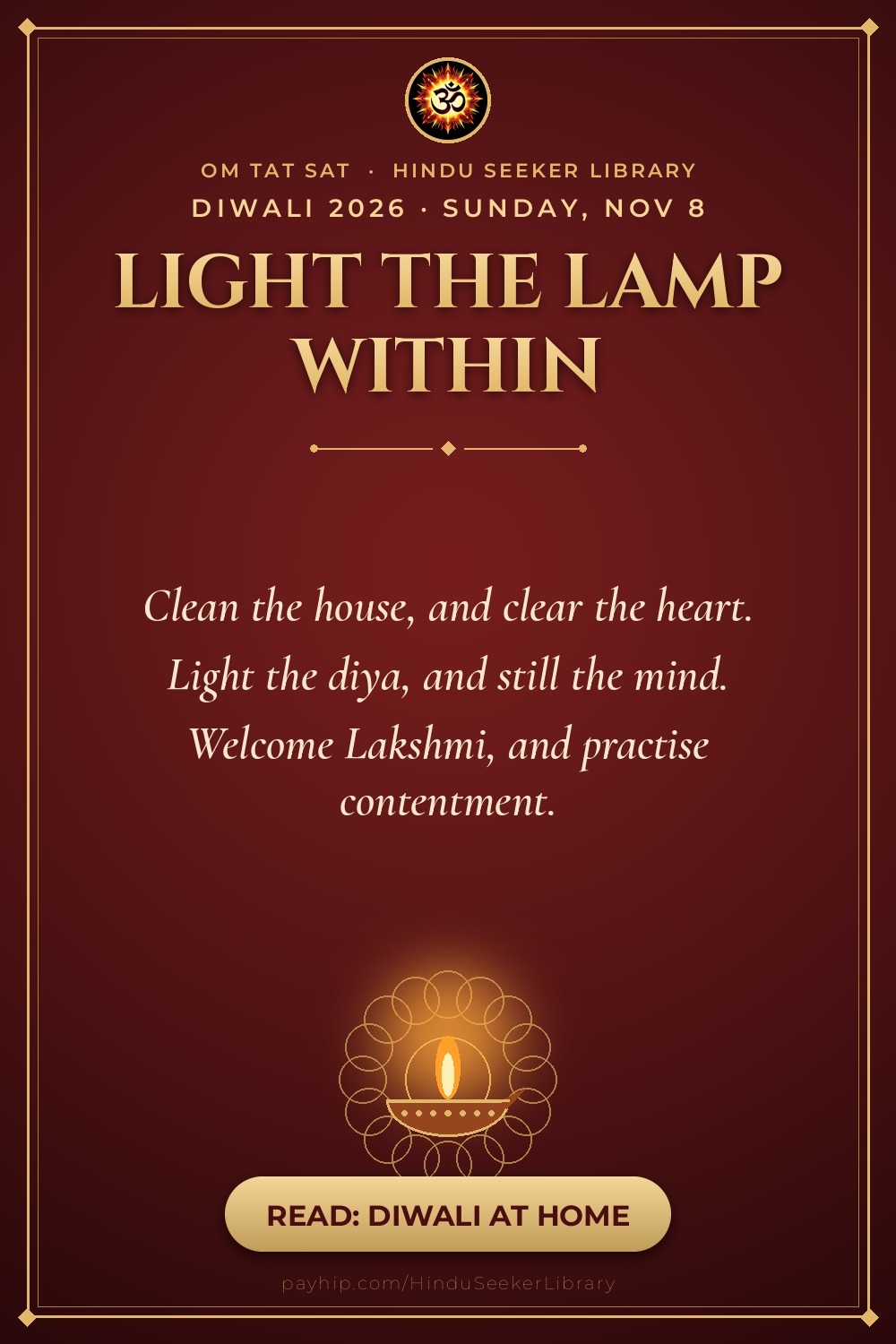
Every year Diwali arrives in a rush. There are sweets to make, gifts to buy, lights to untangle and relatives to call. By the time the lamps are lit, many of us feel more tired than uplifted, and quietly wonder where the festival went.
It is still there. Underneath the shopping and the noise, Diwali remains one of the most beautiful spiritual nights of the Hindu year: a new moon, the darkest night of the month, on which families everywhere choose to light a lamp. You do not need a large mandir, a priest or hours of ritual to honour that. You need a little intention. Here are five simple steps to celebrate Diwali from the inside, at home.
Why Diwali is a spiritual festival
Diwali carries many stories. In the North, it remembers Rama's return to Ayodhya after fourteen years, when the people lit rows of lamps to welcome him home. Many families also remember Krishna's victory over the demon Narakasura on the day before. On the main night, Lakshmi, the goddess of prosperity and auspiciousness, is worshipped together with Ganesha, the remover of obstacles. Jains mark the liberation of Mahavira, and Sikhs celebrate Bandi Chhor Divas.
What ties these stories together is light overcoming darkness. The Upanishadic prayer tamaso ma jyotir gamaya, "lead me from darkness to light", could almost be Diwali's motto. The outer lamps are a reminder of an inner one.
Step 1: Clean with intention
Diwali cleaning is often a chore we rush through. Try treating it as the first part of the puja. Traditionally, Lakshmi is said to enter homes that are clean, bright and welcoming.
As you clear a shelf or sweep a room, let it be a small act of letting go. What are you carrying that no longer serves you? An old grudge, a habit you have outgrown, a worry you keep feeding? You might quietly repeat a Name or a mantra as you work. A clean home is lovely; a home cleaned with prayer feels different.
Step 2: Prepare a simple puja space
You do not need an elaborate altar. Choose a clean corner, a small table or even a shelf. Place on it:
- a lamp (a clay diya with ghee or oil is traditional),
- a little water in a small vessel,
- an image or murti of Lakshmi and Ganesha, or any form of the Divine you love,
- a few flowers, some rice or sweets as an offering.
If you have only a lamp and a moment of sincerity, that is enough. The tradition has always valued the heart over the size of the offering. In the Bhagavad Gita (9.26), Krishna says that whoever offers him even a leaf, a flower, a fruit or a little water with devotion, he accepts it.
Step 3: Light the lamp with a prayer
On Diwali evening, before the outside lights go on, gather the family, or sit alone, in front of your puja space. Light the main diya slowly.
As you light it, you might chant Om Gam Ganapataye Namah for Ganesha, asking for obstacles to be removed, followed by Om Shreem Mahalakshmyai Namah for Lakshmi. Eleven or twenty-one repetitions of each is plenty. If mantras are unfamiliar, simply speak from the heart: thank you for this year, please guide us in the next.
Then light the other lamps around the home from that first flame. It is a lovely image to hold: one light, shared, becomes many, and nothing is lost from the first.
Our free Lakshmi and Ganesha mantra guide gives these mantras with meaning and a simple 11-minute daily practice, and our earlier post on Lakshmi Ganesh Puja mantras for Diwali 2026 goes into the puja order in more detail.
Step 4: Give something away
Lakshmi is not only money. She is Shri: grace, beauty, abundance and generosity. One of the most natural ways to honour her is to let abundance flow outward.
Give sweets to a neighbour who lives alone. Donate to a food bank or a temple kitchen. Call someone who may be lonely during the festival. Let children choose a toy to give away. Generosity is one of the clearest signs that Diwali has touched the heart and not only the calendar.
Step 5: Sit quietly on the new-moon night
After the fireworks, the meal and the phone calls, take ten minutes for yourself. Sit near a lamp. Let the house grow quiet. Watch the flame.
This is the darkest night of the month, and you have chosen to keep a light burning in it. Ask yourself gently: what is the darkness I want to leave behind this year, and what light do I want to grow? You do not need to answer at once. Just let the question sit with you, the way the flame sits steady in still air.
If you like, close with Om Tat Sat, a phrase the Gita (17.23) gives for offering every act to the Divine, or with a few minutes of your own japa.
A note on Santosha
Diwali can quietly feed the feeling that we never have enough: the new clothes, the bigger gift, the better decorations. The yogic answer is santosha, contentment. Patanjali's Yoga Sutra 2.42 says that from contentment comes the highest happiness. Lakshmi's deepest gift may be the ability to feel that what we have is already full. You can explore this further in Santosha: The Ultimate Freedom.
Bringing the light inside
Advaita Vedanta offers one more reflection for this night. The lamps make the room visible, but what makes the lamps visible to you? The Hastamalaka Stotram points to the Self as the light by which everything else is seen. If that idea calls to you, our free ebook The Ever-Shining Self is a gentle place to begin.
This year, try just one thing
You do not need to do all five steps. Choose one, and do it fully. Clean one room with prayer. Light one lamp slowly. Give one gift in secret. Sit for ten quiet minutes.
May this Diwali bring light to your home and to the heart that lives in it.
Shubh Deepavali. Om Tat Sat.