
One of the things I have always loved about teaching is that no two children learn in exactly the same way. During my years in the classroom, I taught children across KS1 and KS2, with a wide range of abilities, needs, interests and starting points. I quickly learned that differentiation isn't simply about giving different children different worksheets. It is about understanding where each child is now, what they need next, and how you can help them get there. That experience has shaped the way I have created Home-Ed Literacy.
Differentiation has always been at the heart of my teaching
As a classroom teacher, I was constantly thinking about how the same lesson could work for children who were at very different stages of development. One child might be confidently writing paragraphs independently, while another was still developing sentence construction. One child might need support with vocabulary, while another was ready to explore more sophisticated language and challenge themselves. The starting point was often the same learning objective or the same text, but the way each child accessed it could be very different. I used questioning, modelling, discussion, practical activities, scaffolding, vocabulary, sentence starters and carefully chosen challenges to help children work at an appropriate level.
My experience leading English across a school also gave me a deeper understanding of progression - knowing what children need to learn, how skills develop over time and how to move learning forward without making it unnecessarily complicated.
Then I started thinking about families
When I began developing resources for home-educating families, I kept coming back to one question:
How can a parent teach several children of different ages without having to plan completely separate lessons for each child? I knew from my classroom experience that it was possible. As teachers, we take a shared topic, text or theme and find different ways for children to engage with it.
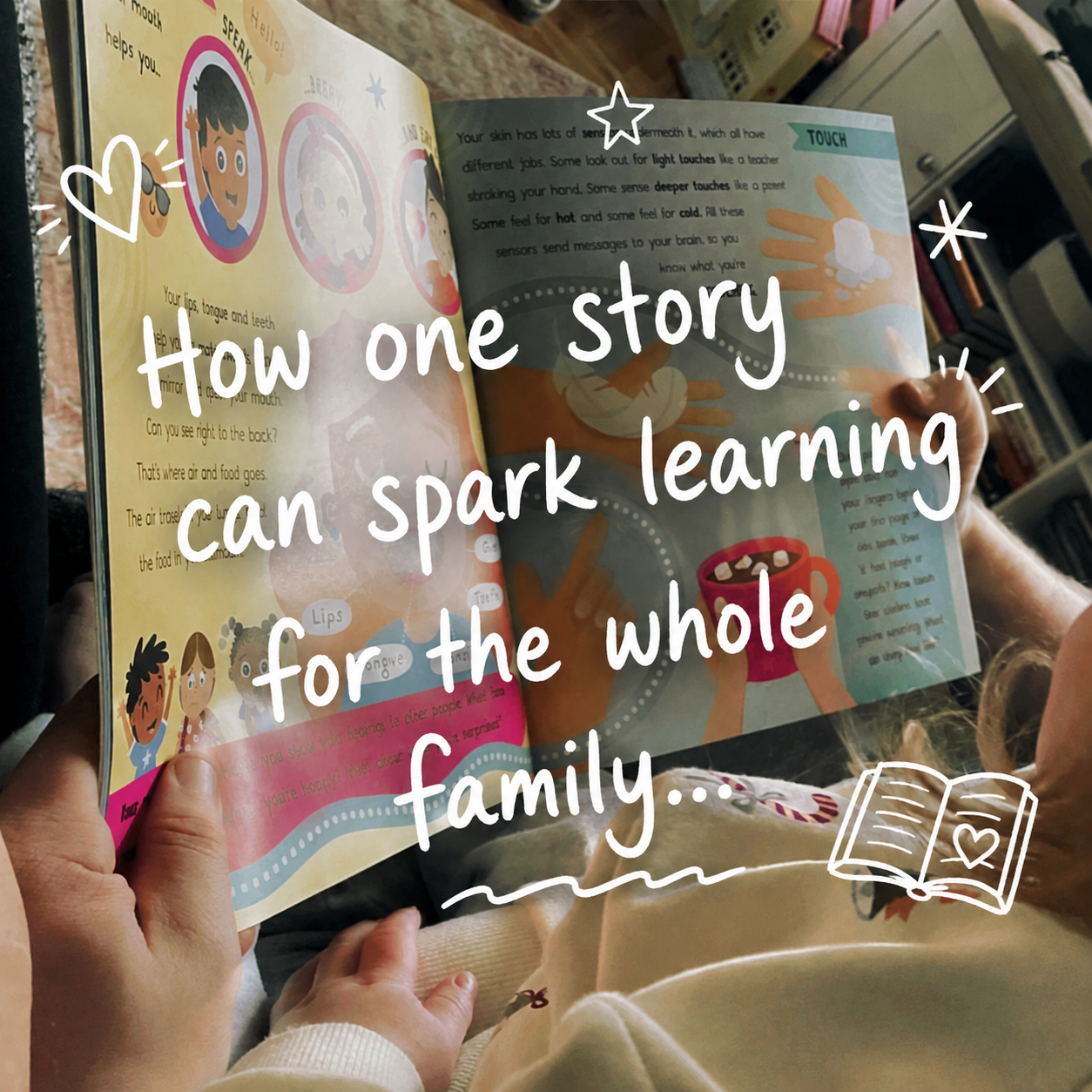
One story can become many different learning experiences...
This is the idea behind my Family Learning Bundles. Rather than creating one activity for a five-year-old, another completely separate activity for an eight-year-old and another for an eleven-year-old, I start with one engaging story. The whole family can read the story together, then the learning can branch out.
A younger child might:
- Talk about the characters
- Draw a picture
- Retell part of the story
- Practise simple sentences
- Count, sort or build
- Explore through play
An older child might:
- Explore character motivation
- Use richer vocabulary
- Write from a character's perspective
- Investigate themes and ideas
- Solve more complex mathematical problems
- Research and make connections across subjects
They're all learning from the same story, but at their own level. Differentiation doesn't have to mean separate work. This is something I really want to emphasise for home-educating families. Differentiation shouldn't mean that a parent has to sit down and teach three completely different lessons. It can be as simple as asking a different question. For example, imagine a family reading a story about a lost dinosaur.
A younger child might be asked:
"How do you think he feels?"
An older child might explore:
"Why do you think the author chose to make the dinosaur lost? How does this help develop the story?"
They're sitting together, sharing the same story and having the same conversation, but the thinking is developing at different levels. That's the kind of learning I wanted to create.
My classroom experience became the foundation
Creating these resources has allowed me to take everything I have learned from the classroom and translate it into something that works for families. My experience of teaching different ages and abilities has helped me think carefully about:
What does this child need to practise?
How can I make this accessible?
How can I add challenge without simply adding more work?
How can siblings learn alongside each other?
And perhaps most importantly:
How can learning feel enjoyable rather than like a series of lessons to get through?
That last question is particularly important to me: I don't want families to feel that home education needs to look like school at the kitchen table. Learning together matters. One of the things I love most about multi-age learning is the opportunity for children to learn from one another. A younger child might have an imaginative idea that an older child hadn't considered, and an older child might model new vocabulary or mathematical thinking. A parent can join in too. The learning becomes a conversation rather than a worksheet, and a story gives everyone a grounding to come back to.
Why I created Home-Ed Literacy
My aim with Home-Ed Literacy is to make it easier for parents to create rich, meaningful learning experiences without having to plan everything from scratch. I want families to be able to pick up a story and think:
"We could read this together."
"We could talk about it."
"We could make something."
"We could investigate that."
"We could write about this."
"We could take this outside."
And suddenly, one story has become a whole learning adventure. That's really where my classroom experience meets my work now. Years of teaching children with different needs and starting points have taught me how to take one learning experience and open it up in different ways. Now I'm using that knowledge to help families do exactly the same thing at home - bringing children of different ages together around one story, while still giving each child the right level of challenge.
Because I truly believe that learning doesn't have to mean everyone doing the same thing; it can mean everyone learning together. 💕