
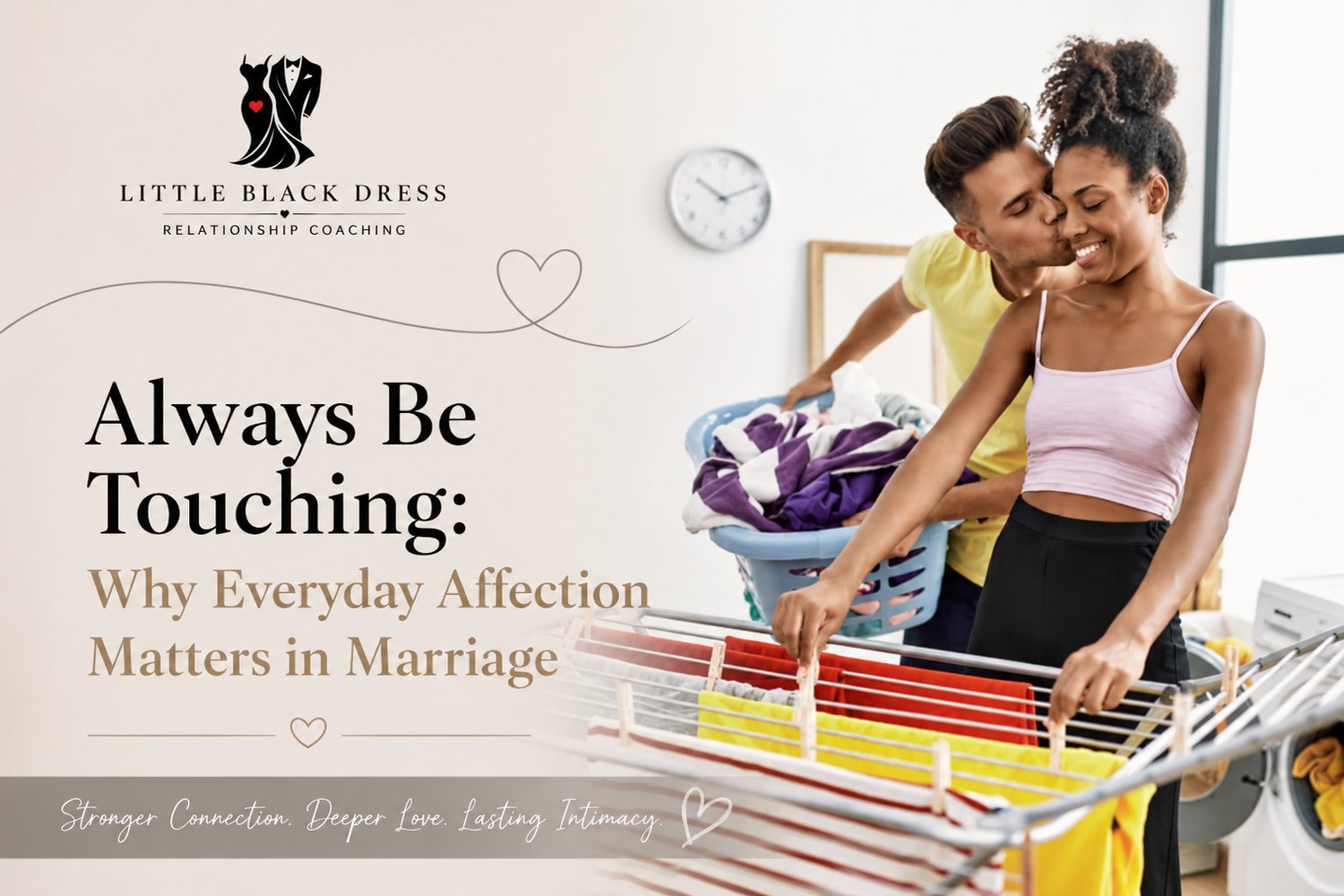
There’s something incredibly powerful about touch in a marriage.
And I’m not talking about sex.
I’m talking about the little touches that happen throughout an ordinary Tuesday:
A kiss when you leave for work.
A hug when you walk through the door.
Sitting close together on the couch.
Putting your hand on your spouse’s leg while you’re watching television.
Cuddling for a few minutes before falling asleep.
Holding hands while you're walking through the grocery store.
A quick squeeze as you pass each other in the kitchen.
These moments may seem small.
They aren't.
They are tiny, repeated signals of connection.
And when those signals become part of the everyday rhythm of your marriage, they can help create something much bigger: a relationship where physical affection feels normal, safe, and familiar.
Always Be Touching
The idea of ABT—Always Be Touching—has been popularized in relationship conversations as a simple reminder that couples benefit from maintaining regular physical affection.
The important part is understanding what that actually means.
It does not mean you should constantly touch your spouse.
It does not mean every touch should be sexual.
And it certainly doesn't mean your spouse should be expected to tolerate touch they don't want.
The idea is much simpler:
Make your marriage a touch-friendly environment.
Create opportunities for affectionate physical contact that don't automatically come with an expectation of sex.
That's an important distinction.
Because physical affection and sexual intimacy are connected, but they aren't the same thing.
Physical Affection Doesn't Have to Lead to Sex
This is one of the biggest concepts I want couples to understand.
If every kiss, hug, cuddle, or back rub becomes an invitation for sex, physical affection can start to feel loaded.
A spouse who isn't interested in sex at that moment may begin avoiding the touch altogether because they're anticipating what it might lead to.
That's not what we're trying to create.
We're trying to create affection without obligation.
A hug can just be a hug.
A cuddle can just be a cuddle.
Holding hands can just mean:
"I like being close to you."
And that matters.
Research examining affectionate touch specifically distinguishes nonsexual physical affection from sexual activity and has found meaningful associations between affectionate touch and relationship well-being. In a longitudinal study of 953 older couples, greater frequency of shared affectionate touch predicted increases in individuals' relationship satisfaction, life satisfaction, and mental health five years later, independent of sexual activity.
That's pretty compelling.
The touch didn't have to be sexual to matter.
Your Marriage Should Have Predictable Affection
Here's where I think the routine part becomes especially interesting.
You don't have to wait until you feel particularly romantic to touch your spouse.
You can build physical affection into the rhythm of your day.
Maybe:
When you wake up:
A kiss or a few seconds of cuddling.
When you leave:
A hug and a kiss goodbye.
When you come home:
A genuine welcome-home hug.
While you're watching television:
Sit close. Hold hands. Put your feet together.
Before bed:
Cuddle for a few minutes before rolling over to sleep.
You don't need to spend hours tangled up together.
In fact, if one of you gets hot and has to roll away, that's perfectly fine.
The point isn't maximizing the amount of physical contact.
It's making affection a normal part of your relationship.
Research on married couples has found that routine affection is relevant to satisfaction with touch. In one study of 180 married couples, lower levels of routine affection were associated with lower touch satisfaction, particularly for some individuals with attachment anxiety.
That gives us another reason to think about consistency.
You don't necessarily need a dramatic romantic gesture.
You need regular connection.
Touch Communicates Without Words
One of the beautiful things about physical affection is that it communicates something without requiring a conversation.
When you reach for your spouse's hand, you're communicating:
I'm here.
When you hug them after a difficult day:
You don't have to carry this alone.
When you kiss them goodbye:
I'll see you later.
When you sit close on the couch:
I want to be near you.
When you cuddle before falling asleep:
You're my person, and I like being close to you.
Touch is a form of nonverbal communication.
Research involving 7,880 participants across 37 countries found a robust positive association between affectionate touch behaviors and reported love in romantic relationships. The researchers specifically examined behaviors such as hugging, kissing, stroking, and other affectionate touch.
That's fascinating because it suggests affectionate touch isn't just something couples do.
It's also one of the ways couples express and experience love.
And This Can Actually Help Separate Affection From Sexual Pressure
This is especially important for couples experiencing a desire discrepancy.
If the lower-desire spouse begins associating every affectionate touch with:
"Uh-oh. They want sex."
they may start avoiding affection altogether.
And that's a terrible tradeoff.
Now you've lost the hug.
You've lost the cuddle.
You've lost the kiss.
You've lost the hand-holding.
Not because either person stopped loving the other—but because touch became associated with pressure.
Nonsexual affection gives couples another option:
Touch can mean connection without creating an obligation.
And ironically, creating more space for affection without expectation can make physical closeness feel safer and more enjoyable for both partners.
Affection Isn't a One-Size-Fits-All Prescription
There's an important caveat here.
Always Be Touching doesn't mean touch your spouse regardless of whether they want it.
People have different preferences for physical affection.
Some people love cuddling.
Some prefer holding hands.
Some don't like prolonged touch.
Some become overstimulated easily.
Some enjoy affection in private but don't like public displays.
Some want a lot of physical contact.
Others need more personal space.
And those differences matter.
Research on touch in marriage has found that individuals aren't equally satisfied with the amount or type of touch they receive, and attachment tendencies can influence how people experience affectionate touch.
So the goal isn't:
"Touch your spouse more, period."
The goal is:
"Learn how your spouse likes to experience affection and intentionally create more of it."
That's a very different message.
Ask Your Spouse
If you're not sure what your spouse likes, ask.
You could literally say:
"What kind of physical affection makes you feel most connected to me?"
Or:
"Do you feel like we touch enough outside of sex?"
Or:
"What's your favorite way for me to show you physical affection?"
And then listen.
Maybe they'll tell you they love when you put your arm around them on the couch.
Maybe they'll tell you they miss getting a real hug when you come home.
Maybe they want you to hold their hand more.
Maybe they love when you rub their back.
Maybe they'll tell you they actually don't like certain types of touch.
That's useful information.
Because intimacy isn't about doing what you would want.
It's about learning how your spouse experiences connection.
Physical Affection Is Not the Same as Foreplay
This deserves its own section because it gets misunderstood so often.
If you kiss your spouse and they immediately think:
"Is this going somewhere?"
you've lost some of the freedom that makes affection enjoyable.
Physical affection can exist entirely outside the sexual system.
You can cuddle.
You can hold hands.
You can kiss.
You can massage your spouse.
You can sit with your legs touching.
You can hug.
And then...
nothing else has to happen.
That's okay.
Actually, that's the point.
You're creating a relationship where touch doesn't always have to accomplish something.
Sometimes connection is the accomplishment.
And Yes, Touch Can Matter to Your Overall Well-Being
There's growing research examining how affectionate touch relates not only to relationships but also to stress and emotional well-being.
For example, research involving couples found associations between affectionate touch and physiological stress regulation, including differences in cortisol responses.
Other research has found that people assigned to imagine receiving affectionate touch from their spouse anticipated lower stress, greater life satisfaction, greater perceived partner affection, and greater relationship quality.
So when you reach over and hold your spouse's hand, you aren't necessarily just being cute.
You're engaging in a behavior that can communicate safety, affection, and connection.
The Little Things Are the Big Things
This is something I say all the time:
It's the little consistent things we do that build our relationships.
Your marriage isn't created by Valentine's Day.
It's created on Tuesday afternoon.
It's created in the kitchen.
It's created on the couch.
It's created when you walk through the door.
It's created in those five minutes before you fall asleep.
It's created when you instinctively reach for your spouse's hand.
Those moments might feel insignificant because they're ordinary.
But ordinary is where marriage lives.
And if affection becomes part of your ordinary, you're creating a relationship where physical connection doesn't have to wait for a special occasion.
Start Small
If physical affection isn't really part of your marriage right now, don't suddenly decide you're going to become the world's most cuddly couple.
Start small.
Tonight, sit a little closer.
Give your spouse a real hug.
Hold their hand.
Kiss them hello.
Cuddle for five minutes before bed.
Put your hand on their back as you walk by.
And don't make it weird.
Don't announce:
"I'm doing this because that relationship coach told me to."
Just touch your spouse.
Because you love them.
Because you enjoy being close to them.
Because physical affection is one more way of saying:
"I choose you."
And then do it again tomorrow.
And the next day.
And the next.
Because that's the real power of ABT—Always Be Touching.
Not grand gestures.
Not pressure.
Not turning every touch into sex.
Just consistent, affectionate, intentional physical connection.
Your marriage should be a place where affection feels normal.
Where touch feels safe.
Where closeness is part of everyday life.
And where you don't have to wait until you're in the bedroom to remind each other:
We're connected.
We're close.
We're us.
Ready to Strengthen Your Marriage?
If this article resonated with you, you'll find dozens of practical, research-backed relationship resources designed to help couples reconnect emotionally, physically, and sexually.
Visit Little Black Dress LLC to explore:
- A growing library of relationship blogs
- Free downloadable relationship resources
- The LBD Method marriage eBook
- The AI Marriage Coach for personalized relationship guidance
- Digital tools designed to help couples build healthier, happier, and hotter marriages
Knowledge creates awareness. Awareness inspires action. Action transforms marriages.
Comments ()