
If you run events for a living, you already know the feeling. It's not one big crisis. It's a hundred small ones, all at once: a guest list that's out of date the moment you export it, a supplier who swears they replied to your email, a hotel rooming list that only exists in your head and one increasingly panicked WhatsApp thread.
Ask most event professionals what the hardest part of the job is, and they won't say "planning." They'll say "keeping track of everything at the same time, for more than one event, without dropping something important."
That's not a discipline problem. It's a tools problem.
The problem isn't that event people are disorganised
Every event coordinator I've ever met has a system. A spreadsheet with tabs for guests, one for hotels, one for the run of show. That's not the issue, multi-tab spreadsheets are completely normal, and most people running events are meticulous about them.
The issue is that those tabs don't talk to each other. Update a guest's dietary requirement in one place, and it doesn't follow them into the catering numbers. Book a supplier, and there's no link between that booking and the contract you're supposed to be chasing, or the insurance certificate that quietly expired six weeks ago. Everything technically exists somewhere. Almost nothing is actually connected.
And that gap is exactly where things fall through the cracks, not because anyone's careless, but because no single tool was built to hold the whole picture at once.
The parts of the job nobody posts about
Guest management, hotels, transport, that's the visible, talked-about layer of event logistics. It's what most templates and planning tools are built around, and it's genuinely important. But it's also table stakes. It's not what keeps experienced producers up at night.
What actually causes the 2am panic is usually further down the list:
Contracts and permits. Every event needs some combination of venue contracts, supplier agreements, RAMS, insurance certificates, and — depending on what you're running - TENs licences, road closure permits, music licences, fire safety plans. These don't cause problems when you sign them. They cause problems months later, quietly expiring while everyone's attention is on the parts of the job that feel urgent.
Risk management. Every experienced event professional runs a mental risk log even if they've never written one down: what happens if the keynote speaker's flight is delayed, if the venue's wifi drops during the big pitch, if a supplier doesn't show. The good operators have already thought through the "what if" and the "what then." Most of them have never had anywhere proper to put it.
Supplier research. Not just "who did we book," but the shortlisting phase before that - who did we consider, what did they quote, what were the pros and cons, why did we choose the one we chose. That knowledge usually evaporates the moment the decision is made, which means it gets rebuilt from scratch for the next event.
Crew and staffing. Call times, day rates, who's covering which zone, who's confirmed and who isn't. Simple in theory, chaotic in practice once you're running more than a handful of people across more than one day.
These are the layers that separate "we're on top of this event" from "we think we're on top of this event." And they're almost never the layer a generic planning template is built around.
It gets worse when you're running more than one event
Most of the tools built for event planning assume you're focused on a single event at a time. In reality, most freelance and in-house event ops people are juggling two, three, sometimes five live projects simultaneously, each at a different stage, one still in the supplier research phase, one about to go into build, one being debriefed after delivery.
Multiply the tab-juggling problem by five events, and you don't just have chaos. You have chaos with a deadline, running in parallel, with real financial and reputational consequences if something slips.
What actually needs to live in one place
The fix isn't more tabs. It's fewer systems that are actually connected to each other. A genuinely useful event operations system needs:
- Every event's core details - dates, venue, budget, client - as a single source of truth
- Guests, hotels, transport, and suppliers linked back to that event automatically, not re-entered in five different places
- Contracts, permits, and certificates tracked with real expiry dates and renewal reminders, not buried in an inbox
- A proper risk register, reviewed regularly, not just a worry sitting in someone's head
- Budget tracking that shows what's committed, what's invoiced, and what's actually been paid and not three different numbers that don't agree
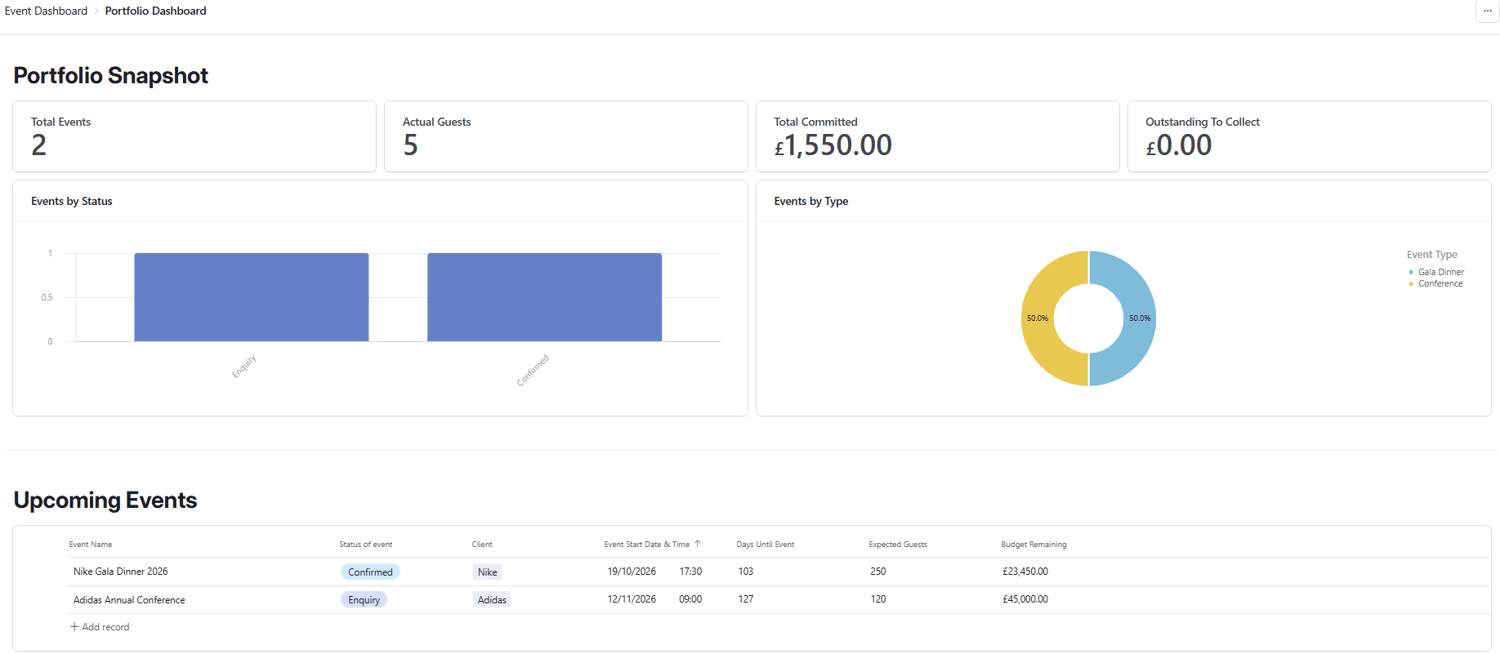
- All of it visible at a glance, across every event you're running, not just the one you happen to have open right now
Why I built the Event Command Centre
I built this because I was doing all of the above manually, for years, rebuilding the same system from scratch for every new event. Eventually the rebuilding itself became the problem.
The Event Command Centre is an Airtable-based system that holds all of it - guests, hotels, transport, suppliers, contracts, permits, risk, crew, budget, and more in one connected base, built specifically around how live events actually run, not around a generic project-management template with the labels changed.
It's built for freelance and in-house event operations people running complex, high-end events for agencies and production companies, who are tired of holding the whole picture together across spreadsheets, email threads, and memory.
If that's you, you can find it on my Payhip store, along with a full walkthrough of how it's structured and how to make it your own.
It won't stop the 6am "wait, who's picking up the AV crew" text. But it will mean you actually know the answer.