
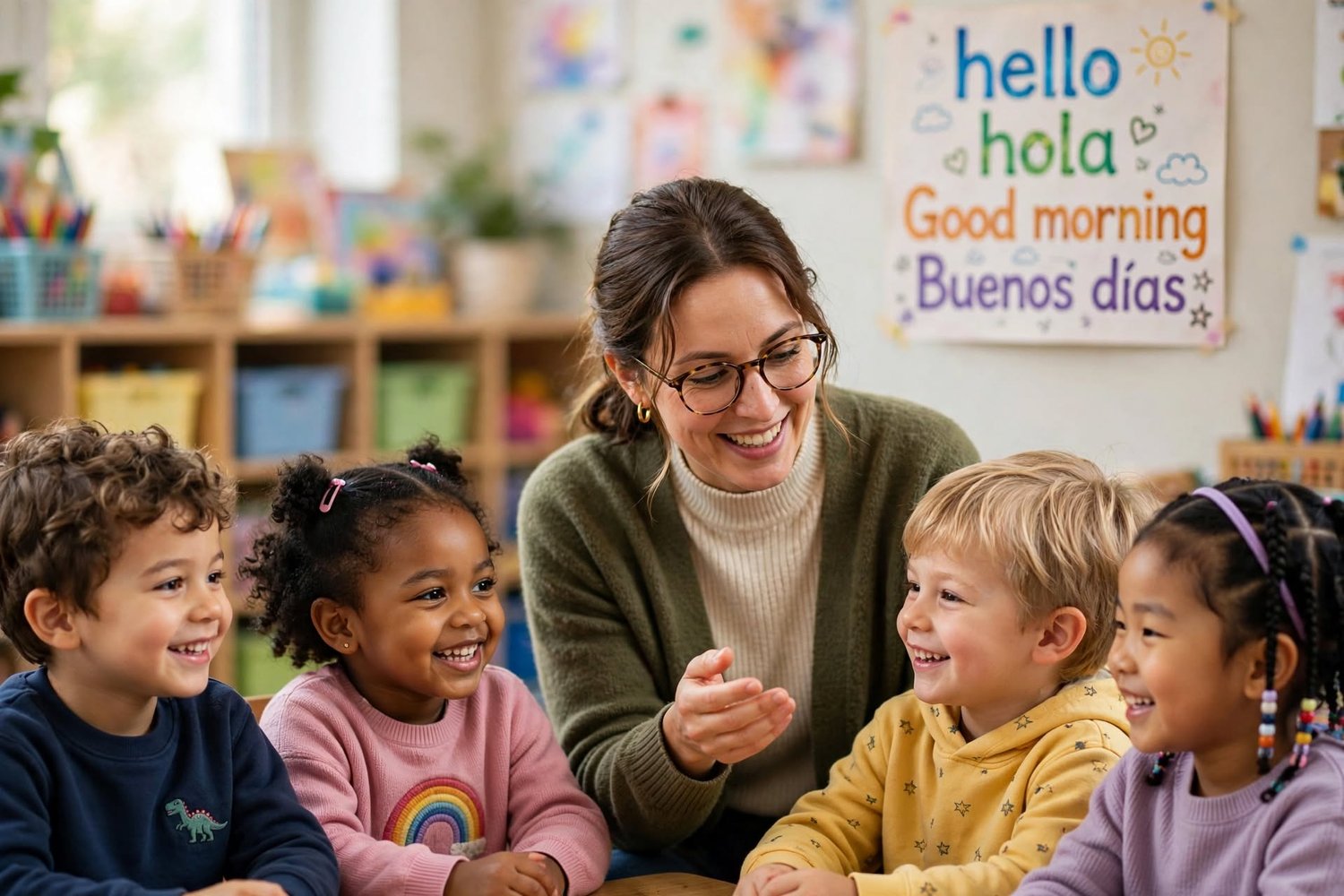
How to Build an Inclusive, Calm Bilingual Classroom: Welcoming Newcomer Students Without Extra Prep
Imagine walking into a room full of strangers where everyone is speaking a language you don’t understand. You don’t know where to put your backpack, when it’s time to eat, or how to ask for help. For a three- to six-year-old newcomer student, that first day of school can feel deeply disorienting.
Now, picture the teacher welcoming that child into an already busy classroom. You want this student to feel safe, seen, and valued—and you want their family to feel respected—but your plate is already full, and you may not speak their home language fluently.
Supporting emergent bilinguals does not require hours of extra lesson planning, personal fluency in a second language, or expensive digital apps. When educators shift from viewing a child’s home language as a "barrier" to honoring it as a cognitive and cultural asset, the entire classroom climate changes.
Why Early Language Inclusion Matters for the Whole School Community
Between ages 3 and 6, a child’s brain experiences peak neuroplasticity, forming millions of neural connections every second. Whether a student is learning English as a Second Language (ESL), acquiring Spanish (SSL/ELE), or growing up in a dual-language home, an inclusive environment supports both academic readiness and emotional well-being:
- Lowering the Affective Filter: In second-language acquisition, stress acts as a mental roadblock. When children see and hear their native language respected alongside the target language, their nervous system relaxes—lowering their affective filter and allowing natural absorption to take place.
- Stronger Executive Function: Managing two active linguistic systems acts as a daily cognitive workout, strengthening impulse control, working memory, and task-switching skills across all subjects.
- Classroom Belonging & Empathy: When multiple languages are visible and valued, all children develop natural perspective-taking and cultural awareness.
- Preserving Family & Generational Bonds: Honoring a child’s heritage language ensures they can continue communicating deeply with parents and grandparents, building trust between families and the school community.
3 Low-Prep, High-Impact Routines for Welcoming Newcomers
You do not need a complex curriculum overhaul to create a calm, inclusive space. Predictability, visual-tactile scaffolding, and co-regulation are your most effective tools. Here are three practical routines from The Bilingual Advantage Blueprint you can implement immediately:
1. Start with a Dual-Language Morning Greeting
Before formal instruction begins, establish emotional safety at the classroom door or morning circle. Use a simple chart with emotion icons and greetings in both English and Spanish:
- "Good morning! How are you feeling today?" (Happy, Calm, Energetic)
- "¡Buenos días! ¿Cómo te sientes hoy?" (Feliz, Tranquilo, Con energía)
Invite students to point to an icon and respond in whichever language feels safe that day—or simply point without speaking. This brief daily ritual communicates a clear message: "Your voice belongs here."
2. Use Visual and Auditory Transition Cues
Transitions—such as moving from free play to cleanup, or carpet time to table work—are often the highest-stress moments for early language learners. When children miss verbal cues, confusion quickly turns into frustration.
Pair a gentle chime or rhythmic clap with a short, predictable call-and-response chant:
- Teacher: "Eyes on me! / ¡Mirame - mirenme!"
- Students: "1, 2, 3! / ¡1, 2, 3!"
Rhythm, melody, and physical gestures provide comprehensible input that bypasses language barriers, allowing newcomer students to move smoothly alongside their peers without feeling singled out.
3. Honor the "Silent Period" and Leverage Cognates
When young learners enter a new language environment, they frequently experience a natural receptive stage (or "silent period") that can last weeks or months. They are not ignoring instruction; their brains are actively mapping sounds, rhythm, and meaning.
Instead of forcing immediate speech or over-correcting natural code-switching (mixing both languages in one sentence), model phrases back warmly and highlight cognates—words that look and sound similar across languages, such as Animal / Animal, Family / Familia, or Ocean / Océano. Cognates act as immediate confidence bridges, showing young learners they already possess valuable vocabulary.
Examples use English and Spanish; the routines work with any home language.
Why Screen-Free, Hands-On Routines Outperform Language Apps
In a digital world, it is tempting to hand an incoming student a tablet with a language-learning app. However, young children acquire language most effectively through human interaction, tactile play, and multi-sensory engagement.
Short, 10-minute screen-free routines—such as pairing letter tracing with spoken dual-language vocabulary—connect fine motor development directly to phonemic awareness and speech production, while giving anxious learners a calm, focused outlet.
Ready to Bring These Strategies to Your Classroom or School?
Every child deserves to walk into school knowing their home language is an asset that enriches the room. And every teacher, counselor, and school leader deserves clear, research-grounded tools that make inclusion sustainable without burnout.
If you are ready to put these routines into practice, download The Bilingual Advantage Blueprint: Brain-Boosting, Screen-Free Routines & Language-Inclusion Tools (Ages 3–6).
Inside this practical guide, you will find:
- Module 1: Daily language-inclusion routines and practical guidance on supporting code-switching without interrupting a child's confidence.
- Module 2: Screen-free fine motor and literacy activities (like Trace, Say, and Connect) that anchor vocabulary through hands-on play.
- Module 3: Dual-directional ESL and Spanish (SSL/ELE) scaffolding strategies, phonics tips, and interactive "Language Bridge" games.
- Module 4: A Printable Visual Poster (The Bilingual Brain: 5 Lifelong Advantages for Early Learners) ready to display on your classroom bulletin board, share during parent-teacher conferences, or include in school orientation folders.
Download The Bilingual Advantage Blueprint Today!
Tags: bilingual education, ESL newcomers, inclusive classroom, early childhood education, dual language, screen-free learning, preschool routines, classroom belonging, Spanish for kids, teacher resources