
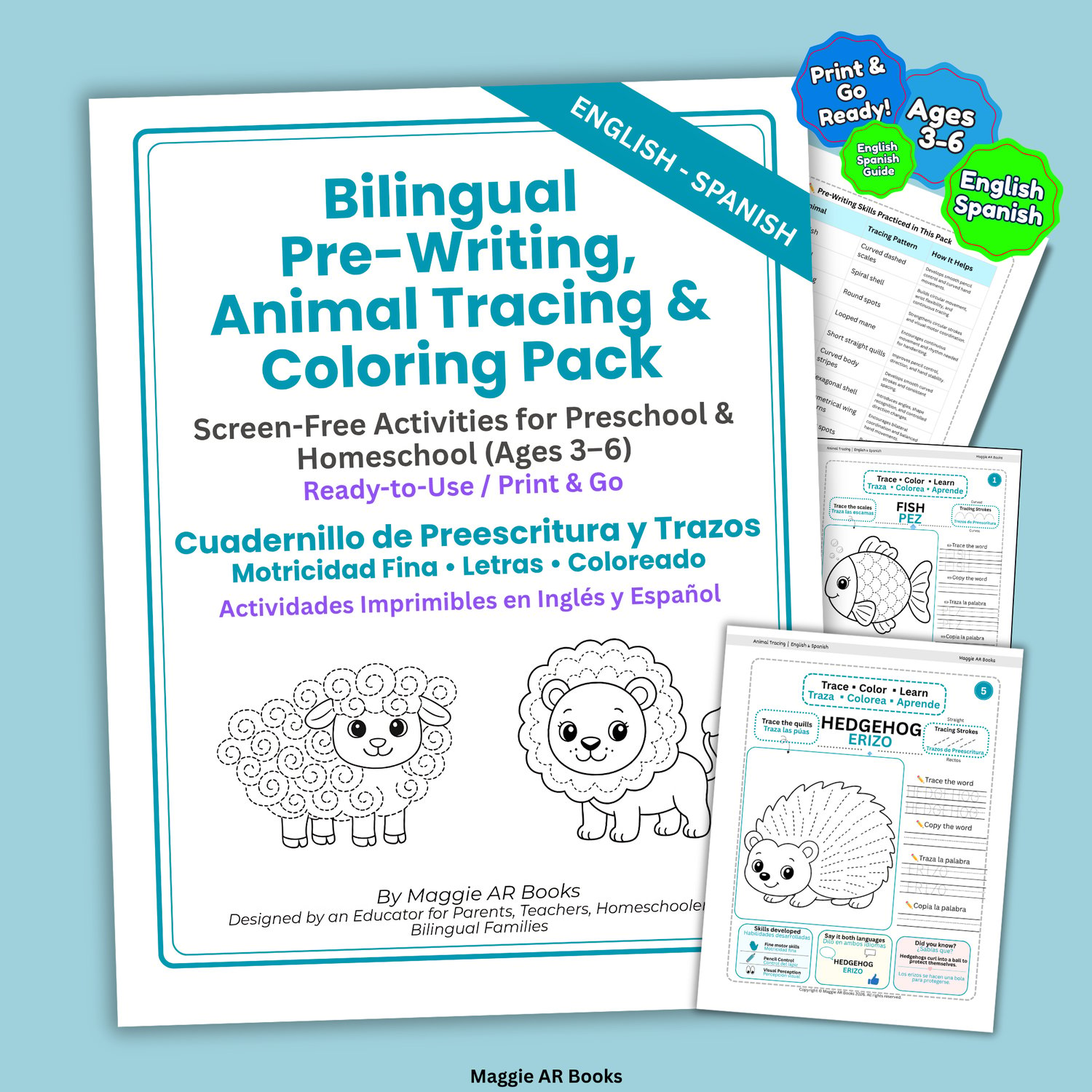
Developing pencil control and fine motor skills in young children ages 3–6 doesn't require boring drills or tracing screens. In fact, early childhood research shows that little hands build stability, muscle memory, and writing confidence best through joyful, tactile play!
If you are a parent or homeschool educator looking to prepare your child for preschool or kindergarten writing success, try focusing on these three simple strategies:
- Focus on Pre-Writing Strokes First: Before children can write letters or numbers, their hands need to practice foundational lines—like straight lines, sharp zig-zags, flowing curves, and tight spirals. Breaking handwriting down into fun patterns removes the stress.
- Connect Words with Imagery: Turn handwriting into a storytelling game! Don't just trace abstract lines; trace the "quills" on a hedgehog, the "spiral" on a snail shell, or the "scales" on a fish. This keeps visual interest high and helps with spatial awareness.
- Introduce Bilingual Vocabulary Early: Tactile tracing is the perfect multi-sensory environment for language building. Saying animal names aloud in both English and Spanish (Fish / Pez, Lion / León) while physically tracing links the vocabulary directly to memory.
💡 Ready to print, trace, and play today?
To make your early learning lessons completely effortless, we created a ready-to-use resource! Our Bilingual Pre-Writing & Animal Tracing Pack includes 12 comprehensive pages of beautiful animal illustrations, unique developmental line patterns, called strokes in many places, and bilingual word tracing guides.
👉 [https://payhip.com/b/xRbw8]
Less screen time, more meaningful learning connections. Happy tracing! 🙋♀️