

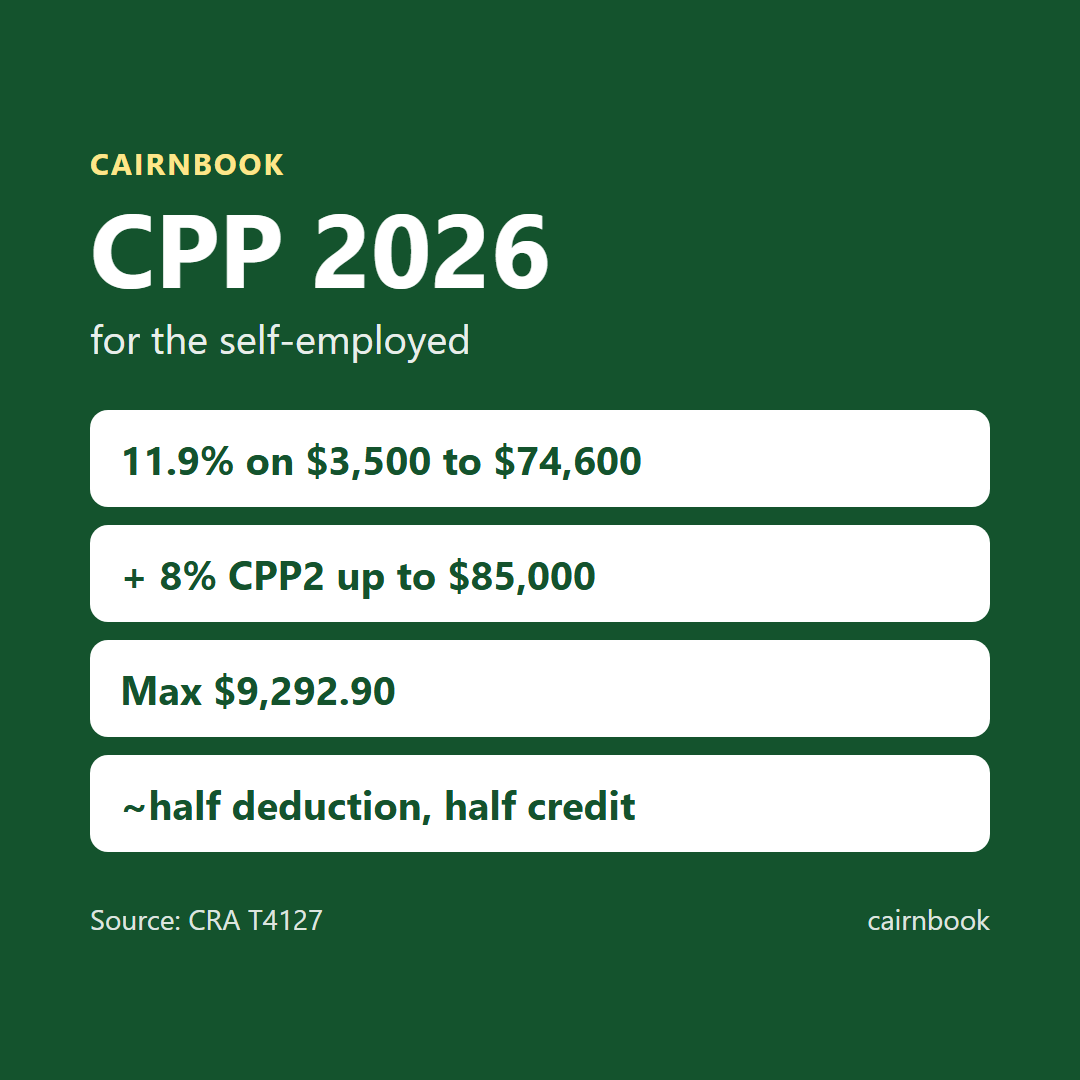
Self-employed people pay both the employee and employer share of the Canada Pension Plan. Here are the official numbers.
2026
- Basic exemption: $3,500
- Maximum pensionable earnings (YMPE): $74,600
- Rate on self-employment: 11.9% (2 x 5.95%) - maximum $8,460.90
- CPP2 on earnings from $74,600 to $85,000: 8% (2 x 4%) - maximum $832
- Maximum total: $9,292.90
2027 (CRA payroll tables)
- YMPE rises to $76,700; CPP2 ceiling to $87,400
- The base rate drops from 4.95% to 4.75% per side, so the self-employed rate becomes 11.5% - maximum $8,418
- CPP2 maximum: $856 - maximum total: $9,274
Job + side business
If you also have a job, the CPP already deducted from your pay (T4 box 16/16A) counts toward the yearly maximum. You only owe CPP on self-employment for the room that's left - which can be much less than 11.9% of your side income.
Deduction and credit
Roughly half of your self-employed CPP (the "employer" half and the enhanced parts) is a deduction; the base employee part earns a non-refundable credit. A business loss means no CPP on self-employment - and the loss can reduce your other income.
Official source: CRA CPP contribution rates, maximums and exemptions.
Free download: Cairnbook Lite is a free income & expense tracker with CRA T2125 categories, plus a one-page 2026 tax cheat sheet.
Cairnbook (2026 / 2027) calculates your self-employed CPP and CPP2 using your T4 boxes, so you're not double-counting.
General information, not tax advice. Figures are from CRA and Revenu Québec publications as of November 2026; confirm your own situation with the CRA or a professional.