
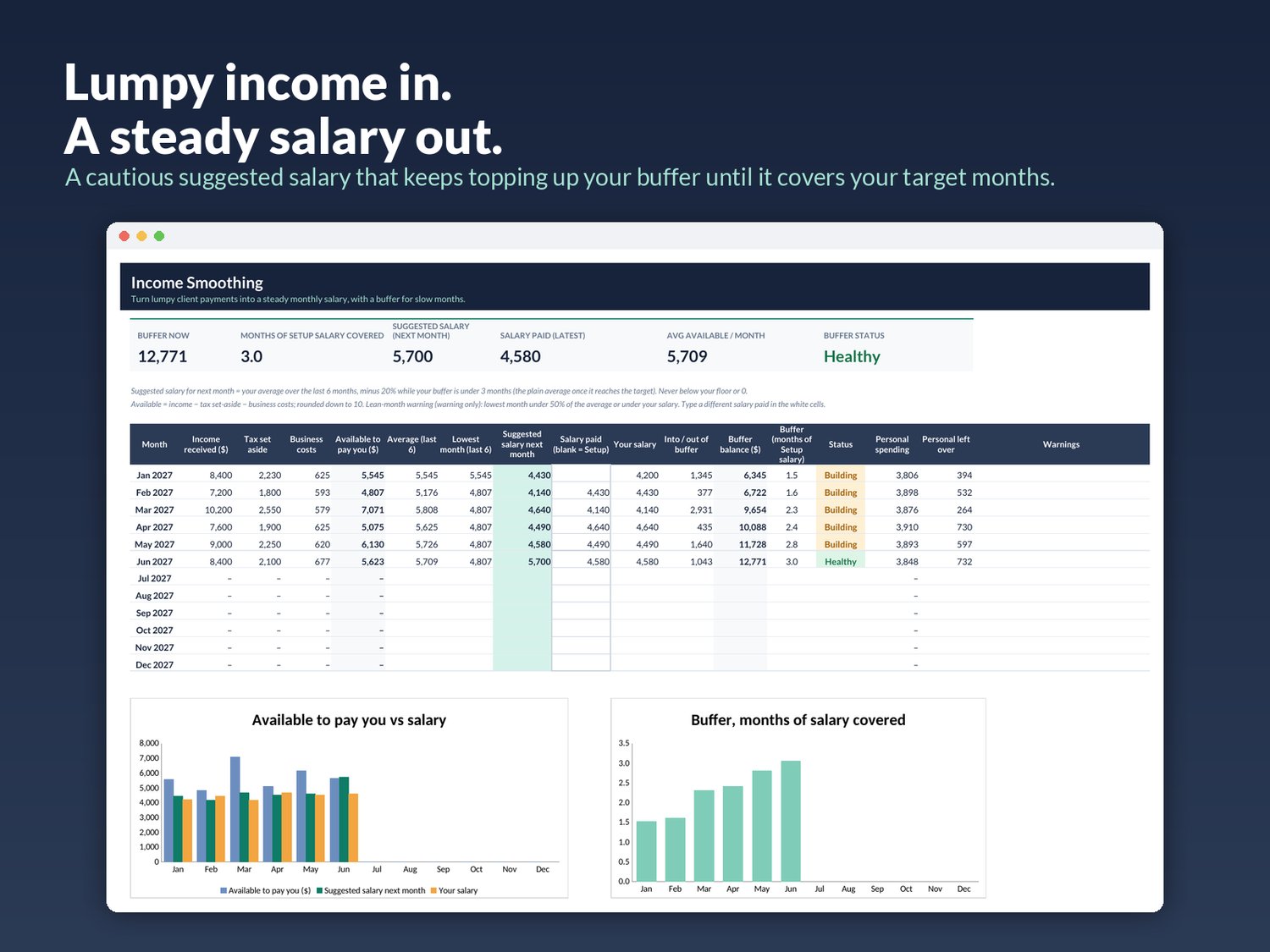
When your income changes every month, a normal "spend this much on groceries" budget falls apart fast. A great month makes you overspend, a slow month makes you panic. The fix isn't a stricter budget. It's paying yourself a steady salary from a buffer.
Prefer video? Watch the 5-minute walkthrough: https://youtu.be/hLWG0_nRSUo
Here's a simple system that works in a spreadsheet.
1. Find your baseline month
Add up the bills you can't skip: rent, utilities, insurance, minimum debt payments, food. That's your baseline. It's the number you need every month, no matter what you earn.
2. Pay yourself a fixed salary
Pick a monthly "salary" at or a bit above your baseline. Every payment you receive goes into one holding account first. On the 1st of each month, move only your salary into your spending account. Good months fill the holding account; slow months draw from it.
3. Set tax aside the moment money lands
If you're self-employed, nobody withholds tax for you. Take a fixed percentage of every invoice (ask an accountant what's right for you) and move it to a separate tax account the day it's paid. Then you're not surprised at tax time.
4. Log every invoice
Track who owes you, how much, when it's due and when it was paid. Late payments are the biggest cause of a "bad month" for freelancers, and a simple invoice log shows you who to chase.
5. Build the buffer before the extras
Aim for one to three months of salary sitting in the holding account. Until it's there, put extra income toward the buffer and debt, not upgrades.
6. Compare plan vs actual each month
At month-end, compare what you planned to spend with what you actually spent, category by category. Adjust next month's plan, not your self-esteem.
Template: Irregular Income Budget Planner 2027
I built a spreadsheet that runs this whole system: an invoice log, automatic tax set-aside, a pay-yourself-a-salary buffer, plan-vs-actual tracking, and debt and savings tabs. It's an Excel file with sample data and a blank copy, no macros, and it opens in Google Sheets too. It's $10: https://payhip.com/b/Lx9On
Bundle: the 2027 Freelance Starter Kit ($22) includes the budget planner plus 4 more 2027 planners (Habit Tracker, Sinking Funds, Debt Payoff, Freelance Client & Invoice Tracker) and a bonus calendar: https://payhip.com/b/dBIiY
Or start with the free Habit Tracker Lite:
This is a planning tool, not tax or financial advice. The templates were designed with AI assistance and formula-tested in LibreOffice.