
The most common money shock in a freelancer's first year is not a late client. It is the tax bill that arrives months after the money was already spent. The fix is boring and it works: move a fixed share of every payment into a separate account the day it arrives, and build a small emergency fund next to it.
Step 1: Estimate your tax and social share
Tax and social contributions depend on your country, your status and your income, so this guide cannot give you the right percentage. Ask your tax office, an accountant or your local guidance for freelancers, and use their figure. In the example below we use 30 % as a placeholder.
If you are unsure, round up. Money left over in the reserve at the end of the year is a pleasant surprise. Money missing is a problem.
Step 2: Turn the yearly figure into a monthly amount
Example:
- Expected profit this year: 36,000
- Estimated tax and social share: 30 %
- Tax reserve needed this year: 36,000 x 30 % = 10,800
- Set aside per month: 10,800 / 12 = 900
Step 3: Add an emergency fund
Freelance income is uneven. A buffer of a few months of costs lets you say no to bad clients and survive a slow quarter.
- Monthly fixed living and business costs: 3,500
- Months of emergency fund wanted: 3
- Emergency fund goal: 3,500 x 3 = 10,500
- Already saved: 2,500
- Still missing for tax and buffer together: 10,800 + 10,500 - 2,500 = 18,800
- Save per month to reach both in 12 months: 18,800 / 12 = about 1,567
If 1,567 a month is not realistic, stretch the emergency fund over more months, but keep the tax part at full speed. The tax bill has a date, the buffer does not.
Step 4: For uneven income, use a percentage of each payment
A fixed 900 a month is hard when one month brings 1,200 and the next 4,500. Instead, move 30 % of every payment the day it lands:
- Payment received: 2,000; Move to tax account (30 %): 600
- Payment received: 4,500; Move to tax account (30 %): 1,350
- Payment received: 1,200; Move to tax account (30 %): 360
- Payment received: 7,700; Move to tax account (30 %): 2,310
You never have to remember a monthly target, and the reserve grows exactly in line with what you earn.
Step 5: Check it once a month
Compare what is in the tax account with 30 % of your profit so far this year. If profit is higher than planned, raise the monthly amount. If you changed status or income bracket, check the percentage again with your adviser.
Templates for this
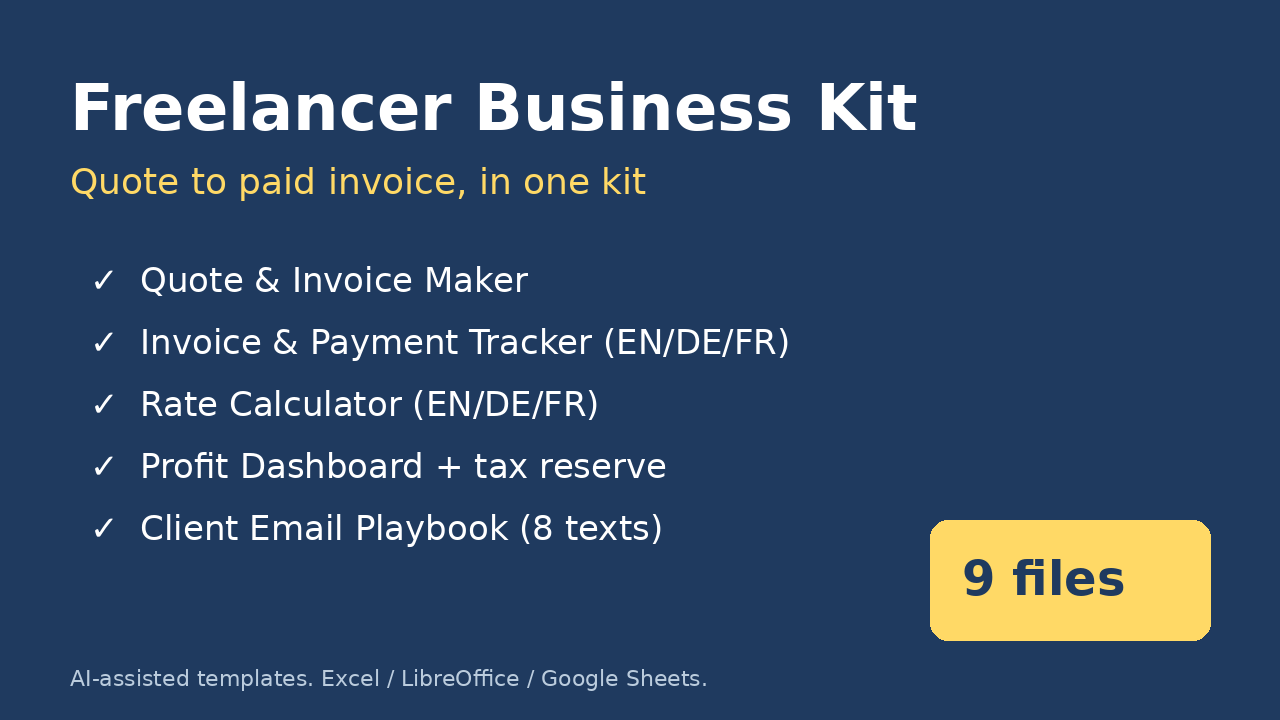
The Freelancer Pro Bundle (39 EUR) has a Tax & Reserve planner with exactly this calculation, plus a 12-month cashflow forecast, budget vs actual, a break-even sheet, a quote and invoice maker, a payment tracker and a profit dashboard. It contains the Business Kit and the Cashflow & Budget Kit, 9 EUR less than buying both separately. Works in Excel, LibreOffice and Google Sheets.
To see how the reserve fits into a full plan, read Cashflow forecast for a small business (simple 6-month example). To check that your rate leaves room for tax at all, see How to calculate your freelance hourly rate.
This guide was written with AI assistance and checked by hand. Example figures only, not legal, tax or financial advice.